

Industrial cybersecurity company Dragos reported this week that attackers had been stealing data from inside three AI inference providers for months, and that none of the three knew until the researchers told them. An inference provider is a company that runs AI models on its own servers and lets other companies send questions to them, usually over the internet. Some of the stolen requests were marked Zero Data Retention (ZDR), the setting that is supposed to mean a prompt is never stored. On November 22, OpenRouter, a gateway that routes customers’ AI requests to a pool of third-party providers, said it had removed three providers from its platform, removed 125 endpoints from ZDR eligibility and notified all potentially affected customers. OpenRouter said the findings showed no breach of OpenRouter itself. The Hacker News has the full report.
If your developers use AI coding agents, you almost certainly send prompts to a model provider, possibly through a gateway or reseller, and those prompts often contain the contents of your files. This post explains what Dragos found, why it matters for the secrets in your code and configuration, and what to do. We give general steps any team can take with built-in tools, and then explain how Cloudanix can help.
Primary source: The Hacker News report, based on Dragos’s research and statements from OpenRouter, Phala, Together AI and Novita. Dragos has not named the three breached providers and OpenRouter has not named the three it removed. Neither has said whether they are the same three. The report notes that planted test keys and links were still being accessed months after the first thefts. Commands below are our own guidance and should be tested first.
Who Should Read What
- Developers using AI coding assistants: “What Happened,” Steps 1 to 3. What your agent reads, it sends.
- Platform and security engineers: Steps 4 to 8, including commands for decoy keys and log searches.
- CISOs and engineering leaders: “Why This Is Different From a Normal Data Leak” and “Key Takeaways.” The decision is where prompts are allowed to go.
- Procurement and vendor management: Step 3. “Zero Data Retention” needs verifying, not trusting.
- Compliance teams: Step 3 and Step 8. Prompts that contain personal data are data transfers.
What Actually Happened
How the researchers found it. Dragos used canary tokens. A canary token is a fake secret, such as a fake cloud key or a unique web link, that no real system uses. Because only someone who read the prompt carrying it could know it, any use of the token proves that somebody read that prompt. Between July and November, Dragos seeded about two million prompts with unique links and credentials, then watched for anyone using them.
Three providers were breached.
- The earliest breach started in mid-July. The planted prompts were bait, but they were processed alongside real customer requests, and Dragos said those were almost certainly copied too.
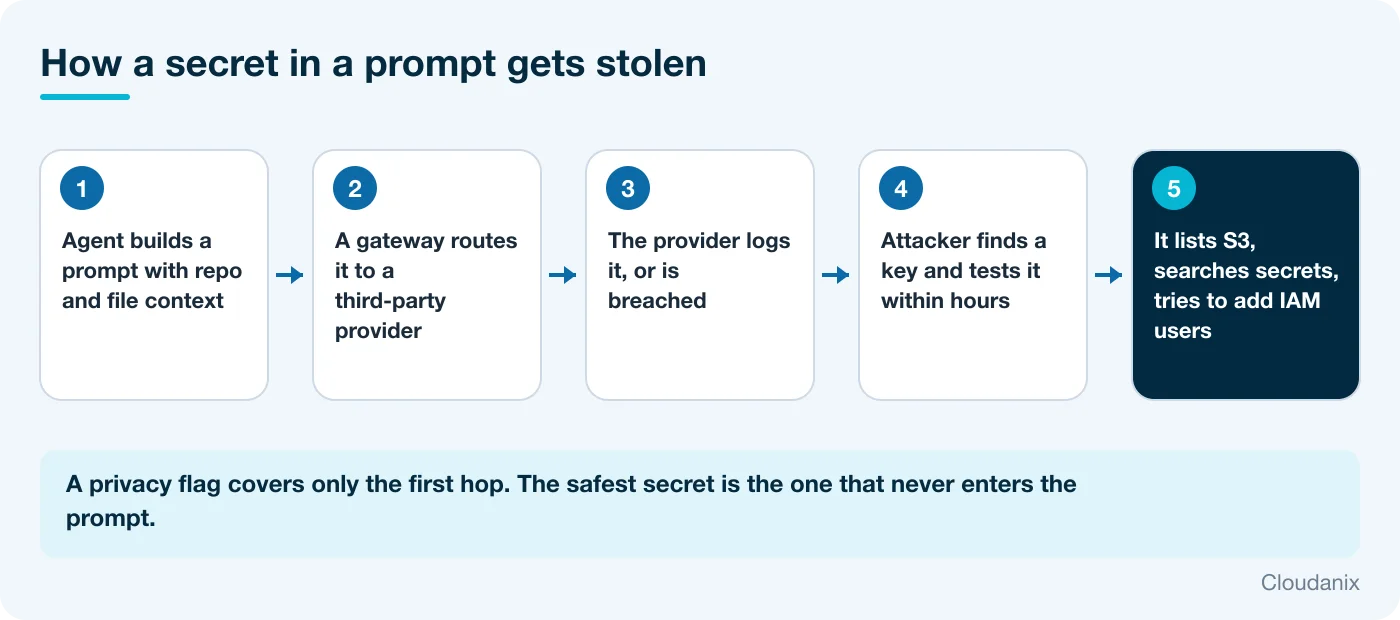
- The largest breach involved a couple hundred planted AWS keys, each sent in exactly one request to one provider during a few short windows in late October. Every request sent during those windows was stolen. Some stolen requests were ones the provider had rejected before a model ever ran, which suggests the attacker was copying traffic at the first point it arrived.
- One attacker appears to have compromised two of the providers at once, using secrets from both from a single rented server.
What the thieves did with the keys. They tested stolen keys within hours in some cases. They listed S3 storage buckets, searched Secrets Manager and Parameter Store (the places where AWS keeps secrets), tried to create Bedrock API keys, tried to add IAM users to keep access, and made tens of thousands of AWS API calls. On November 1 the attacker brought in ARTEX, an AI-driven penetration testing framework, only to confirm that keys it already held were still live. Two ARTEX user-agent strings seen were artex-agent and artex-judge-r121, which Dragos could not find in any public indicator list and recommends adding to detections. ARTEX is the same framework behind the Barracuda breach and is described in the FBI’s warning.
A second finding needed no break-in. Sellers on an AI inference marketplace listed models at the lowest prices, switched on request logging and collected whatever passed through. One seller worked from a home internet connection in France, took passwords from two prompts and tried root SSH logins by hand. One planted key had traveled through a router that quietly forwarded some traffic to the marketplace, a hop no customer had been told about. Route tracing across about 2,000 paths found several hundred unidentified systems, and one seller that quietly added about 1,000 hidden tokens to every prompt.
A model lab fetched links from prompts. A Chinese AI lab that Dragos does not name fetched the secret links from more than half of the seeded prompts sent to its models, including about two-thirds of requests marked as no data collection or Zero Data Retention. Prompts sent to U.S. hosting providers that resell the lab’s models triggered the same scraper. Twenty-four days after one prompt was sent, its secret link was posted into a chat on a Chinese workplace app and opened within two minutes from several devices. In Dragos’s words, flagged prompts were kept, passed to other companies and read by human beings.
What the providers said.
- Phala: an attacker took control of an inference server and could view request data while it was processed. The incident was contained on November 8. Requests to one model that reached Phala through the gateway between October 21, 00:00 UTC and November 8, 05:35 UTC should be treated as exposed, and every key, token or password in them should be rotated.
- Together AI: an unauthorized party downloaded stored samples of customer prompts after an AI coding agent committed a credential to the company’s public GitHub repository. It has made zero data retention the default for new accounts.
- Novita: a routing configuration issue sent some requests on to another company’s official API beyond what was intended.
OpenRouter’s response. It removed the endpoints, is adapting the researchers’ testing so checks can run continuously, and is verifying the network paths to see where requests might be forwarded to third parties. The researchers are now working with about a dozen providers.
Why This Is Different From a Normal Data Leak
A privacy setting only covers the first hop
Dragos’s research chief put it this way: a privacy flag binds only the first hop. If you tell a gateway “do not store my prompt” and the gateway passes it to a provider, which passes it to a hosting company, the flag is only as good as every party in the chain. In this research, the flag did not stop an attacker who was already inside a provider’s servers.
Coding agents send whatever they can read
When you ask an agent to “fix the billing service,” it reads files near the task: configuration, environment files, notes, test fixtures. It then attaches them to the prompt. If a key is in any of those files, the key is in the prompt. The agent is not careless. It is doing what it is designed to do, which is use all the context it can find. Dragos made the same point: AI agents will send whatever they can read, credentials included.
Stolen secrets are tested within hours
The thieves in this research did not hoard what they took. They tested keys quickly and ran a large number of calls against AWS. A key that is still valid when it reaches the attacker is a working door.
You may not know your provider chain
Gateways, routers and resellers add hops. The researchers found hidden hops, unlabeled systems and a seller adding invisible tokens. Choosing the cheapest endpoint means handing the decision about who reads your prompts to the lowest price.
Detection is on the provider’s side, not yours
None of the three providers noticed for months. You cannot fix a provider’s logging. What you can control is what you send, how long what you send stays valid, and whether you are told when it is used.
The Protection Guide
These steps need no particular product. They are ordered from the one that matters most, which is not putting secrets in prompts at all.
Step 1: Keep secrets out of what an agent can read
If a secret is not in the agent’s reach, it cannot be in the prompt. Start with the files:
- Remove secrets from files in repositories, including
.envfiles, notes and test fixtures. Replace them with references to a secrets manager, resolved at run time by the application, not read by the agent. - Tell each agent tool which paths it must not read. Most AI coding tools have a configuration for this, such as a permissions deny list or an ignore file. For example, Claude Code supports a deny rule in
.claude/settings.json:
{
  "permissions": {
    "deny": [
      "Read(./.env)",
      "Read(./.env.*)",
      "Read(~/.aws/**)",
      "Read(./secrets/**)"
    ]
  }
}
Use the equivalent setting in whichever tools your developers use. Remember that this only limits the files the agent chooses to open. It does not scan the text of what is sent, and it does not cover a secret pasted into a prompt or printed in a command’s output.
Step 2: Make any leaked key short-lived and narrow
Assume a secret will reach somewhere you did not intend. The question is how long it stays useful. Use temporary credentials, which expire on their own, instead of permanent access keys.
# AWS: get credentials that expire in 15 minutes (the shortest allowed)
aws sts assume-role \
  --role-arn arn:aws:iam::123456789012:role/ReadOnlyForTask \
  --role-session-name task-$(date +%s) \
  --duration-seconds 900
Give the role only the actions the task needs. A key that is read-only, limited to one bucket and valid for 15 minutes is a poor reward for a thief who tests it hours later.
Step 3: Verify your provider chain, do not assume it
Write down every place a prompt can go: the model provider, any gateway or router, and any reseller or marketplace. Then:
- Choose providers yourself. Do not accept a default pool of upstream providers.
- Verify privacy settings change the route. A “no retention” toggle that does not change where requests go is only a label. Ask for written confirmation, and test it with a canary (Step 5).
- Avoid reseller marketplaces for anything sensitive. Dragos found sellers logging prompts, and some marketplace capacity that runs on stolen keys.
- Consider direct use of a first-tier provider for sensitive work. That leaves one company, one contract and one privacy policy to check.
- Consider self-hosting the model for the most sensitive data. Dragos notes that self-hosting is the only option where no third party reads a prompt.
- Record who can see what. Personal data in prompts can be a regulated data transfer.
Step 4: Scan and block secrets before they leave the machine
A scanner that sits between the agent and the network catches what Step 1 misses, such as a key printed in a test log. Whatever tool you use, it should check outgoing prompts and tool output for known secret formats (cloud keys, tokens, private keys, connection strings) and personal data patterns, and either redact or block. Remember Dragos’s caveat: scrubbing known credential formats helps, but it misses sensitive data that is not shaped like a key, such as a business strategy paragraph or an unlabeled password.
Step 5: Plant your own tripwires
You can copy Dragos’s method for your own environment. A decoy credential that no real system uses becomes an alarm.
# Create a decoy IAM user with NO permissions and an access key.
aws iam create-user --user-name svc-backup-legacy
aws iam create-access-key --user-name svc-backup-legacy
# Place the key in a file the agent can read, such as a fake .env in a test repo.
Then alert on any use of it. This CloudWatch Logs Insights query (against CloudTrail logs) finds activity from the decoy:
fields @timestamp, eventName, sourceIPAddress, userAgent
| filter userIdentity.userName = "svc-backup-legacy"
| sort @timestamp desc
Any hit means someone read a prompt, a file or a log that contained the decoy. Treat it as an incident. Free canary-token services exist for the same purpose if you prefer not to build your own.
Step 6: Hunt for what the thieves did
If you sent prompts through any of the affected paths, search your cloud audit logs for the behavior Dragos described:
fields @timestamp, userIdentity.accessKeyId, eventName, sourceIPAddress, userAgent
| filter eventName in ["ListBuckets","GetSecretValue","GetParameter","GetParameters",
                       "CreateUser","CreateAccessKey","CreateApiKey"]
| stats count() as calls by userIdentity.accessKeyId, sourceIPAddress, userAgent
| sort calls desc
Pay particular attention to calls from addresses you do not recognize, and to the user-agent strings artex-agent and artex-judge-r121. Bursts of listing and secret-searching calls from one key, followed by attempts to create users or keys, match the reported pattern.
Step 7: If you used an affected path, rotate and review
If your traffic went through Phala’s exposed window (October 21 to November 8), through any provider OpenRouter removed, or through a provider you cannot verify, treat every secret in those prompts as exposed:
- Rotate every key, token and password that could have been in a prompt, from a clean machine.
- Review what each could reach and remove permissions it never needed.
- Check your audit logs back to the first date of exposure.
Step 8: Set a rule for what may be sent
Write a short policy that developers can follow:
- Which tools and providers are approved for which data classes
- What must never be pasted or attached: production secrets, customer personal data, regulated data
- Who reviews prompt logs, and how long they are kept
- What happens when a secret is found in a prompt: rotate, record, and learn
How Cloudanix Can Help
The steps above work without Cloudanix. The platform helps in two places: stopping secrets from leaving the developer’s machine, and giving agents access without handing them a key.
Block secrets and personal data before they leave. Coding Agent Guardrail is an on-host guard that hooks into coding agents, including Claude Code, Kiro, Cursor and Copilot. It inspects each outgoing prompt, and tool results coming back, before the network request is made. It checks for cloud keys, tokens, private keys, connection strings and personal data patterns using pattern matching and classifiers, and applies your policy: allow, warn, redact or block. It also has a file denylist for paths such as .env and ~/.aws/credentials. Rules live in a policy file you keep with your code, and every decision is logged with the user, time, matching rule and action, and can be sent to your SIEM. In plain terms, the AWS key in Dragos’s example would be caught on the laptop and the prompt would not be forwarded.
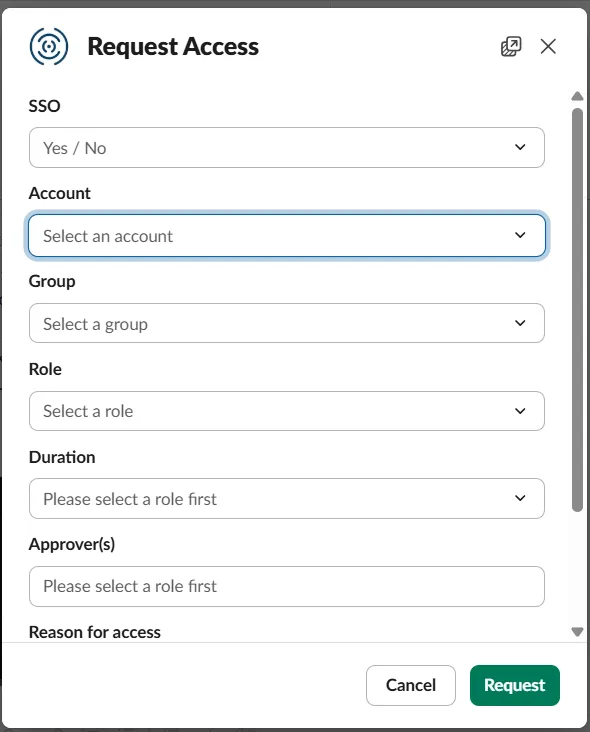
Give agents access without giving them keys. Coding Agent JIT puts a broker between the agent and your systems. The agent states what it wants to do, on which resource, and for how long. The broker applies your policy, asks a human for approval in Slack or Teams when the action is risky, and then issues short-lived credentials limited to exactly that action, for example one S3 policy change for 15 minutes. The agent never sees a long-lived key, so there is nothing durable for a prompt to carry to a provider. Every step is linked to a real person’s identity. Agentic JIT applies the same pattern to CI/CD jobs and services. See also why AI coding agents become an identity and credential risk and 24,000 secrets in MCP config files.
See and limit what any key can reach. CIEM and non-human identity governance list keys and roles and flag the over-privileged ones, so Step 2’s “narrow” is measurable. Cloud UEBA and cloud detection and response watch for identities acting unlike themselves, such as one key suddenly listing buckets and searching for secrets from a new address, which is the pattern in Step 6.
What this does not do. Cloudanix cannot stop a model provider from being breached or from logging prompts, and it cannot choose your provider chain for you. The guard covers the agents it hooks into; text typed by hand into an unmanaged chat window is outside its view. Like any scanner, pattern and classifier matching will miss sensitive content that does not look like a secret or personal data. The aim is to make the stolen prompt contain nothing worth stealing, and to make any key that escapes short-lived and narrow.
Quick Reference Checklist
- Removed secrets from files agents can read; secrets are fetched at run time
- Configured each agent tool to deny reads of
.env, credentials and key files - Moved from permanent keys to temporary credentials with the shortest practical lifetime
- Listed every provider, gateway and reseller that prompts pass through
- Chose providers explicitly and verified that privacy settings change the route
- Avoided reseller marketplaces for sensitive work
- Added a pre-send scan that blocks or redacts secrets and personal data
- Planted decoy credentials with alerts
- Searched audit logs for listing, secret-search and user-creation calls and the ARTEX user agents
- Rotated every secret that may have been in prompts through affected paths
- Published a short policy on what may be sent to AI tools
Key Takeaways
- Dragos found three AI inference providers breached for months, using about two million canary-seeded prompts. Stolen AWS keys were tested within hours and used to list buckets, search for secrets and try to add users.
- A “Zero Data Retention” flag covers only the first hop. Some flagged prompts were still stolen, kept or read.
- Coding agents send whatever they can read. The most effective control is keeping secrets out of what they read and out of what they send.
- Short-lived, narrow credentials make a stolen key close to worthless. Decoy credentials tell you when a prompt was read.
- Choose your provider chain deliberately. Do not let the cheapest endpoint choose it for you.
Want to see where secrets and standing keys could reach your coding agents today, and how an on-device guard and brokered access would change that? Book a session and we will map it with you.
People Also Read
- Why AI Coding Agents Become an Identity and Credential Risk
- 24,000 Secrets in MCP Config Files: Why AI Agents Need JIT, Not Key Vaulting
- A Vendor’s Exposed Key Put a Fake Claude Code Extension in Cursor’s Marketplace
- AI Coding Agents Leaking Credentials: What Security Teams Need to Know
- LLMjacking: Stolen AI API Keys and AI Developer Platform Breaches
- Barracuda’s Cloud Breach Started With a Vendor Key That Was Never Retired
- Paved Paths and Guardrails for AI Coding Agents
- What is a Coding Agent Firewall?
- Data Loss Prevention for AI Coding Agents
- What are AI Agent Guardrails?
- Cloudanix Coding Agent Guardrail
- Cloudanix Coding Agent JIT