
01
Nothing to set up
No scoring model to build, no weights to tune, no rules to rewrite. The context that matters is already attached to every policy, so your queue re-ranks itself from day one.
Every scanner ships one hard-coded severity per rule. So an internal-only bucket and an internet-facing one arrive in your queue with the same red badge, and your team spends Monday deciding which Criticals were real. Cloudanix computes severity per asset from the security graph — exposure, environment, data, identity — and always shows you why it landed where it did.
Contextual severity means a finding's severity is decided by the asset it landed on — not by the rule that found it. Cloudanix reads the live context the security graph already holds about that asset: how it is exposed, what it holds, what it can reach, what is running on it, and what it is part of. The finding arrives with a severity that reflects that reality, and the specific reasons that produced it. Nothing is hidden, nothing is silently suppressed, and the base assessment is always one hover away.
One value, authored once, applied to every account, every environment and every asset it will ever touch. This is where every other tool stops.
Which signals apply is decided per policy, not globally — a transport-encryption rule and an over-permissive-role rule care about different things.
Still open. Still in compliance scope. Still able to escalate the day any of that changes.
A rule author has to pick one severity for every customer, every account and every asset that rule will ever touch. The only safe choice is the worst case. So the worst case is what everyone gets — thousands of times a day.
The same rule fires on your sandbox and your payments account with identical weight. Everyone learns to distrust the badge, and the real Critical loses its only advantage — being rare.
When severity can't move, the only way to quiet a finding is to mute it. Muting deletes the signal permanently — including the day that asset becomes internet-facing and the finding genuinely matters.
Editing severity finding-by-finding is a manual queue that resets every scan. What teams actually want is a policy: "in this workspace, this rule is Medium on internal assets." Once.
Plenty of tools compute a smarter risk ranking — in a separate view, next to the severity that still drives alerts and reports. Two truths, one inbox. The engineers keep following the old one.
Contextual is how Cloudanix reports severity out of the box, so a quieter queue is the starting point rather than a project. If you ever want a flat number back, or your own, each policy can be switched in a click.

Severity that fits the asset.
Each finding is weighed against the asset it landed on, so the Criticals in your queue are the ones that can actually hurt you. Every adjustment shows its reason in plain English.
Pin whatever you want.
Some controls are non-negotiable for your business or your auditor. Set those to the severity you want and nothing will move them.
The flat number, if you prefer it.
One severity for the rule, everywhere, the way most tools do it. It is always there as the baseline, and switching back takes one click.
The point is not the scoring. The point is that Monday morning starts with a handful of findings that deserve your week, each one telling you plainly why it's there — and that nothing quietly went missing to achieve it.
No scoring model to build, no weights to tune, no rules to rewrite. The context that matters is already attached to every policy, so your queue re-ranks itself from day one.
The context comes from what Cloudanix already knows about your estate. Nothing extra to deploy, nothing extra to collect, no separate line item.
Lists, dashboards, thresholds and Slack notifications all read the same severity. Point your pager at Critical and it means what you think it means.
A quieter finding is still an open finding — visible, searchable, and in compliance scope. It gets loud again on its own the day your exposure changes.
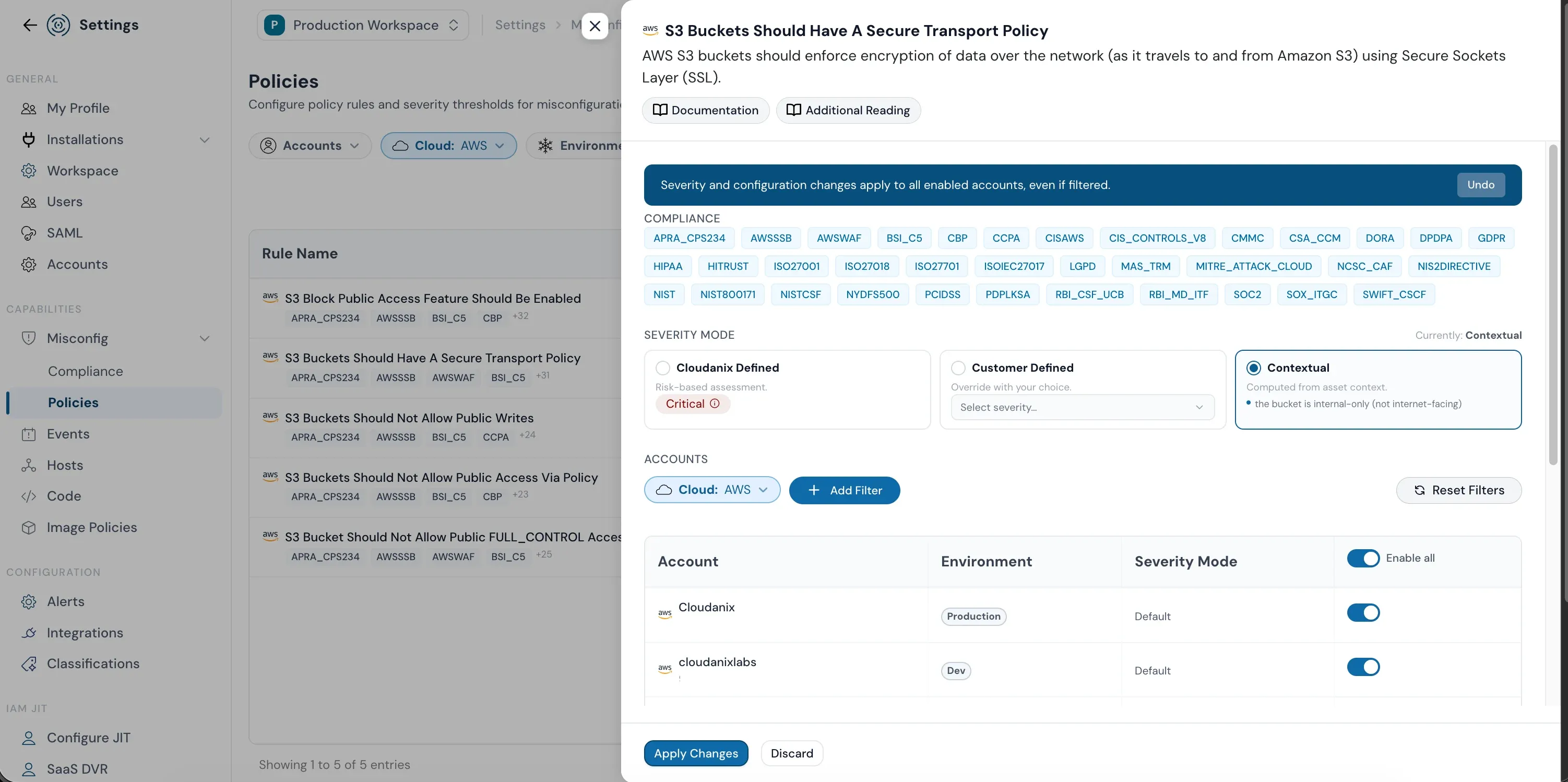
Not a fixed list of attributes, and not a closed set — the more of your estate Cloudanix covers, the sharper your severities get, without you changing a thing.
Whether the asset can actually be reached — resolved through policies, ACLs, endpoints, load balancers and routes, rather than read off a single public flag.
Production or not, which account tier it belongs to, and who owns it. The coarsest signal, and often the one that resolves the most volume.
Whether the asset holds or can reach regulated or customer data. A weak control in front of nothing is not the same finding as one in front of PII.
How far the identities attached to the asset can get — escalation, cross-account assumption, and what sits downstream if any of it is compromised.
Whether a confirmed chain already exists from the internet to this asset. When the graph has proven reachability, that is the strongest escalation signal there is.
What is actually running, whether the asset already carries an exploited vulnerability, and whether anything suspicious has touched it recently.
You don't tune any of this. The context that matters is already attached to each policy, so switching a rule to Contextual is a single choice — not a scoring model you have to configure, maintain, or explain to your auditor. And because it reads the same graph as the rest of the platform, every capability you turn on makes your severities sharper without you touching a thing.
"Is this bucket internet-facing?" looks like a one-field lookup and almost never is. The answer runs through policies, ACLs, VPC endpoints, load balancers, route tables and the identities that can reach it. A scanner with a flat finding table cannot answer it, which is exactly why static severity has survived this long.
Cloudanix already models your cloud as a typed asset graph to walk attack paths. Contextual severity is the same graph answering a different question — so it arrived as a correlation feature rather than a new product with a new agent and a new data pipeline.
“Can something out there reach this asset, and what does it touch next?”
Walk the chain →“Given what this asset is and where it sits, how loud should this finding be?”
You are hereAnything that can lower a severity deserves suspicion. Here is what a de-escalated finding still does for you.
Compliance is scored pass/fail, never weighted by severity. A de-escalated finding is still an open finding against every framework it maps to — so nothing "completes" SOC 2, ISO 27001 or PCI because a number went down. Your evidence pack does not change.
Every adjusted finding shows the conditions behind it and the severity it started from. When an auditor, a customer or your own board asks three months later, the answer is on the finding rather than in someone's memory.
Posture severity is re-evaluated as your assets change. The day an internal bucket becomes internet-facing, its findings get loud again on their own — the thing muting a finding can never do for you.
Contextual is on by default, and any single policy can be pinned to your own value or switched back to a flat severity in one click. You are never stuck with a number you disagree with.
Contextual severity is not a feature of one module — every surface that produces findings inherits it, so your posture, detection, workload, identity and code queues speak one severity language. Pick your surface below to see what that looks like in practice.
Context-aware prioritization is a real and growing part of this market — several platforms rank findings by exposure and reachability, and cloud-native services expose per-finding severity edits through their APIs. The difference is where the context lands. Below is what we think is actually distinct, stated narrowly enough to be true.
If you are evaluating us against a specific tool, ask them one question: can I express "this rule is Medium on internal assets and Critical on exposed ones" as a policy, and will my alerts respect it? That is the whole feature.
What Our Users Are Saying
Cloudanix is trusted by security leaders worldwide to deliver proactive, reliable, and cutting-edge cloud security.
One day, I changed the password of a root account, and my CTO called me within less than a minute to confirm if I did so. I was not expecting a reaction this quick. He told me Cloudanix alerted him of this password change and that he wanted to confirm as it was a critical security notification. I couldn't believe it!

Compliance is one way of staying secure, but what I want is the ability to go deeper and attain 'true security.' Cloudanix provides us the capability to do so.

Cloudanix is building for the future of the cloud, which makes the product all the more desirable.
Cloudanix gave us the visibility we were missing. Being able to move from permanent access to a robust Just-In-Time (JIT) workflow has fundamentally changed our security posture without slowing down our engineering velocity.

We are excited to leverage Cloudanix's comprehensive multi-cloud DevSecOps solution to secure our production workloads on AWS. Cloudanix has demonstrated that it can solve many challenges that DevSecOps teams face while continually adding new features such as SOC2 compliance and drift detection.

Managing third-party partner access was once a major concern for our security posture. With Cloudanix JIT Cloud, we've effectively achieved zero third-party risk. We can now grant access confidently, knowing that it is temporary, audited, and automatically revoked, resulting in a 100% reduction in our privileged access exposure.
The snooze feature and responsible alerts have helped us save time and prioritize what to tackle first.
Implementing Cloudanix JIT internally allowed us to practice what we preach. By eliminating permanent access to our own clouds and databases, we've neutralized the risk of standing privileges, ensuring our own 'keys to the kingdom' are never left exposed.

The problem with permissions is a lot of times, the gaps are left open due to oversights from inside the organization itself. With Cloudanix's CIEM, we get a complete view of user permissions and access. This enables us to update the permissions, reducing the attack surface.

In the world of Fintech, trust is our currency. Cloudanix provided the frictionless visibility we needed to secure our EKS workloads across AWS, ensuring we stay audit-ready for SOC2 and GDPR without slowing down our engineering velocity.

Cloudanix delivered value within 5 minutes of onboarding. Continuous monitoring, timely detection, and excellent documentation helped us attain a great cloud security posture.
Technology strategies and business strategies are in a state of constant change which includes centralization and decentralization of responsibilities. Regardless of strategic shift, we still have intellectual property to protect. Cloudanix are critical partners for us in our public cloud security posture across our three cloud providers.

Cloudanix has been amazing. They opened up a common Slack channel with us — and it feels like we are talking to our own team and getting things done with Cloud security. The support team is always available, friendly, helpful, and ready to go out of their way.
Beyond just access management, Cloudanix CSPM has given us a unified view of our AWS environment. The real-time alerting and anomaly detection allow us to prevent any untoward activity before it happens, which is critical for a marketplace connecting 50+ financial institutions.
For a Fintech company, data is our most valuable — and most sensitive — asset. Cloudanix DAM hasn't just improved our visibility; it has given us control. The ability to mask data and prevent unauthorized queries in real-time is a game-changer for our compliance and customer trust.

Our clients, especially in the Middle East financial sector, demand absolute accountability. Cloudanix JIT Cloud has been a competitive differentiator for us, allowing us to provide secure, governed access to customer accounts that meet their strictest audit and compliance requirements.
Cloudanix is always on my team's lips because of its exceptional support. Be it a small or big query, Cloudanix has gone above and beyond to resolve them. This one's a keeper for us.

For a long-lasting partnership, great support goes a long way. Cloudanix has delivered exceptional support whenever required. Their edge is their team is always ready to go beyond to solve any issues that we have. This speaks volumes about the culture at Cloudanix.

Beyond the technology, Cloudanix feels like an extension of our own team. Their willingness to stand up a dedicated Middle East tenant for us and provide exceptional support at a sensible price makes them a long-term partner for Hugosave.

The real-time notifications that Cloudanix provides are a real lifesaver. Their adaptive notifications ensure that my team stays productive and doesn't get interrupted all the time.
The whole point in technological evolution is to help improve the world we live in. We must protect that and to do so requires an effective and efficient security strategy. The Cloudanix team helped make our public cloud security posture management strategy a reality. The symbiotic relationship we have allows for a continuous feedback loop which is how business should operate.

Connect a cloud account in under 30 minutes. See every finding rooted in identity, asset, and blast radius — with a fix path attached.
Book a Demo