Cloudanix Joins AWS ISV Accelerate Program

Just-In-Time Access | Zero Standing Privilege | Cloudanix

Just-In-Time Access — Seven Flavors of JIT for Your Cloud

Eliminate standing access across cloud consoles, databases, VMs, Kubernetes, SaaS, CI/CD pipelines, and AI coding agents. One engine, one audit trail, auto-revoke.

What is Just-In-Time Access?

What is Just-In-Time Access?

Standing access is the top cloud attack vector. A leaked key or over-privileged identity gives an attacker persistent reach across your infrastructure. Just-In-Time (JIT) access eliminates this by replacing permanent privileges with a simple lifecycle: request → approve → time-boxed grant → auto-revoke. An engineer (or CI/CD pipeline, or AI coding agent) asks for a specific privilege on a specific target for a specific duration. An approver clicks Approve in Slack or Teams (or it auto-approves per policy). Cloudanix grants the access for the requested window, then removes it automatically. Every step is identity-stamped and audited. No standing privilege survives.

Learn More About JIT
Seven Surfaces, One JIT Engine

Seven Surfaces, One JIT Engine

Most JIT tools handle one access type. Cloudanix governs seven — from cloud consoles to AI agents — with the same request → approve → provision → revoke lifecycle, the same multi-level approval engine, and the same audit trail.

Cloud Console JIT

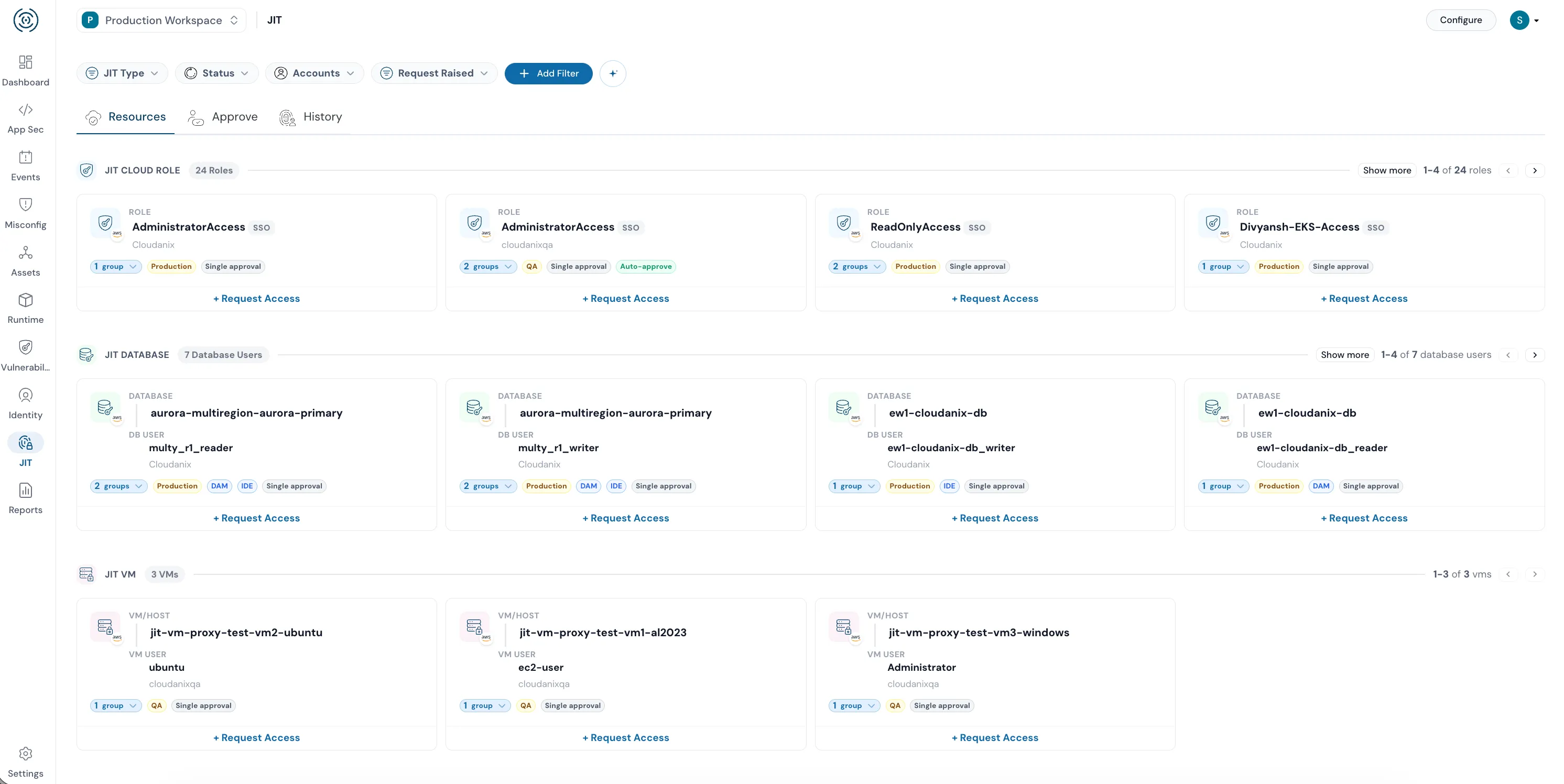
Time-boxed AWS, Azure, GCP access through your existing SSO. No new portal.

Database JIT

Keyless, identity-stamped access. No shared passwords, no jumpbox.

VM JIT

Short-lived SSH certificates. No static keys. Auto-revoked sessions.

Kubernetes JIT

Ephemeral kubeconfig for any cluster — including private ones.

SaaS JIT

Time-boxed app access through your IDP. License optimization built in.

Agentic JIT

Ephemeral credentials for CI/CD, Lambda, ECS, and K8s pods.

Coding Agent JIT

Scoped cloud access for AI coding agents via MCP. Human-in-the-loop.

Just-In-Time Access

Why Zero Standing Privilege Matters

Standing access is the largest contributor to cloud breaches. 80% of successful attacks involve compromised or over-privileged credentials. The problem isn't that people have access — it's that access exists when nobody's using it. A leaked key at 2 AM gives an attacker the same reach as your most senior engineer at 2 PM. Cloudanix JIT replaces this with time-boxed grants that exist only when actively needed — and auto-revoke the moment the window expires. One engine covers cloud consoles, databases, VMs, Kubernetes, SaaS, CI/CD pipelines, and AI coding agents.

Built for Real-World Access Challenges

Why Teams Choose Cloudanix JIT

Not another PAM tool. Cloudanix JIT is built for cloud-native teams that need speed, security, and audit — without forcing engineers into a new workflow.

Zero New Tools for Engineers

Engineers keep using the same AWS SSO portal, the same IDE for databases, the same kubectl for clusters. JIT is invisible until they need access they don't have.

  • Same SSO portal, same bookmarks
  • CLI-based for DB, VM, K8s
  • Slack/Teams for requests
  • No training required

Multi-Level Approvals

Auto-approve read-only access. One approver for staging. Quorum of three for production admin. Different sensitivity, different workflow — all configurable per role.

  • Up to 3 approval levels
  • Per-role policy configuration
  • Auto-approval for low-risk
  • Slack and Teams approve buttons

Multi-Cloud, One Engine

AWS IAM Identity Center, Microsoft Entra ID, Google Cloud Identity, Okta, JumpCloud — one JIT engine governs all of them. Same lifecycle, same audit, same policy.

  • AWS, Azure, GCP
  • All major IDPs supported
  • Unified audit trail
  • One console, one policy

Humans + Machines + Agents

The same engine that governs your engineers also governs your CI/CD pipelines, Kubernetes service accounts, and AI coding agents. Non-human identities are first-class citizens.

  • Developer JIT (cloud, DB, VM, K8s)
  • Pipeline JIT (Agentic)
  • AI Agent JIT (Coding Agent)
  • Contractor JIT (third-party)

Identity-Stamped Audit

Every request, approval, grant, session, and revocation is logged with the real human identity — not just the federated role name. Correlates with CloudTrail, Activity Log, and Audit Log.

  • Who requested, who approved
  • Which commands ran during the session
  • Duration and scope of access
  • Exported to your S3/SIEM

Scheduled & On-Demand

Request access now for an incident, or schedule it for a maintenance window next Tuesday at 2 AM. Both go through the same approval flow and auto-revoke.

  • Immediate access for incidents
  • Scheduled for future windows
  • Break-glass for emergencies
  • All audited identically

Slack · Microsoft Teams · Cloudanix Console

Request Access Where You Already Work

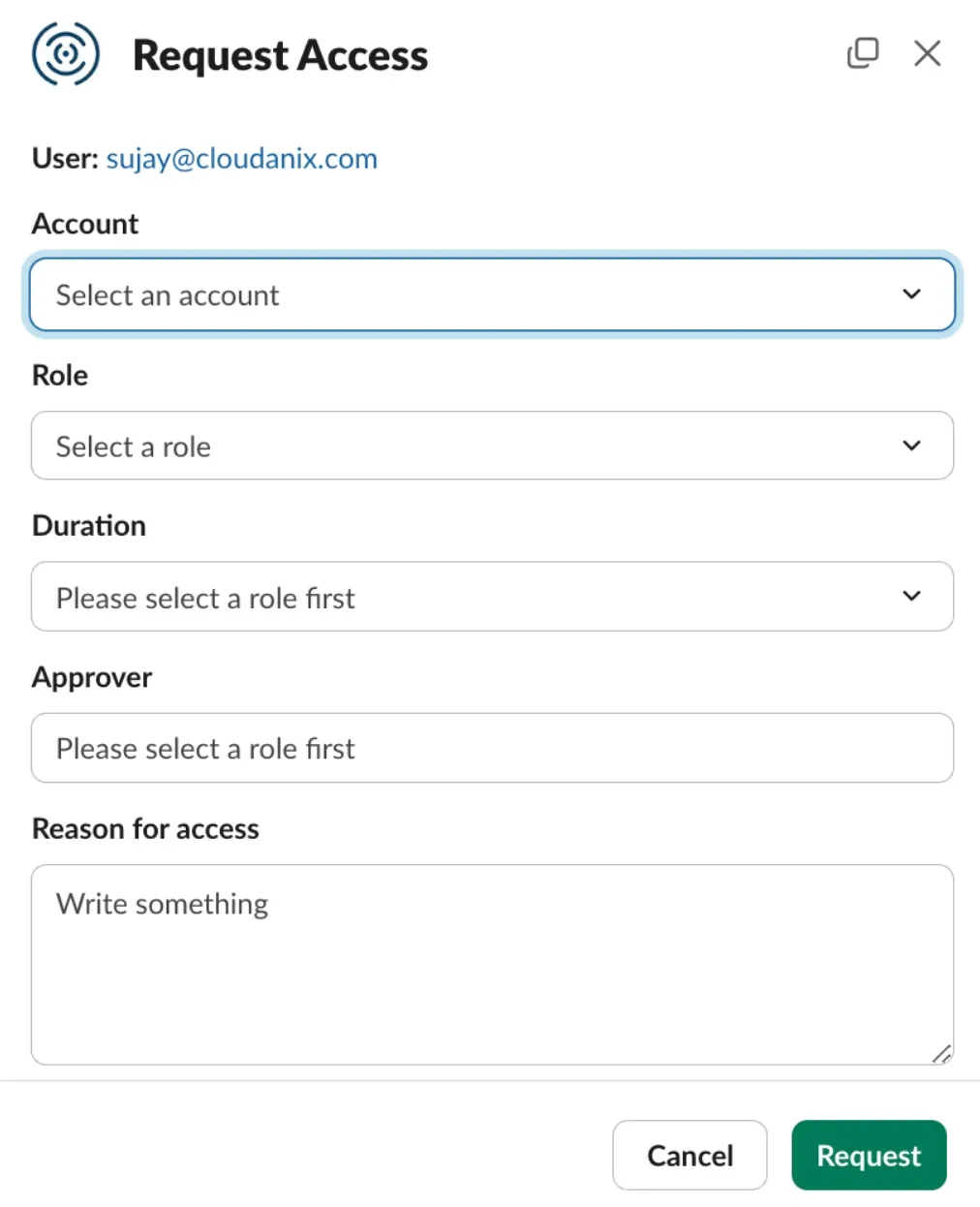
Developers don't need to context-switch to request access. Ask for a role directly from Slack, Microsoft Teams, or the Cloudanix Console — approvers respond inline with one click, and access is provisioned in seconds. No tickets, no waiting, no new tool to learn.

Customer voice

Managing privileged access to our AWS environment was once one of our biggest security concerns. With Cloudanix JIT, access is now temporary, audited, and automatically revoked — giving us a 100% reduction in privileged-access exposure without slowing our engineering team down. As a marketplace connecting more than 50 financial institutions, that level of confidence is essential.
Okesh Badhiye
Okesh Badhiye Head of Technical Engineering , Finfinity
See all stories

Seven Flavors of JIT

Explore Each JIT Surface

Each surface has its own grant mechanics, approval workflow, and audit trail — but they all share the same engine, the same policy system, and the same console. Pick the one that matches your access challenge.

Cloud Console JIT

Time-boxed AWS, Azure, or GCP console access through your existing SSO. Cloudanix flips the IDP assignment for the granted window — engineers use the same portal, same bookmark, same CLI. No new tool.

Explore Cloud JIT

Database JIT

No jumpbox. No shared passwords. No mystery queries. Short-lived, identity-stamped access to databases in private subnets — PostgreSQL, MySQL, SQL Server, Oracle — via your IDE. Every query logged.

Explore Database JIT

VM JIT

Keyless SSH into any virtual machine. Short-lived certificates replace static SSH keys. Sessions are recorded, identity-stamped, and auto-revoked. Works across AWS EC2, Azure VMs, and GCP instances.

Explore VM JIT

Kubernetes JIT

Ephemeral kubeconfig for any cluster — EKS, AKS, GKE, even private clusters. Temporary RBAC bindings scoped to namespace and role. No standing cluster-admin for anyone.

Explore Kubernetes JIT

SaaS JIT

Time-boxed access to your SaaS catalog through your IDP. Grant temporary access to Datadog, PagerDuty, Salesforce, or any SAML/OIDC app — auto-revoked when the window closes.

Explore SaaS JIT

Agentic JIT

Zero standing access for non-human identities. Govern CI/CD pipelines, Kubernetes pods, Lambda functions, ECS tasks, and service accounts with policy-pre-approved, time-bounded credentials via SDK.

Explore Agentic JIT

Coding Agent JIT

Give Claude Code, Cursor, or Kiro the credentials they need — not the keys to the kingdom. Short-lived, scoped access via MCP with human-in-the-loop approval and full audit trail.

Explore Coding Agent JIT

Your questions answered.

Frequently Asked Questions

Get clarity on Just-In-Time (JIT) Access — how it works, why standing privileges are dangerous, and how Cloudanix implements zero standing privilege across seven access surfaces.

JIT access is a security model where no user, service account, or AI agent has permanent elevated access to cloud resources. Instead, privileges are granted on-demand for a specific task, for a limited duration, with automatic revocation when the window expires. It eliminates standing access — the #1 cloud attack vector.
Traditional PAM vaults still store credentials — a compromised vault means compromised access. Cloudanix JIT creates credentials on-demand and destroys them after use. There's nothing to steal. Additionally, Cloudanix covers seven access surfaces (cloud consoles, databases, VMs, Kubernetes, SaaS, CI/CD, and AI agents) where traditional PAM typically handles only SSH and RDP.
No. For Cloud JIT, engineers continue using their existing AWS SSO portal, Azure Entra ID, or Google Cloud Identity — same bookmark, same CLI. For Database and VM JIT, they use their existing IDE or terminal via the lightweight cdx CLI. The only change is how they request access (Cloudanix console or Slack/Teams).
Yes. Cloudanix supports configurable approval policies per role. ReadOnlyAccess can be auto-approved instantly. PowerUserAccess might require one approver. AdministratorAccess on production can require a quorum of three approvers. You define the risk level, Cloudanix enforces the workflow.
Yes. One JIT engine governs AWS (IAM Identity Center), Azure (Entra ID), GCP (Google Cloud Identity), and OCI. Same lifecycle, same audit trail, same policy — regardless of which cloud you use.

Ready to see your graph?

Connect a cloud account in under 30 minutes. See every finding rooted in identity, asset, and blast radius — with a fix path attached.

Book a Demo