
What is CSPM?
CSPM stands for Cloud Security Posture Management. It is a category of security tools that continuously monitors cloud infrastructure configurations, detects misconfigurations, flags compliance violations, and helps security teams maintain a secure baseline across AWS, Azure, GCP, OCI, and other cloud providers.
In practical terms, a CSPM tool answers one question: “Is my cloud infrastructure configured securely right now?”
It does this by scanning your cloud accounts against security best practices (CIS Benchmarks, NIST, SOC 2, ISO 27001, HIPAA, PCI-DSS), identifying resources that deviate from secure baselines, and alerting your team before those deviations become exploitable vulnerabilities.
CSPM was first defined as a category by Gartner in 2019 to address the growing problem of cloud misconfigurations — the single most common cause of cloud data breaches. By 2026, the category has matured significantly: CSPM is now a foundational component within broader Cloud-Native Application Protection Platforms (CNAPP), rather than a standalone product.
How Does CSPM Work?
A CSPM tool operates through a continuous cycle of discovery, analysis, assessment, and remediation. Here is the technical workflow:
1. Cloud Environment Discovery
The CSPM connects to your cloud accounts via read-only API access (typically an IAM role or service principal). It discovers every resource in your environment — compute instances, storage buckets, databases, networking components, IAM policies, Kubernetes clusters, serverless functions, and more.
This discovery is continuous, not one-time. As your team deploys new infrastructure, the CSPM maps it automatically.
2. Configuration Assessment
Once resources are discovered, the CSPM evaluates their configurations against a set of security rules. These rules map to:
- Security best practices — CIS Benchmarks for AWS, Azure, GCP, and Kubernetes
- Compliance frameworks — SOC 2, ISO 27001, HIPAA, PCI-DSS, NIST CSF, GDPR, DPDPA, RBI, MAS, APRA
- Custom organisational policies — rules specific to your security requirements
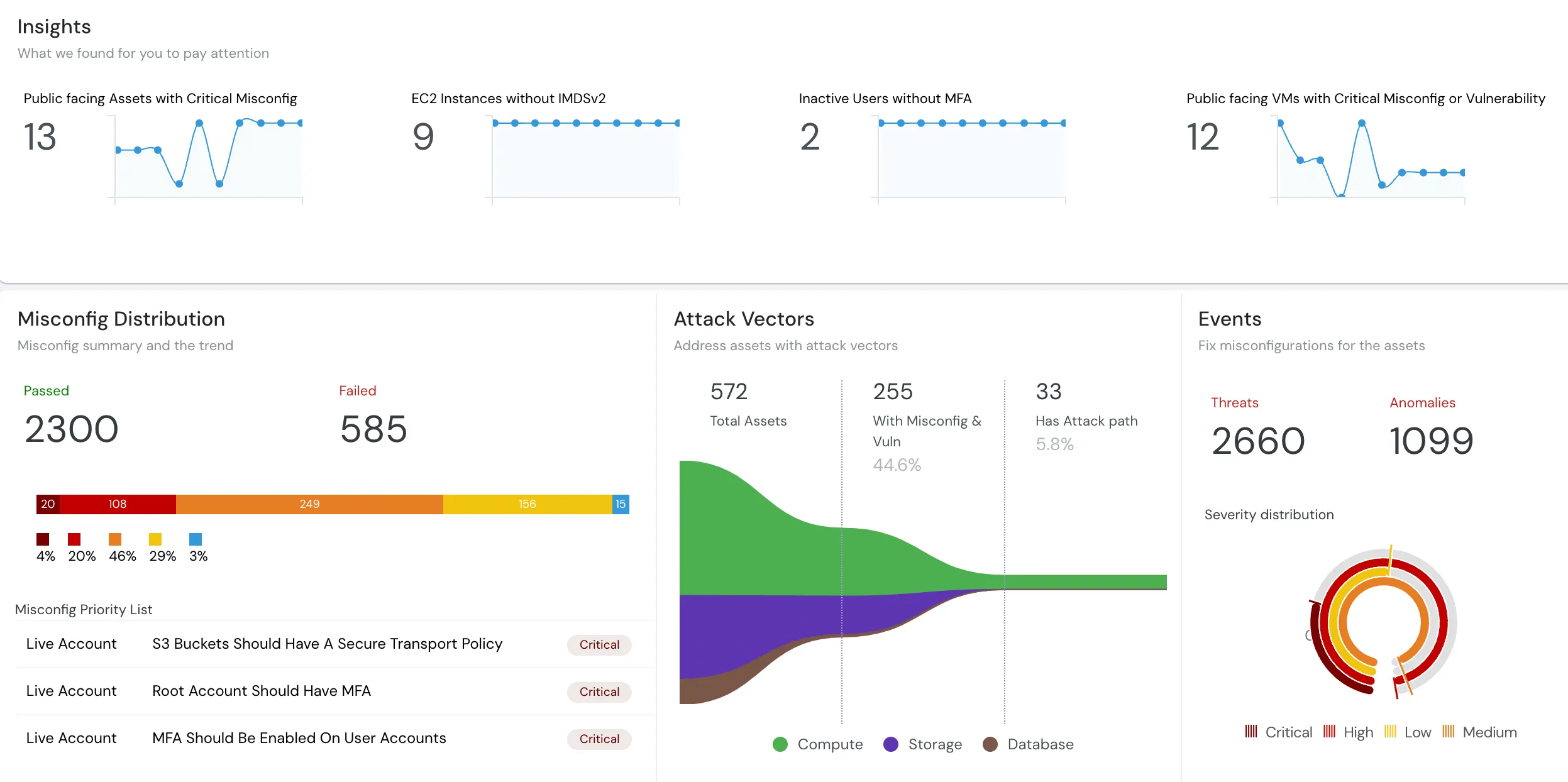
For example, it checks whether S3 buckets are publicly accessible, whether security groups allow unrestricted inbound traffic, whether encryption is enabled on databases, or whether IAM roles have excessive permissions.
3. Risk Prioritisation
Not all misconfigurations carry equal risk. Modern CSPM tools prioritise findings by:
- Severity — how exploitable is the misconfiguration?
- Exposure — is the resource internet-facing?
- Blast radius — what data or systems could be compromised if exploited?
- Context — is the resource in production or development?
This prevents alert fatigue by surfacing the misconfigurations that actually matter, rather than generating thousands of low-priority findings.
4. Continuous Monitoring and Drift Detection
Cloud environments change constantly. Developers push infrastructure-as-code updates, auto-scaling creates new resources, and manual changes introduce configuration drift.
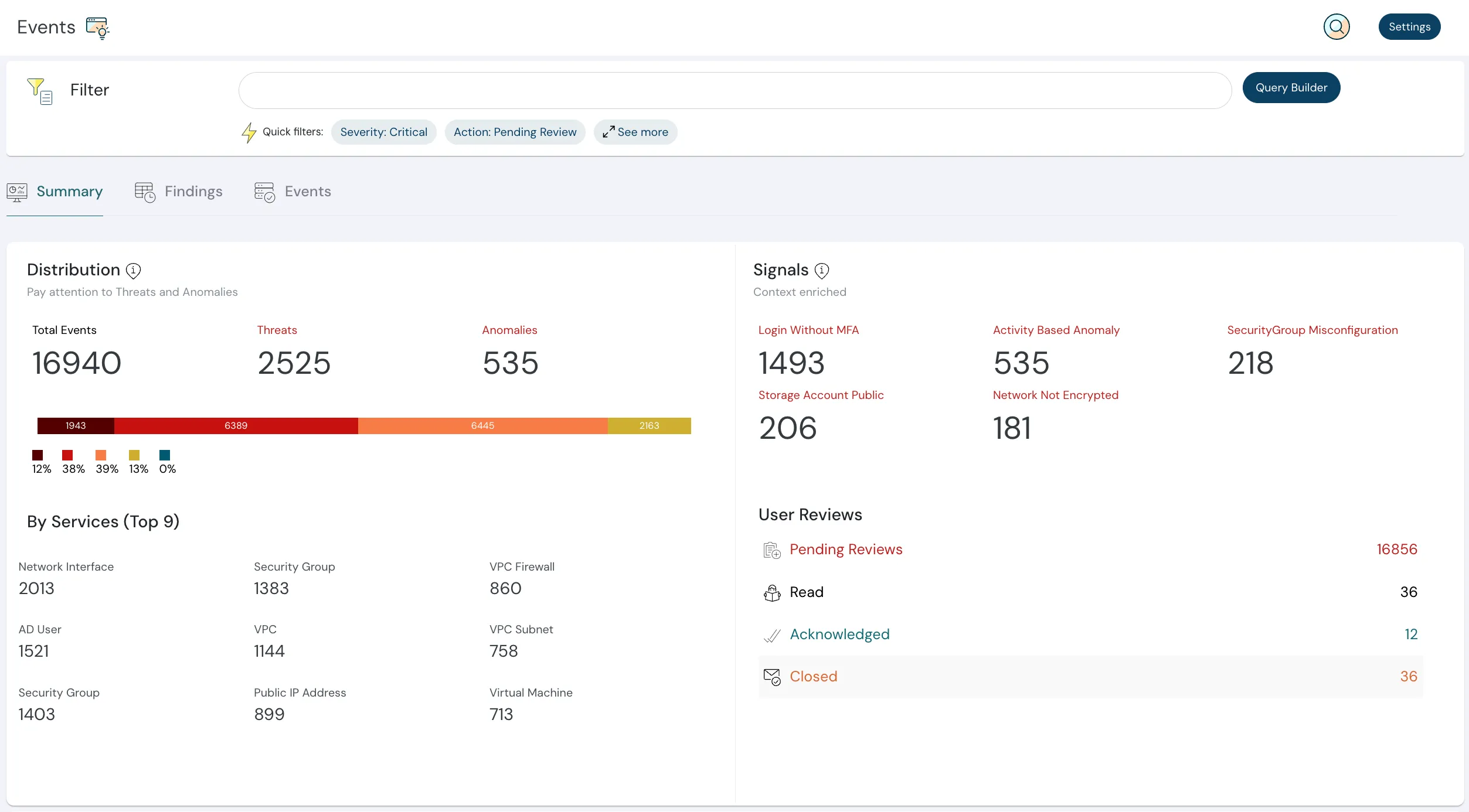
CSPM tools continuously monitor for these changes and detect when a previously secure configuration drifts out of compliance — alerting your team in real time, not during the next quarterly audit.
5. Remediation Guidance and Automation
When issues are detected, CSPM tools provide:
- Remediation guidance — step-by-step instructions to fix the misconfiguration
- Copy-paste CLI commands — ready-to-execute fixes for engineering teams
- Auto-remediation — automatic correction of specific misconfigurations (e.g., removing public access from a storage bucket)
- Integration with ticketing systems — creating Jira tickets, Slack alerts, or PagerDuty incidents for team workflows
6. Compliance Reporting
CSPM generates compliance reports mapped to specific regulatory frameworks. These reports show:
- Which controls are passing and failing
- Evidence of security controls for auditors
- Historical posture trends over time
- Exportable audit-ready documentation
What Does CSPM Cover?
A comprehensive CSPM platform provides coverage across these domains:
Misconfiguration Detection
The core function of CSPM. It identifies insecure configurations across cloud resources:
- Open storage buckets (S3, Azure Blob, GCS)
- Unrestricted security groups and network ACLs
- Unencrypted databases and volumes
- Missing logging and monitoring configurations
- Overly permissive IAM policies
- Exposed management ports (SSH, RDP)
- Missing multi-factor authentication requirements
Compliance Mapping
CSPM maps cloud configurations to regulatory and industry frameworks, providing continuous compliance monitoring rather than point-in-time audits. Common frameworks include SOC 2, ISO 27001, HIPAA, PCI-DSS, NIST CSF, CIS Benchmarks, GDPR, DPDPA, FedRAMP, and HITRUST.
Asset Inventory and Visibility
CSPM maintains a real-time inventory of all cloud resources, their relationships, and their security posture. This gives security teams complete visibility into:
- Total resource count across all cloud accounts
- Resource relationships and dependencies
- Unused or orphaned resources
- Shadow IT and unmanaged accounts
Network Exposure Analysis
CSPM evaluates network topology to identify resources with unnecessary internet exposure, misconfigured load balancers, overly broad VPC peering, and insecure public endpoints.
Configuration Drift Detection
When infrastructure drifts from its intended state — whether through manual changes, failed deployments, or policy violations — CSPM detects the drift and alerts the responsible team.
Why is CSPM Important?
Cloud Misconfigurations Remain the #1 Cause of Breaches
Industry research consistently shows that misconfigurations are responsible for the majority of cloud security incidents. Public S3 buckets, exposed databases, and overly permissive IAM roles continue to be exploited at scale. CSPM exists to catch these before adversaries do.
Cloud Complexity is Growing
The average mid-market organisation now runs multiple cloud accounts, uses multiple cloud providers, deploys Kubernetes clusters, and operates serverless functions alongside traditional VMs. Without automated posture monitoring, security teams cannot manually audit configurations at this scale.
Compliance is Non-Negotiable
Regulatory pressure is increasing globally. SOC 2 auditors now expect continuous posture evidence. DPDPA (India) carries penalties up to INR 250 crore. HIPAA requires documented proof of security controls. Manual compliance reporting is no longer viable for organisations operating at cloud scale.
Security Teams are Small
Most mid-market organisations have security teams of 2–5 people covering an attack surface of thousands of cloud resources. CSPM automates the configuration hygiene that would otherwise require manual auditing, freeing the team to focus on higher-order security decisions.
Developers Move Fast
In organisations deploying multiple times per week, every deployment is an opportunity for misconfiguration. CSPM operates as a safety net — catching the public bucket or the open port that slipped through code review.
The Evolution of CSPM: 2019 to 2026
Understanding where CSPM fits in 2026 requires context on how the category has evolved.
2019–2021: Standalone CSPM
CSPM emerged as a standalone category. Organisations deployed dedicated CSPM tools alongside separate vulnerability scanners, identity tools, and workload protection solutions. The market was fragmented, and “cloud security” meant buying five to eight point tools.
2022–2023: CSPM Becomes a CNAPP Component
Gartner introduced the CNAPP (Cloud-Native Application Protection Platform) category, recognising that CSPM alone was insufficient. CNAPP unified CSPM with CWPP (workload protection), CIEM (identity governance), and code security into a single platform.
2024–2026: CNAPP+ and the Expanded Attack Surface
The attack surface moved beyond configuration and workloads. Identity abuse, database access, and AI coding agents became primary vectors. Leading platforms now ship CSPM as one layer within a broader stack that includes:
- Just-In-Time access for humans, non-human identities, and AI agents
- Database Activity Monitoring with dynamic PII masking
- Coding Agent Firewall for AI development tools
- Behavioural analytics and threat detection (CDR/UEBA)
The takeaway: CSPM remains essential, but it is now a foundation layer, not a complete security strategy. Organisations that treat CSPM as their entire cloud security posture leave identity, data, and runtime gaps unaddressed.
What CSPM Does Well — And Where It Stops
Being precise about CSPM’s boundaries helps organisations make informed decisions about their security architecture.
CSPM Excels At:
- Detecting misconfigurations before they are exploited
- Maintaining compliance baselines across regulatory frameworks
- Providing a single view across multi-cloud environments
- Catching public exposure (open buckets, unrestricted ports)
- Detecting configuration drift from secure baselines
- Generating audit-ready compliance evidence
CSPM Does Not Cover:
| Gap | What’s Needed | Why It Matters |
|---|---|---|
| Identity and privilege | CIEM + JIT Access | CSPM sees that a role has admin permissions. It does not eliminate standing privilege or broker time-bound access. |
| Runtime behaviour | CDR / UEBA | CSPM is a snapshot of configuration state. It does not detect anomalous activity during a session. |
| Data tier | Database Activity Monitoring | CSPM knows a database exists. It does not watch who connects, mask PII, or block destructive queries. |
| Code vulnerabilities | SAST / SCA / Secrets scanning | Hardcoded secrets and vulnerable dependencies in source code are outside CSPM’s scope. |
| AI coding agents | Coding Agent Firewall + Agent JIT | Agents operating with long-lived cloud credentials are invisible to CSPM. |
| Workload runtime | CWPP | Container and VM runtime threats (cryptominers, reverse shells) require workload-level telemetry. |
This is not a criticism of CSPM — it is a scope definition. CSPM was designed for configuration hygiene and compliance monitoring. Expecting it to solve identity, data, and runtime problems leads to a false sense of coverage.
CSPM vs Other Cloud Security Categories
Security teams frequently need to distinguish CSPM from adjacent categories. Here is a clear comparison:
CSPM vs CNAPP
CNAPP (Cloud-Native Application Protection Platform) is a superset that includes CSPM. CNAPP unifies CSPM + CWPP + CIEM + Code Security into a single platform covering the full application lifecycle. CSPM is one component within CNAPP.
When you need CNAPP over standalone CSPM: When your security requirements extend beyond configuration hygiene into workload protection, identity governance, or code security.
→ Detailed comparison: CNAPP vs CSPM
CSPM vs CWPP
CWPP (Cloud Workload Protection Platform) protects what runs inside your infrastructure — containers, VMs, and serverless functions — at runtime. CSPM protects the infrastructure configuration itself.
The relationship: CSPM ensures your security groups are correct. CWPP detects the cryptominer that got in despite the correct security groups.
→ Detailed comparison: CSPM vs CWPP
CSPM vs DSPM
DSPM (Data Security Posture Management) discovers and classifies sensitive data across your cloud. CSPM monitors the infrastructure those data stores run on.
The relationship: CSPM ensures a database has encryption enabled. DSPM tells you that database contains PII. Neither watches who connects to it or what queries they run — that requires Database Activity Monitoring.
→ Detailed comparison: CSPM vs DSPM
CSPM vs SSPM
SSPM (SaaS Security Posture Management) does for SaaS applications what CSPM does for cloud infrastructure. SSPM monitors configurations in tools like Salesforce, Microsoft 365, Slack, and GitHub.
When you need both: If your organisation uses both IaaS/PaaS (cloud infrastructure) and SaaS applications, you need both CSPM (for cloud) and SSPM (for SaaS). They cover different attack surfaces.
→ Detailed comparison: CSPM vs SSPM
CSPM vs CIEM
CIEM (Cloud Infrastructure Entitlements Management) focuses specifically on identity and access permissions. CSPM covers the broader infrastructure configuration — including but not limited to IAM.
The relationship: CSPM flags that an IAM role has admin access. CIEM analyses whether that access is actually used and recommends right-sizing. Neither eliminates the standing privilege — that requires JIT access.
CSPM vs SIEM
SIEM (Security Information and Event Management) collects and correlates security logs from across your infrastructure for threat detection and incident response. CSPM monitors configuration state.
The relationship: CSPM tells you a misconfiguration exists. SIEM tells you someone exploited it. They serve different purposes and complement each other.
How to Evaluate a CSPM Solution
When selecting a CSPM tool for your organisation, evaluate against these criteria:
Multi-Cloud Coverage
Does the CSPM support AWS, Azure, GCP, OCI, and Kubernetes with genuine parity — or is it strong on one cloud with limited coverage on others?
Rule Depth and Currency
How many checks does it run? Are they mapped to current framework versions (CIS v3, PCI-DSS v4.0, ISO 27001:2022)? Does it update rules as new services are released by cloud providers?
Contextual Prioritisation
Does it prioritise by severity alone, or does it incorporate context like internet exposure, blast radius, asset criticality, and identity relationships?
Remediation Quality
Does it provide actionable fix guidance — copy-paste CLI commands, IaC templates, or automated fixes — or just a finding description and a link to documentation?
Time to Value
How long from connecting your cloud account to seeing first findings? Best-in-class CSPM tools deliver findings within 30 minutes of a read-only API connection.
Integration Depth
Does it integrate with your team’s workflow — Slack, Teams, Jira, PagerDuty, CI/CD pipelines — or does it require teams to log into a separate dashboard?
Path to CNAPP
If you expect your security requirements to grow (identity, workload, code, data), does the CSPM vendor offer a path to full CNAPP coverage on the same platform — or would you need to rip and replace later?
CSPM and Cloudanix
Cloudanix provides CSPM as a core layer within a unified CNAPP+ platform. The CSPM foundation includes:
- 1,000+ misconfiguration checks with cross-cloud parity across AWS, Azure, GCP, OCI, and Kubernetes
- 15+ compliance frameworks mapped and continuously assessed — SOC 2, ISO 27001, HIPAA, PCI-DSS, NIST, GDPR, DPDPA, RBI, MAS, APRA, CIS, HITRUST, FedRAMP, OWASP, MITRE
- Contextual severity scoring — findings prioritised by exposure, blast radius, and asset criticality
- GenAI-powered remediation playbooks — copy-paste-ready CLI commands with cross-cloud translation
- Unified asset graph — 300+ resource types with typed relationships and recursive attack-path traversal
- 30-minute agentless onboarding — read-only IAM connector, first findings same day
- Adaptive notifications with auto-snooze to eliminate alert fatigue
Beyond CSPM, Cloudanix extends into the surfaces CSPM cannot cover: Just-In-Time access for humans, non-human identities, and AI coding agents; Database Activity Monitoring with dynamic PII masking and query prevention; Coding Agent Firewall for on-host DLP; and CloudPrem deployment for full data sovereignty.
Start with a free cloud security assessment. Connect your cloud accounts in 30 minutes, agentless and read-only. See your posture findings the same day. Book your assessment →
Additional Resources
- Best CSPM Tools in 2026: Platforms Compared
- How to Use CSPM to Detect and Remediate Cloud Misconfigurations
- Top 10 Challenges of Cloud Security Posture Management
- CNAPP vs CSPM: Which Do You Need?
- CSPM for ECS-Heavy AWS Workloads
- Multi-Cloud CSPM for GCP-Heavy FinTech
- Implementing CSPM on AWS: A Practical Guide