
What is Cloud Workload Protection Platform?
The art of securing container workloads
CWPP or Cloud Workload Protection Platform helps organization protects their workloads running in the cloud. Using CWPP solutions, organizations have constant visibility and control over their workloads to reduce data breaches and improve compliance.
Importance of Cloud Workload Protection Platform
Businesses today, know the importance and benefits of using cloud infrastructure. As the saying goes “With great power, comes great responsibility”, the need to secure these infrastructures is a must. Use CWPP to relieve this pain, as it protects infrastructure from a wide range of threats, including malware and ransomware attacks, data breaches, and cloud misconfigurations.
Here are a few reasons to consider CWPP
- Cloud environments are getting more complex and dynamic compared to earlier IT environments. Without a dedicated cloud security solution, it is difficult to secure these environments.
- Cloud workloads are often exposed to more threats than traditional IT workloads. Because cloud workloads can be accessed from anywhere in the world, protecting such structures gets overwhelming.
- Misconfigurations are internal. A single misconfiguration can attract attackers to enter your cloud environment.
Using CWPP will help mitigate all these problems and provide you a safe and secure cloud posture.
Note: Just using CWPP is not the only solution.
How a CWPP actually works
A CWPP protects the workload itself — the running VM, container, or serverless function — as opposed to the cloud control plane around it. In practice it operates across the workload lifecycle:
- Build time. Scan images and packages for known vulnerabilities before they ship, so you catch issues while they are cheap to fix. This overlaps with container image scanning and software composition analysis.
- Deploy time. Apply policy and admission controls so workloads that violate baselines (privileged containers, missing labels, disallowed base images) never reach production.
- Runtime. Monitor live behavior — process execution, file changes, network connections, privilege changes — and detect the activity a pre-deployment scan cannot predict. A clean image can still be compromised once it runs.
Protecting different workload types
“Workload” is a broad word, and each type needs a different protection approach — which is part of why CWPP is harder than protecting a fleet of identical servers:
- Virtual machines are long-lived and behave like traditional servers. They benefit from OS hardening, patch management, host-based intrusion detection, and file integrity monitoring. An agent on the VM can see deep runtime detail.
- Containers are short-lived and immutable. You do not patch a running container; you rebuild the image and redeploy. Protection shifts left toward image scanning and admission policy, plus runtime detection of process, file, and network behavior inside the container. A pod that lives for ninety seconds still needs to be observed while it runs.
- Serverless functions run for milliseconds and give you no host to install an agent on. Protection focuses on the code and dependencies (vulnerability scanning, least-privilege function roles) and on monitoring invocation behavior and permissions rather than the underlying host.
A capable CWPP covers all three without forcing you to bolt together a separate tool per workload type.
Agent-based vs agentless
There are two broad collection models, and most mature programs use both:
- Agent-based CWPP installs a lightweight sensor on the workload (or as a DaemonSet in Kubernetes). Agents see deep runtime detail — syscalls, in-memory activity, process lineage — and can enforce inline. The tradeoff is deployment and lifecycle overhead.
- Agentless CWPP inspects workloads by scanning snapshots, disk images, or cloud APIs without installing anything. It is fast to roll out and great for broad vulnerability and configuration coverage, but it sees point-in-time state rather than continuous runtime behavior.
The honest tradeoff: agentless gives you fast, wide coverage; agents give you deep, real-time detection and enforcement. Choosing between them is really about which workloads warrant runtime depth versus which just need coverage.
CWPP mitigates the below risks
- Application control: Knowing which applications run on your workloads.
- Behavioral monitoring: Detect malicious activities by monitoring the behavior of your workloads.
- Intrusion prevention: Blocks malicious traffic from reaching your workloads.
- Anti-malware protection: Protect your workloads from malware attacks.
Benefits of using Cloud Workload Protection Platform
Two major factors to consider using a CWPP are the size and complexity of your cloud environment and the types of workloads you want to protect. Implementing security budgets for your organization’s cloud infrastructure is important. CWPP solutions can also be integrated with other security solutions like SIEMs and firewalls.
Here are some of the benefits of using a CWPP
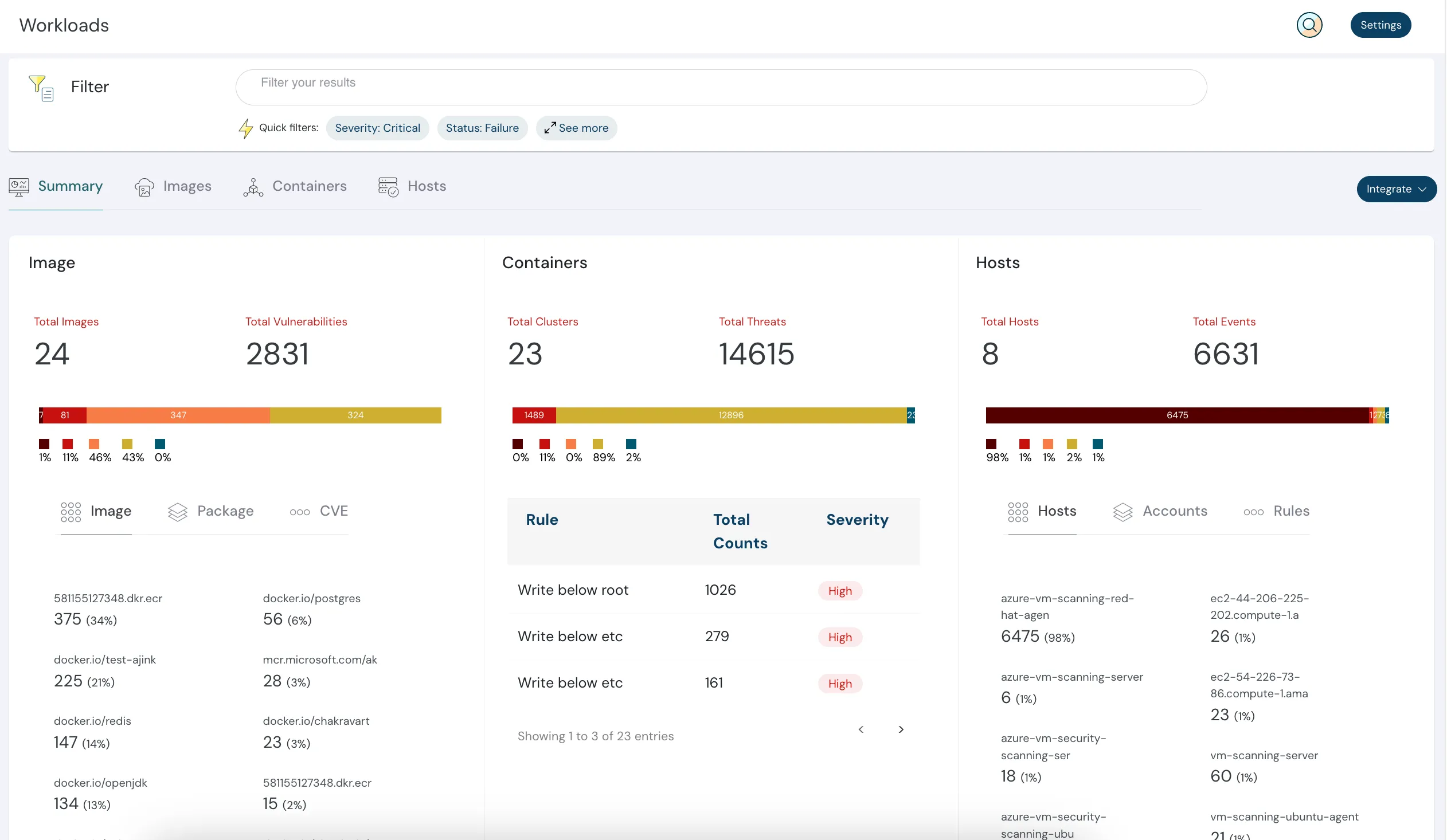
- Increased visibility and control over workloads: CWPPs provide a single dashboard to manage and secure workloads across multi-clouds and on-prem environments.
- Reduced risk of data breaches: CWPPs can help to prevent data breaches by detecting and blocking suspicious activity.
- Improved compliance: CWPP helps organizations comply with various compliance standards, such as PCI DSS, HIPAA, and others.
How can CWPP help security leaders?
Apart from the features of the product, it is highly important to understand the functionality and working of a CWPP solution for the proper functioning and future advancements in your infrastructure. We have listed a few things to consider before buying a CWPP solution.
- Visibility: The solution should provide enough visibility and control of your workload to track, configure and take required actions.
- Threat detection: Security teams should be able to detect a wide range of threats and data breaches and keep the infrastructure secure.
- Compliance: The selected tool should be able to comply with industry standards such as PCI DSS, HIPAA, etc.
- Usability: Tools should be easy to use in order to get the most out of it.
- Scalability: Tools should be scalable. Meaning that they allow you to add newer workloads with ease.
- Cost: Choose a tool that is pocket friendly, and does not blow your bank accounts.
- Effortless Integration: CWPP tool should integrate with other security solutions so that it gives a holistic view of your security posture.
Considering all the above-mentioned details and factors, Organizations are set to start and evaluate different CWPP solutions. There are a number of CWPP vendors on the market, so you should be able to find one that meets your needs and budget.
CWPP vs CSPM vs CNAPP
These acronyms get blurred, but the distinction is practical:
- CSPM (Cloud Security Posture Management) focuses on the cloud control plane — misconfigurations in your accounts, storage buckets, security groups, and IAM policies. It asks “is the cloud configured safely?” See what is CSPM.
- CWPP focuses on the workload — the VM, container, or function that runs your code. It asks “is the thing running here safe and behaving normally?”
- CNAPP (Cloud Native Application Protection Platform) unifies both, plus identity (CIEM), code security, and vulnerability prioritization, into one platform with shared context. See what is CNAPP.
The reason CNAPP emerged is that CWPP and CSPM findings are far more useful together. A vulnerable container (CWPP finding) matters much more when it is internet-facing and its identity can reach sensitive data (CSPM and CIEM context). Treating them as separate tools produces two disconnected lists; treating them as one graph produces a prioritized set of real risks. For a deeper comparison, see CSPM vs CWPP.
What to watch out for
- Alert volume without prioritization. A CWPP that reports every CVE on every workload equally will bury the ones that matter. Prioritize by exploitability and reachability, using signals like EPSS and the CISA KEV catalog.
- Runtime blind spots. Configuration-only coverage misses live compromise. Make sure something is watching behavior, not just posture at rest.
- Coverage gaps across workload types. VMs, containers, and serverless each need different techniques; confirm the platform actually covers your mix.
Additional Resources
- The Ultimate Guide to Cloud Workload Protection
- Agentless vs Agent-Based CNAPP: 2026 Buyer’s Guide
- What is Container Image Scanning?
- What is Kubernetes?
- Blog - CASB, CSPM, SIEM: Their role in operating your Cloud workloads?
- What is CIEM?
- DevOps Must Have Top 10 Tools For Collaboration around Cloud Workloads
- The Convergence of eBPF and AI: Modern Strategies for Cloud Workload Protection
Cloudanix’s CWPP
Cloudanix is at the top of all this and provides a robust architecture for consistent visibility and control over all workloads; regardless of location, size, or architecture. With Cloudanix CWPP, you can:
- Identify and remediate misconfigurations that could be exploited by attackers
- Protect your workloads from known and unknown threats with real-time threat detection and response
- Automate security workflows to improve efficiency and productivity
What sets the Cloudanix approach apart is that workload protection does not live in a silo. As part of a CNAPP+ platform, CWPP findings share a unified asset graph with CSPM, CIEM, Kubernetes posture, and code security. That means a runtime detection on a container is automatically scored by whether the workload is internet-facing, what its identity can reach, and whether it sits on a known attack path — so your team fixes the handful of workload risks that actually chain into an incident. For regulated FSI and healthcare teams, the same findings map across 15+ frameworks with audit-evidence export, turning workload security work into compliance evidence rather than a separate exercise.
Secure your cloud workloads with Cloudanix CWPP, a scalable and low-friction solution.
Explore Cloudanix Cloud Workload Protection Platform →
People also read
- What Is CWP (Cloud Workload Protection)?
- CSPM vs CWPP: Differences Explained
- What Is Container Security?
- What Is Falco Runtime Security?
- What Is CNAPP?