

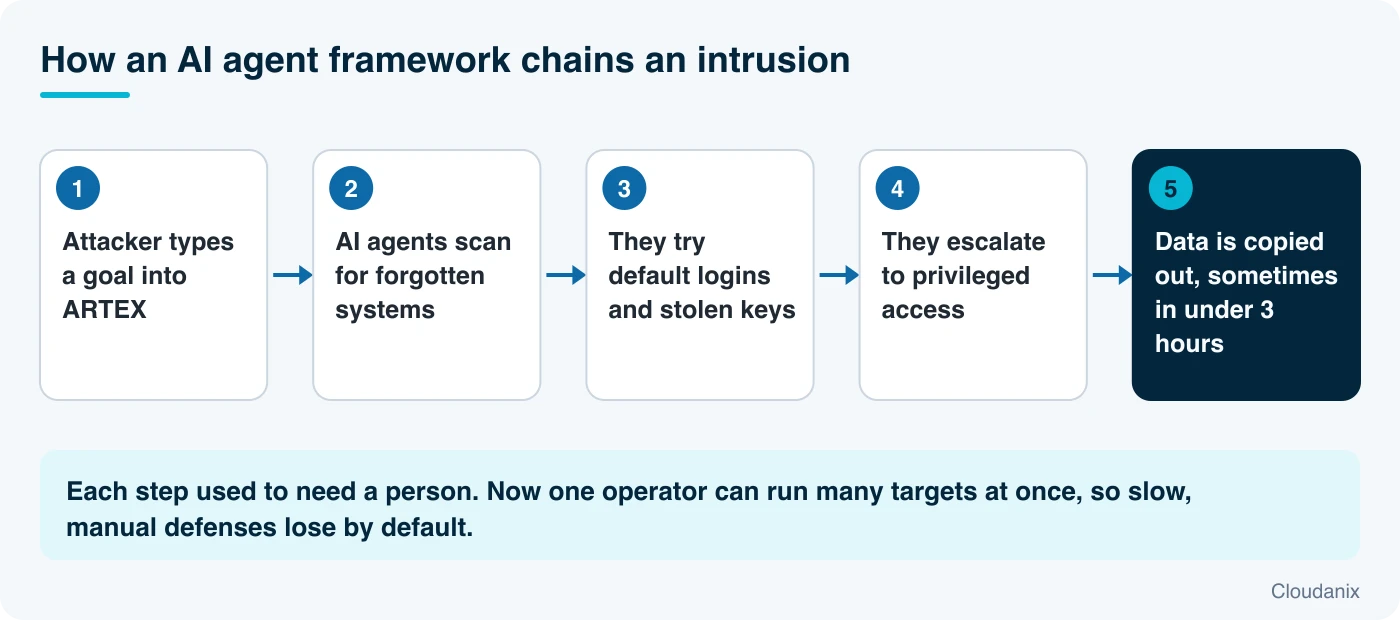
On Friday, November 13, 2026, the FBI released a FLASH advisory about a tool called ARTEX. The advisory says multiple threat actors have used this open-source, AI-driven penetration testing framework since at least August 2026 to attack organizations in finance, government, technology, defense, healthcare and other sectors. Its most important sentence for defenders is about time: the FBI says some intrusions progressed from initial targeting to privileged access in under three hours.
We have written about specific ARTEX campaigns before, including agents scanning GitHub for secrets. This post is about the FBI advisory itself and the question it raises for everyone who runs a cloud environment: if an attacker can move that fast, which of your defenses still work? It explains what ARTEX is, what the FBI reports it has done, why speed changes the math, and a plan that fits teams of different sizes.
Primary sources: BleepingComputer’s report on the FBI advisory is our main source for the advisory’s contents. We could not open the FBI’s 13-page advisory directly, so everything attributed to it is as quoted by BleepingComputer. The follow-on campaign details (ConnectWise, South Korean banks, Vapor Panda) are also as reported there. The recommendations and queries below are our own guidance and should be tested in your environment.
Who Should Read What
- CISOs and security leaders: “Why Speed Changes the Math,” Step 1, and “Key Takeaways.” The decision is about what to automate, because humans alone cannot respond within hours.
- Security engineers and SOC analysts: the whole guide, especially Steps 3 and 5 on detection.
- Cloud and platform engineers: Steps 2, 4 and 6 on exposure and credentials.
- Compliance and risk teams: “What the FBI Reported” and Step 1. Many controls were designed around review cycles measured in weeks.
- MSP and MSSP leaders: the ConnectWise example in “What the FBI Reported,” which shows how one provider’s compromise reaches its customers.
What the FBI Reported
What ARTEX is
ARTEX is an autonomous penetration testing framework written in the Go programming language. A penetration test is an authorized attempt to break into a system in order to find weaknesses. ARTEX does that work with AI agents, which are programs that pursue a goal by deciding on their own what step to take next: scan the target, find a weakness, try to exploit it, raise their access, collect data.
ARTEX does not contain its own AI model. It connects to external large language models (LLMs), which are the text-based AI systems behind tools like chatbots. The FBI lists Anthropic Claude, OpenAI GPT, DeepSeek, GLM, Grok and Kimi as models it can use. The operator types a goal. ARTEX turns it into commands that specialized agents carry out, and it can run against many organizations at the same time.
How it became a criminal tool
According to the advisory as reported, a developer using the name Autumn-27 first published ARTEX on GitHub in July 2026 and removed the repository on October 8, after reports that threat actors were abusing it. Removal did not end its spread. The FBI says it remains available through community forks, archived copies, localized versions and a commercial edition called ARTEX PRO. Researchers had identified more than 1,600 publicly exposed ARTEX control consoles as of early November, and the real number is believed to be higher.
What the FBI says it changes
The advisory makes three claims that matter for defenders:
- Speed. ARTEX “significantly reduces the time required to chain attack techniques.” The under-three-hours figure describes the time from first targeting to privileged access in some intrusions.
- Skill. The framework lets actors with minimal technical expertise run complex, multi-target operations. Capability that used to need a trained team is now available to anyone who can run the tool.
- Where it looks. It is especially effective at finding weaknesses in overlooked systems: partner portals, employee applications, legacy services and third-party integrations. These are the places where an organization is least likely to have current inventory, patching or monitoring.
The FBI also notes that this automated activity can generate large volumes of suspicious traffic that trigger alerts. The problem is that the speed leaves defenders little time to respond before a breach occurs.
Incidents tied to ARTEX
BleepingComputer lists campaigns that the advisory references:
- ConnectWise Cloud Backup (October). Attackers compromised the application identities used by ConnectWise’s cloud backup service, formerly SkyKick Cloud Backup. Those identities held permissions in customers’ Microsoft 365 tenants. Huntress reported at least 162 compromised tenants. Microsoft attributed the campaign to a China-state-aligned actor it tracks as Storm-0940, which used ARTEX to speed up reconnaissance, password spraying and abuse of cloud application permissions. After the compromise, the attackers tried to authenticate against more than 2,250 downstream Microsoft 365 tenants.
- South Korean financial institutions. A Chinese-speaking actor combined ARTEX with Claude Code agents to attack several banks, exposing personal information of about 67,000 people. CrowdStrike found the attacker’s exposed infrastructure, which held ARTEX configuration files and Claude Code session histories.
- South Korean police action. Police arrested seven suspects tied to attacks against more than 90 organizations, with ARTEX reportedly used in most. Authorities said about 8.2 million data records were stolen.
- Vapor Panda. CrowdStrike reported that this Chinese cyberespionage group used ARTEX in automated attacks on more than 200 organizations in 14 countries, compromising at least nine, with AI agents handling reconnaissance, exploitation, web shells and credential theft, and trying other paths when the first failed.
What the FBI recommends
Per BleepingComputer: secure internet-facing applications, restrict access to cloud administration interfaces, review application permissions and authentication logs, rate-limit sensitive APIs, and monitor for bursts of automated requests, suspicious cloud activity, unexpected credential or privilege changes, and large data transfers. Organizations that see suspicious activity can report it to the FBI or its Internet Crime Complaint Center. The advisory includes indicators of compromise (IOCs), such as IP addresses and command-and-control infrastructure, though the FBI warns that those addresses may have changed. A researcher known as MalwareMustDie also released an open-source ARTEX detection pack with rules and a playbook sorted by confidence level.
Why Speed Changes the Math
Most security programs are built on human time. A vulnerability scan runs weekly. A quarterly access review checks who has admin rights. An analyst triages alerts in the order they arrive. A change request waits for approval. None of that is wrong, but each step assumes the attacker also works at human speed.
If an intruder can go from first contact to privileged access in under three hours, then:
- A weekly scan finds the exposed system after the attacker already did. The window between “exposed” and “exploited” is shorter than your review cycle.
- A quarterly access review is too slow to remove the standing permission that the attacker chains into.
- Alert volume works against you. The FBI points out that the activity is noisy. A noisy attacker buried in a noisy queue still wins if nobody looks in time.
- Obscurity stops working. A forgotten partner portal used to be safe because nobody was looking. An agent that scans everything does not forget.
The answer is not to “move faster” in the same way. It is to change what exists at rest, so there is less for a fast attacker to chain: fewer exposed systems, fewer standing privileges, fewer long-lived credentials, and alerts that rank by real risk. And it is to automate the response steps that are safe to automate.
The Response Guide
Step 1: Decide which steps cannot wait for a human
For each of these, ask whether a person has to be involved within the hour:
- Disabling a credential that is being used from a new country
- Revoking an elevated session after its approved window
- Blocking a burst of failed logins against an exposed API
Automate the ones that are low-risk to get wrong, and keep humans for the ones that are not. Write the rules down. A response that is “we will see it in the next review” does not fit a three-hour attack.
Step 2: Find your overlooked internet-facing systems
The FBI says ARTEX is effective against overlooked systems. Build the inventory attackers would build.
# AWS: public IPs attached to network interfaces, by region
for r in $(aws ec2 describe-regions --query 'Regions[].RegionName' --output text); do
  echo "== $r"
  aws ec2 describe-network-interfaces --region $r \
    --query 'NetworkInterfaces[?Association.PublicIp!=`null`].[Association.PublicIp,Description,Attachment.InstanceId]' \
    --output text
done

# AWS: security groups open to the whole internet on any port
aws ec2 describe-security-groups \
  --query "SecurityGroups[?IpPermissions[?IpRanges[?CidrIp=='0.0.0.0/0']]].[GroupId,GroupName]" \
  --output text
Also include things that do not show up as virtual machines: load balancers, API gateways, storage buckets with public policies, partner and vendor portals, old staging environments, and admin consoles for cloud and SaaS tools. For each one, record an owner. Anything without an owner is the first candidate to be shut down.
Step 3: Detect bursts of automated behavior
The advisory recommends watching for bursts of automated requests and unexpected privilege changes. If you send AWS CloudTrail to CloudWatch Logs, this query finds identities with unusual numbers of denied calls, a sign of an automated agent probing for what it is allowed to do:
fields @timestamp, userIdentity.arn, sourceIPAddress, eventName, errorCode
| filter errorCode in ["AccessDenied", "UnauthorizedOperation", "Client.UnauthorizedOperation"]
| stats count() as denied by userIdentity.arn, sourceIPAddress, bin(5m)
| sort denied desc
| limit 50
And this one surfaces privilege changes, which the FBI also names:
fields @timestamp, userIdentity.arn, eventName, requestParameters.userName, sourceIPAddress
| filter eventName in ["AttachUserPolicy", "AttachRolePolicy", "PutUserPolicy", "PutRolePolicy", "CreateAccessKey", "CreateUser", "CreateLoginProfile", "UpdateAssumeRolePolicy"]
| sort @timestamp desc
| limit 100
Alert on these in minutes, not in a daily report. Also collect authentication logs for your identity provider and SaaS administration consoles.
Step 4: Review the permissions given to applications
The ConnectWise incident worked because the attackers took over application identities: the accounts that one product uses to act inside another organization’s tenant. When you approve a third-party application, you give its identity a standing set of permissions that an attacker who compromises the vendor inherits.
- List every third-party application with access to your cloud and productivity tenants.
- For each, record what it can do, who approved it, and whether you still use it.
- Remove what is unused. Reduce what is over-broad.
- Ask vendors how they protect the identities that act in your tenant.
Step 5: Rate-limit and protect the endpoints that matter
Apply rate limits to sign-in, password reset, token and API endpoints, because a framework that tries many paths quickly will lean on them. Require phishing-resistant multi-factor authentication on administrative and remote access. Do not expose cloud administration interfaces to the internet where a private path will do.
Step 6: Remove the credentials that make a three-hour chain possible
Every fast intrusion needs something to chain. The most common links are long-lived access keys, shared passwords, over-broad roles and standing administrator rights.
# AWS: users and keys that have not been used recently (credential report)
aws iam generate-credential-report
aws iam get-credential-report --query Content --output text | base64 -d \
  | cut -d, -f1,4,5,9,11,14,16
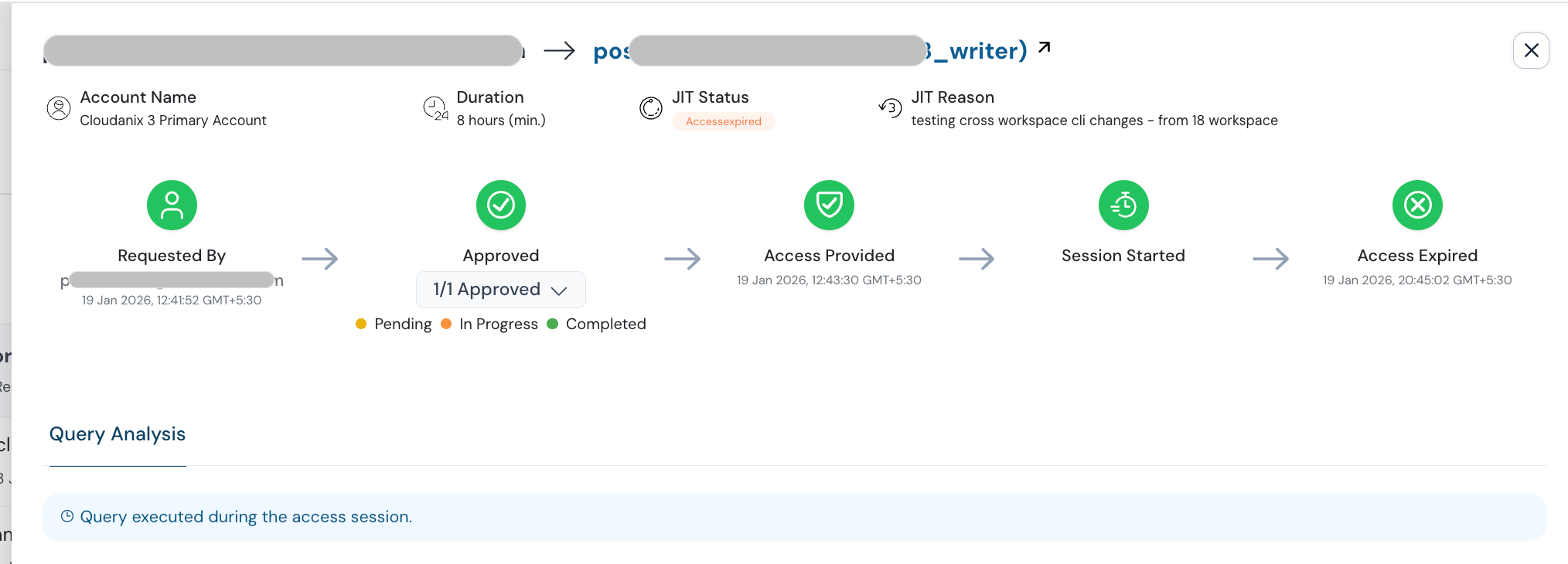
Replace long-lived human keys with federated sign-in. Replace service keys with roles. And make elevated access temporary by default: requested for a reason, approved, valid for a short window, then revoked without anyone remembering to do it. See What is Zero Standing Privilege?. The point is not that a time-boxed grant makes an intrusion impossible. It is that when the attacker reaches the step that needs privilege, there is none sitting there to take.
Step 7: Rank findings by real risk
The advisory warns of a flood of suspicious traffic. Your finding queue has the same problem. A flat list in which an internal test bucket and an internet-facing production database both show “High” hides the one that matters. Rank findings by whether the asset is exposed, what environment it is in, what data it holds and which identities can reach it. This is the idea behind contextual severity.
Where Cloudanix Fits
ARTEX is not a vulnerability you patch, and no single product detects every use of it. The useful question is which links in the chain you can remove or shorten.
Privilege that does not sit at rest. Cloud JIT replaces standing administrator access in AWS, Azure and GCP with a request, approve, time-boxed grant, auto-revoke flow, working through your existing identity provider. Agentic JIT does the same for pipelines and services, and Coding Agent JIT does it for AI coding agents. If a fast intrusion needs elevated rights, those rights exist only inside an approved window. Every grant is logged with the human identity to your own S3 bucket.
Findings ranked by context. CSPM connects to AWS, Azure and GCP without agents, and recomputes severity per asset using exposure, environment, data sensitivity and identity, with the reasoning shown. That gives the exposed production database a different rank from the isolated test bucket, which directly serves Steps 2 and 7. The attack path view shows how an identity or misconfiguration connects to sensitive data. Findings are refreshed on different cadences: cloud activity is surfaced in near real time, while the full compliance posture runs on a roughly 24-hour cycle.
Machine and third-party identities. Non-human identity and CIEM show service accounts, keys, roles and application identities, which are stale, and which are over-permissioned. That covers the inventory work in Step 4 and Step 6.
Behavior that does not match. Cloud UEBA and cloud detection and response look for unusual behavior, such as an identity acting from a new place or at a new pace, which is what Step 3 describes.
What this does not do. Cloudanix does not recognize ARTEX by name or signature. It cannot patch a vendor’s product or un-publish a leaked secret. It does not replace multi-factor authentication, rate limiting or a response process. The claim is narrower: fewer standing privileges and long-lived credentials mean a fast attacker finds less to use, and ranked, correlated findings mean your people look at the right thing first.
Quick Reference Checklist
- Wrote down which response actions must be automated (credential disable, session revoke, API block)
- Built an inventory of internet-facing systems, each with an owner
- Closed or removed overlooked portals, staging systems and legacy services
- Added alerts for bursts of denied calls and for privilege changes
- Reviewed every third-party application identity with access to your tenants
- Applied rate limits to sign-in, token and API endpoints
- Required phishing-resistant MFA for administrative access
- Replaced long-lived keys with roles and federation
- Made elevated access time-boxed by default
- Ranked findings by exposure, environment, data and identity
Key Takeaways
- The FBI says ARTEX, an AI-driven penetration framework, has been used since at least August 2026 and that some intrusions reached privileged access in under three hours.
- It lowers the skill needed to run complex, multi-target attacks, and it is good at finding overlooked systems such as partner portals, legacy services and third-party integrations.
- The framework is still circulating through forks and a commercial edition, so removing the original repository did not stop it.
- Human-speed controls (weekly scans, quarterly reviews, queue-order triage) do not fit a three-hour attack. Reduce what exists at rest and automate safe responses.
- Fewer standing privileges, fewer long-lived credentials and findings ranked by real context limit what a fast attacker can chain.
Want to see which of your internet-facing systems, standing privileges and application identities a fast attacker would find first? Book a session and we will map it with you.
People Also Read
- AI Agents Are Scanning GitHub for Your Secrets, and One Reached Azure Key Vault in Five Minutes
- A Dozen AI Developer Platforms Breached in a Month: Why Your AI Provider Keys Are Now Resale Inventory
- Greeter: How an Abandoned AI Agent Server Becomes a Door to Your Cloud Credentials
- CISA Flags an Ivanti Connect Secure Zero-Day: Why the Fix Is Exposure and Blast Radius
- Cloudanix: Contextual Severity













