
CSPM vs CWPP: What’s the Difference?
CSPM (Cloud Security Posture Management) and CWPP (Cloud Workload Protection Platform) protect different layers of your cloud environment. CSPM secures the infrastructure configuration — the settings, policies, and network rules that define how your cloud is built. CWPP secures the workloads running inside that infrastructure — the containers, VMs, and serverless functions executing your application code.
The simplest way to think about it:
- CSPM answers: “Is my cloud configured securely?”
- CWPP answers: “Are my workloads protected at runtime?”
Both are essential. Neither alone is sufficient. Understanding the boundary between them helps security teams avoid blind spots and avoid paying for overlapping capabilities they do not need.
What is CSPM?
Cloud Security Posture Management continuously monitors your cloud accounts for misconfigurations, compliance violations, and security risks at the infrastructure layer.
What CSPM Protects:
- Cloud account configurations (IAM policies, security groups, network ACLs)
- Storage bucket permissions (S3, Azure Blob, GCS)
- Encryption settings on databases and volumes
- Network topology and public exposure
- Compliance posture against frameworks (SOC 2, ISO 27001, HIPAA, PCI-DSS, CIS)
- Configuration drift from secure baselines
How CSPM Works:
CSPM connects to cloud provider APIs (read-only) and continuously scans resource configurations against security rules. When a resource violates a rule — for example, an S3 bucket is publicly accessible or an IAM role has admin permissions — CSPM flags the finding, prioritises it by risk, and provides remediation guidance.
CSPM Operates At:
The control plane level. It reads the configuration state of your cloud infrastructure through management APIs. It does not inspect traffic, monitor runtime processes, or detect threats executing inside workloads.
What is CWPP?
Cloud Workload Protection Platform secures the compute workloads running in your cloud — virtual machines, containers, Kubernetes pods, and serverless functions — at runtime.
What CWPP Protects:
- Running containers and container images (vulnerability scanning, runtime detection)
- Virtual machines (malware detection, file integrity monitoring)
- Kubernetes clusters (runtime policy enforcement, pod security)
- Serverless functions (execution monitoring, dependency analysis)
- Application runtime behaviour (process anomaly detection, network activity)
How CWPP Works:
CWPP typically operates through:
- Agent-based telemetry — A lightweight agent on the workload captures system calls, process execution, file changes, and network connections in real time.
- Agentless scanning — Snapshot-based analysis of workload images and filesystems without deploying an agent.
- Runtime policies — Rules that define expected behaviour and alert or block deviations (e.g., unexpected process execution in a container, connection to a known malicious IP).
CWPP Operates At:
The data plane level. It monitors what happens inside compute resources during execution — processes, file access, network connections, and system behaviour.
Side-by-Side Comparison
| Dimension | CSPM | CWPP |
|---|---|---|
| What it protects | Infrastructure configuration | Workloads (containers, VMs, serverless) |
| Layer | Control plane (management APIs) | Data plane (runtime telemetry) |
| Primary threats | Misconfigurations, compliance drift, public exposure | Malware, cryptominers, lateral movement, runtime exploits |
| Detection method | Configuration scanning against rules | Runtime behaviour analysis, anomaly detection |
| Deployment | API-based, agentless | Agent on workloads (or agentless snapshot scanning) |
| Example finding | “S3 bucket is publicly readable” | “Unexpected process xmrig running in container” |
| Time dimension | Point-in-time configuration state | Continuous runtime monitoring |
| Remediation | Fix the configuration (change the setting) | Kill the process, isolate the workload, patch the vulnerability |
| Compliance role | Maps infrastructure to compliance frameworks | Provides runtime evidence of workload protection controls |
When Do You Need CSPM?
CSPM is essential when your organisation:
- Runs cloud infrastructure on AWS, Azure, GCP, or OCI — regardless of workload type
- Has compliance requirements that mandate continuous posture monitoring (SOC 2, HIPAA, ISO 27001, PCI-DSS)
- Operates multiple cloud accounts where configuration consistency is a challenge
- Has experienced misconfiguration incidents — public buckets, exposed databases, overly permissive IAM
- Needs visibility into the full inventory of cloud resources and their security posture
- Cannot manually audit configurations at the speed of cloud deployments
CSPM is the baseline. Every organisation using public cloud should have posture monitoring in place.
When Do You Need CWPP?
CWPP becomes essential when your organisation:
- Runs containers or Kubernetes — especially in production, where runtime threats are a material concern
- Deploys VMs that execute untrusted code, process sensitive data, or face internet exposure
- Needs runtime threat detection — catching cryptominers, reverse shells, or lateral movement attempts
- Has compliance requirements that mandate workload-level protection (PCI-DSS runtime monitoring, HIPAA workload encryption)
- Operates in environments where the misconfiguration is not the entry point — the vulnerability in the running application is
- Wants to detect zero-day exploits or behavioural anomalies that configuration scanning cannot identify
The Relationship: How CSPM and CWPP Work Together
CSPM and CWPP are complementary, not competing. Here is how they interact in a real-world scenario:
Example Scenario: Compromised Container
- CSPM detects that a security group allows inbound traffic from
0.0.0.0/0on port 8080. - A developer deployed a container with a known vulnerability (CVE in an open-source library).
- An attacker exploits the vulnerability through the open port.
- CWPP detects anomalous process execution inside the container — a reverse shell spawning.
- CWPP alerts the security team and can automatically kill the malicious process.
Without CSPM, the misconfiguration would have gone undetected. Without CWPP, the runtime compromise would have been invisible until data was exfiltrated.
The Coverage Gap Without Both:
| If You Have Only CSPM | If You Have Only CWPP |
|---|---|
| You catch the open port but not the exploitation | You catch the exploitation but not the root-cause misconfiguration |
| You know configurations are wrong but cannot detect active threats | You detect threats but cannot prevent them at the infrastructure layer |
| You have compliance evidence for configuration but not workload protection | You have runtime evidence but cannot demonstrate posture compliance |
CSPM vs CWPP vs CNAPP: Where Does CNAPP Fit?
CNAPP (Cloud-Native Application Protection Platform) unifies CSPM, CWPP, and additional capabilities (CIEM, Code Security, KSPM) into a single platform.
The market is converging toward CNAPP because:
- Separate CSPM and CWPP tools create correlation gaps — a misconfiguration finding in one tool and a runtime alert in another require manual investigation to connect them.
- Unified platforms correlate configuration state with workload behaviour — showing that the publicly exposed resource with the runtime threat is a higher-priority incident than either finding alone.
- Fewer tools means lower operational overhead for small security teams.
For most organisations in 2026, the practical recommendation is: Evaluate CNAPP platforms that include both CSPM and CWPP as integrated capabilities, rather than buying them separately. The correlation between infrastructure configuration and workload runtime is where security value compounds.
Making the Choice: Practical Decision Framework
Start with CSPM if:
- You are early in cloud security maturity
- Your immediate pain is compliance posture and misconfiguration visibility
- You run primarily managed services (RDS, Lambda, S3) with limited custom workloads
- You have budget constraints and need to prioritise one capability
Add CWPP when:
- You run containers, Kubernetes, or custom VMs in production
- Runtime threat detection is a compliance requirement
- You have experienced or are concerned about workload-level attacks
- Your workloads process sensitive data with regulatory obligations
Start with CNAPP if:
- You need both posture and workload protection from day one
- You want to avoid integrating separate tools later
- Your security requirements span configuration, identity, workload, and code
- You are consolidating existing point tools into a single platform
How Cloudanix Covers Both CSPM and CWPP
Cloudanix provides both CSPM and CWPP as integrated capabilities within a unified CNAPP+ platform:
CSPM coverage:
- 1,000+ misconfiguration checks across AWS, Azure, GCP, OCI, and Kubernetes
- 15+ compliance frameworks continuously assessed
- Contextual severity scoring by exposure, blast radius, and identity relationships
- Configuration drift detection with adaptive notifications
CWPP coverage:
- Container image scanning for vulnerabilities and misconfigurations
- Kubernetes security posture management (KSPM)
- Runtime threat detection for containers and VMs
- File integrity monitoring and anomaly detection
The unified value: A single asset graph correlates a misconfiguration (CSPM), the workload it exposes (CWPP), the identity that can access it (CIEM), and the attack path connecting them. One investigation, not three tools.
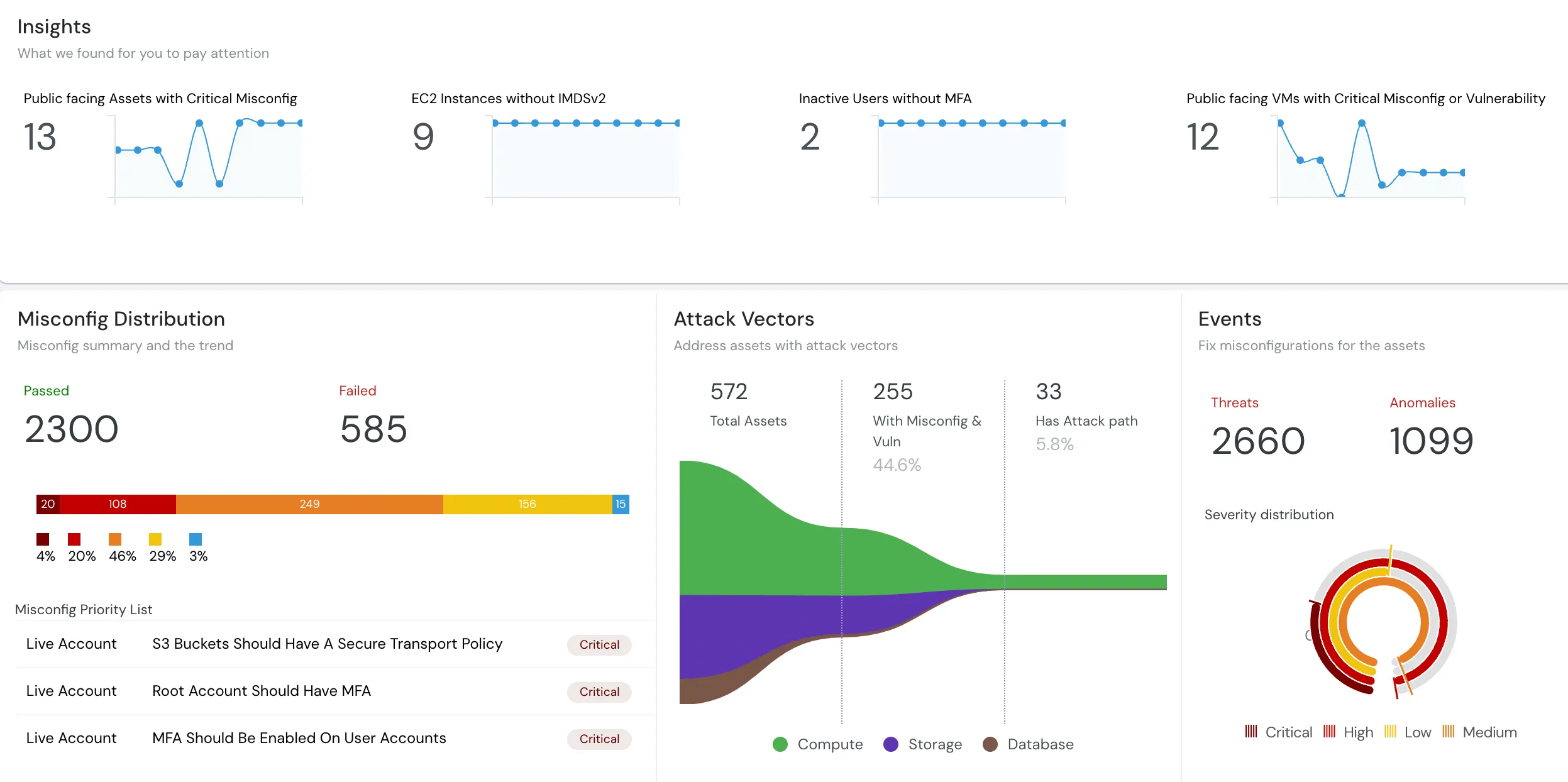
See your cloud security posture in 30 minutes. Connect your cloud accounts — agentless, read-only. First findings the same day. Book a free assessment →
Additional Resources
- What is CSPM? Cloud Security Posture Management Explained
- What is CWPP? Cloud Workload Protection Explained
- Best CSPM Tools in 2026: Platforms Compared
- CNAPP vs CSPM: Which Do You Need?
- CSPM vs DSPM: Key Differences
- Beyond Traditional CSPM: Container Security and Real-time Visibility
- Best Container Security Tools in 2026
- Cloudanix CSPM Platform
- Cloudanix CWPP Platform