

Cloudanix Joins AWS ISV Accelerate Program

Cloudanix – Your Partner in Cloud Security Excellence

Preparing EC2 Workloads for a Kubernetes Migration: A Security Readiness Guide

  • Abhiram Shindikar Abhiram Shindikar
  • Thursday, Sep 10, 2026

Moving workloads from EC2 to Kubernetes is one of the most common infrastructure transitions teams make. The operational and scaling benefits are well understood. The security implications are less often discussed, and they are significant, because Kubernetes does not just change where your workloads run. It changes what your attack surface is made of.

If you are planning a migration from EC2 to a Kubernetes platform such as EKS, this guide walks through the security surfaces that change and what to have in place before you cut over. It draws on how one team went about securing EC2 workloads through a Kubernetes migration in healthcare, where the transition window was the highest-risk period. The goal is to migrate without opening a coverage gap during the transition, which is exactly when many teams are most exposed.

Why the Security Surface Changes

On EC2, your security model is built around instances, security groups, IAM roles, and the network. It is a relatively flat model: a workload is an instance, and you reason about the instance.

Kubernetes introduces an entire orchestration layer on top of that, which is why Kubernetes security is treated as its own discipline. Now you also have pods, deployments, service accounts, role-based access control (RBAC), network policies, namespaces, and admission control. Each of these is a new configuration surface with its own failure modes. Securing your EC2 instances well does not automatically secure any of these, because none of them existed in the EC2 model. This is the core reason a migration is a security event, not just an operational one.

The Readiness Checklist

1. Establish Your EC2 Baseline First

Before you migrate, know where you stand. Have a clear picture of your current posture on EC2, misconfigurations, exposed instances, over-permissioned roles, so you are migrating from a known state rather than carrying unknown problems into a more complex environment. Migrating unresolved issues does not fix them; it relocates them into a system that is harder to reason about.

2. Plan RBAC From the Start

Kubernetes RBAC is powerful and easy to get wrong. Overly broad ClusterRole bindings, default service accounts with more access than they need, and wildcard permissions are common early mistakes. Decide your RBAC model before you migrate, principle of least privilege applied to every service account and role, rather than granting broad access to “get things working” and intending to tighten later. Later rarely comes. Pairing RBAC with Kubernetes JIT keeps engineer access time-bound from day one — the approach behind eliminating standing Kubernetes privileges with JIT access for EKS cluster RBAC.

3. Design Network Policies Deliberately

By default, pods in a Kubernetes cluster can talk to each other freely. That flat internal network is convenient and dangerous, it means a single compromised pod can reach everything else. Plan network policies that restrict pod-to-pod communication to what is actually required, so a compromise in one workload does not automatically become lateral movement across the cluster.

4. Map Identity: IRSA and Service Accounts

On EC2, workloads assume IAM roles via instance profiles. On EKS, the mapping between Kubernetes service accounts and AWS IAM roles (IRSA) is a new identity surface. Misconfigured, it can grant pods far more cloud access than intended. Plan how pod identities map to cloud permissions, and apply the same least-privilege discipline you would to any IAM role.

5. Address Image Provenance and Vulnerabilities

Containers run images, and images come from somewhere. Pulling from public registries without scanning, without digest pinning, and without knowing the provenance of what you run introduces supply-chain risk that plain EC2 did not have in the same form. Establish where your images come from, scan them for vulnerabilities, and pin to digests so you are running what you think you are running.

6. Harden Pod Configuration

Kubernetes lets pods request capabilities that are dangerous by default, privileged mode, host networking, host path mounts, running as root, writable root filesystems. Each expands the blast radius of a compromised container, potentially toward the host. Define pod security standards that disallow these unless explicitly justified, and enforce them through admission control rather than hoping every manifest gets them right.

7. Don’t Lose Runtime Protection at the Cutover

If you have runtime protection on your EC2 workloads, plan how Kubernetes runtime security moves with them rather than treating it as something to figure out after the migration. A unified container security view that spans both the old and new environments makes that continuity far easier to maintain. The transition window, workloads moving, clusters spinning up, the team learning a new platform, is precisely when runtime visibility matters most.
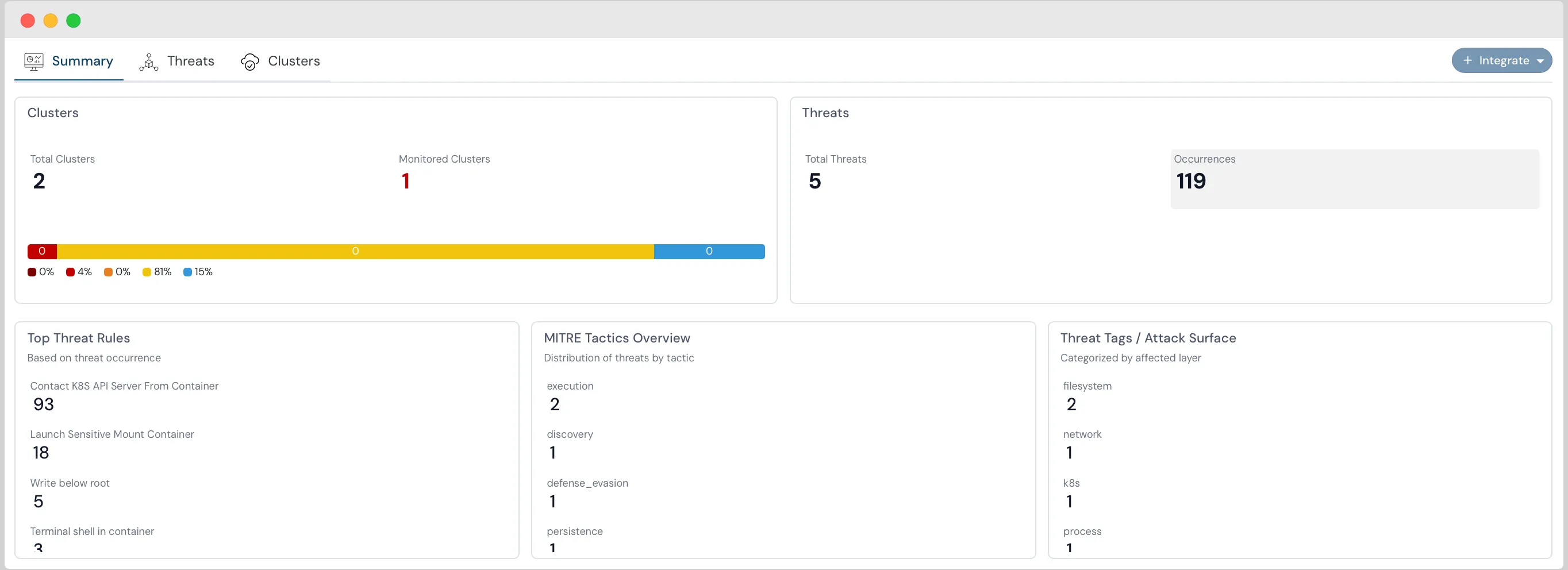
Cloudanix — Container security dashboard across Kubernetes and Docker workloads Losing it at the cutover means running in your least-familiar environment with your protection turned off.

8. Extend, Don’t Restart, Your Attack-Path View

On EC2, an attack path runs through instances, security groups, and IAM roles. On Kubernetes it also runs through pods, RBAC bindings, and service accounts. If you reason about attack paths today, make sure that reasoning extends to the new resource types, otherwise you lose visibility into how a compromise could chain through the cluster exactly when the environment becomes more complex.

Avoiding the Coverage Gap

The recurring theme across this checklist is continuity. The riskiest part of a migration is not the destination; it is the transition, the period when workloads are in motion and the team is rebuilding operational muscle for a new platform. Teams that plan security as an integral part of the migration, rather than a follow-up project, avoid the window where controls are half-configured and the environment is half-migrated.

Practically, that means favouring approaches where your existing security model extends to Kubernetes rather than being rebuilt for it. Whether that is your posture management, your identity analysis, or your runtime protection, the less you have to reinvent at the migration, the smaller your exposure window during it.

The Bottom Line

Migrating from EC2 to Kubernetes is not a lift-and-shift from a security standpoint. It adds pods, RBAC, service accounts, network policies, image provenance and scanning, and admission control to your attack surface, none of which your EC2 controls address on their own. Establish your baseline first, plan the new surfaces deliberately, and make sure posture, identity, runtime, and attack-path coverage extend through the transition rather than restarting after it. Migrate with security continuous, not with security resumed.


People Also Read

What Our Users Are Saying

Customer Reviews

Cloudanix is trusted by security leaders worldwide to deliver proactive, reliable, and cutting-edge cloud security.

One day, I changed the password of a root account, and my CTO called me within less than a minute to confirm if I did so. I was not expecting a reaction this quick. He told me Cloudanix alerted him of this password change and that he wanted to confirm as it was a critical security notification. I couldn't believe it!

Ritesh Agarwal
Ritesh Agarwal
CEO, Airgap Networks

Compliance is one way of staying secure, but what I want is the ability to go deeper and attain 'true security.' Cloudanix provides us the capability to do so.

Vishal Madan
Vishal Madan
Head of Engineering, iMocha

Cloudanix is building for the future of the cloud, which makes the product all the more desirable.

Ritesh Agarwal
Ritesh Agarwal
CEO, Airgap Networks

Cloudanix gave us the visibility we were missing. Being able to move from permanent access to a robust Just-In-Time (JIT) workflow has fundamentally changed our security posture without slowing down our engineering velocity.

Pavan Kumar Lekkala
Pavan Kumar Lekkala
SRE Lead, HugoHub

We are excited to leverage Cloudanix's comprehensive multi-cloud DevSecOps solution to secure our production workloads on AWS. Cloudanix has demonstrated that it can solve many challenges that DevSecOps teams face while continually adding new features such as SOC2 compliance and drift detection.

Satish Mohan
Satish Mohan
Co-founder & CTO, Airgap Networks

Managing third-party partner access was once a major concern for our security posture. With Cloudanix JIT Cloud, we've effectively achieved zero third-party risk. We can now grant access confidently, knowing that it is temporary, audited, and automatically revoked, resulting in a 100% reduction in our privileged access exposure.

Okesh Badhiye
Okesh Badhiye
Head of Technical Engineering, Finfinity

The snooze feature and responsible alerts have helped us save time and prioritize what to tackle first.

Satish Mohan
Satish Mohan
Co-founder & CTO, Airgap Networks

Implementing Cloudanix JIT internally allowed us to practice what we preach. By eliminating permanent access to our own clouds and databases, we've neutralized the risk of standing privileges, ensuring our own 'keys to the kingdom' are never left exposed.

Girish Manghnani
Girish Manghnani
Managing Partner, Tech Inspira

The problem with permissions is a lot of times, the gaps are left open due to oversights from inside the organization itself. With Cloudanix's CIEM, we get a complete view of user permissions and access. This enables us to update the permissions, reducing the attack surface.

Nilesh Pethani
Nilesh Pethani
Application Architect, iMocha

In the world of Fintech, trust is our currency. Cloudanix provided the frictionless visibility we needed to secure our EKS workloads across AWS, ensuring we stay audit-ready for SOC2 and GDPR without slowing down our engineering velocity.

Amol Naik
Amol Naik
Head of Security & Infrastructure, HugoHub

Cloudanix delivered value within 5 minutes of onboarding. Continuous monitoring, timely detection, and excellent documentation helped us attain a great cloud security posture.

Divyanshu Shukla
Senior DevSecOps, Meesho

Technology strategies and business strategies are in a state of constant change which includes centralization and decentralization of responsibilities. Regardless of strategic shift, we still have intellectual property to protect. Cloudanix are critical partners for us in our public cloud security posture across our three cloud providers.

Jerry Locke
Jerry Locke
Senior Director Global Solutions Engineering, Eversana

Cloudanix has been amazing. They opened up a common Slack channel with us — and it feels like we are talking to our own team and getting things done with Cloud security. The support team is always available, friendly, helpful, and ready to go out of their way.

Satish Mohan
Satish Mohan
CTO, Airgap Networks

Beyond just access management, Cloudanix CSPM has given us a unified view of our AWS environment. The real-time alerting and anomaly detection allow us to prevent any untoward activity before it happens, which is critical for a marketplace connecting 50+ financial institutions.

Okesh Badhiye
Okesh Badhiye
Head of Technical Engineering, Finfinity

For a Fintech company, data is our most valuable — and most sensitive — asset. Cloudanix DAM hasn't just improved our visibility; it has given us control. The ability to mask data and prevent unauthorized queries in real-time is a game-changer for our compliance and customer trust.

Jiten Gala
Jiten Gala
President Engineering and Product, Kapittx

Our clients, especially in the Middle East financial sector, demand absolute accountability. Cloudanix JIT Cloud has been a competitive differentiator for us, allowing us to provide secure, governed access to customer accounts that meet their strictest audit and compliance requirements.

Girish Manghnani
Girish Manghnani
Managing Partner, Tech Inspira

Cloudanix is always on my team's lips because of its exceptional support. Be it a small or big query, Cloudanix has gone above and beyond to resolve them. This one's a keeper for us.

Sujit Karpe
Sujit Karpe
CTO, iMocha

For a long-lasting partnership, great support goes a long way. Cloudanix has delivered exceptional support whenever required. Their edge is their team is always ready to go beyond to solve any issues that we have. This speaks volumes about the culture at Cloudanix.

Akash Maheshwari
Akash Maheshwari
Co-founder, MoveInSync

Beyond the technology, Cloudanix feels like an extension of our own team. Their willingness to stand up a dedicated Middle East tenant for us and provide exceptional support at a sensible price makes them a long-term partner for Hugosave.

Surya Tamada
Surya Tamada
CTO, HugoHub

The real-time notifications that Cloudanix provides are a real lifesaver. Their adaptive notifications ensure that my team stays productive and doesn't get interrupted all the time.

Digvijay Singh
Staff Security Engineer, Meesho

The whole point in technological evolution is to help improve the world we live in. We must protect that and to do so requires an effective and efficient security strategy. The Cloudanix team helped make our public cloud security posture management strategy a reality. The symbiotic relationship we have allows for a continuous feedback loop which is how business should operate.

Larry Wheat
Larry Wheat
Staff Solutions Engineer, Eversana

Ready to see your graph?

Connect a cloud account in under 30 minutes. See every finding rooted in identity, asset, and blast radius — with a fix path attached.

Book a Demo