

On Monday, November 23, 2026, CrowdStrike announced it had agreed to acquire Zscaler in an all-stock transaction valued at about $43.9 billion. Bloomberg had reported on November 20 that the companies were in talks. According to SecurityWeek, the deal would combine one of the largest endpoint security providers with a pioneer in cloud-delivered zero-trust access, and CrowdStrike expects the combined company to have more than $10 billion in annual recurring revenue. It is one of the largest deals ever struck in cybersecurity.
Headlines about deals like this tend to leave security buyers with one question: what do I do? If you are a CISO, security lead or head of platform at a mid-sized company, the honest answer is that nothing changes on your systems this week, and a lot changes in the conversations you will have over the next two years. This post explains what was announced in plain terms, what it does and does not mean for cloud security buyers, and gives a practical way to decide when to consolidate and when not to. We offer a vendor-neutral method first, then say where Cloudanix fits and where it does not.
Primary source: SecurityWeek’s report of the announcement. The deal has been approved by both boards but is not complete. It still needs to close, which the report says is expected in the second half of CrowdStrike’s fiscal 2028. Statements about product plans are the companies’ intentions, not shipped products. Comparison claims about Cloudanix and CrowdStrike come from our comparison page, which marks what each vendor publicly ships today. We do not sell network security, so we do not compare ourselves with Zscaler’s products.
Who Should Read What
- CISOs and security leaders: “What Was Announced,” “What It Means for Buyers” and Steps 1 to 4.
- Heads of IT, procurement and finance: Steps 2, 3 and 6, on contracts, renewals and negotiating position.
- Cloud, platform and security engineers: Steps 1, 4 and 5, which are about gaps and proof.
- Managed service providers: “What It Means for Buyers.” Your customers will ask about this.
- Founders and CTOs at smaller companies: the section on mid-market realities.
What Was Announced
The deal. CrowdStrike will acquire Zscaler for about $43.9 billion in stock. Zscaler shareholders would receive 1.135 CrowdStrike shares for each Zscaler share, which valued Zscaler at about $260.41 per share, a premium of roughly 34% based on the prior Friday’s closing prices. After the deal, CrowdStrike shareholders would own about 84.1% of the combined company. Both boards approved it unanimously. Zscaler’s founder and CEO, Jay Chaudhry, is expected to continue leading the Zscaler business and join CrowdStrike’s board.
What each company is known for. CrowdStrike began with endpoint security, meaning software on laptops and servers that detects attacks, and has extended into cloud security, identity and security operations. Zscaler is known for cloud-delivered zero-trust access, a way of connecting users to applications through its network so that being on the corporate network no longer grants trust. It has also expanded through acquisitions in recent years, for example SPLX (tools to find, test and protect AI models and agents), Red Canary (managed detection and response), SquareX (a browser extension for enforcing security policy on unmanaged devices) and Avalor (security data and risk prioritization).
The stated plan. CrowdStrike said the two companies already share more than 2,000 customers and have 16 product integrations, and that in September they announced plans to extend their partnership so CrowdStrike’s platform could assess user risk and share it with Zscaler’s access controls. After the deal closes, CrowdStrike plans to bring the products together on a single platform with a common data layer and a single customer contract. It projects about $1 billion in additional annualized revenue within 30 months, partly from selling more products to existing customers.
The market effect. The report says the deal would place CrowdStrike in more direct competition with broad platform providers such as Palo Alto Networks. In plain terms, the largest security vendors are racing to be the one platform that a customer’s security spending consolidates onto.
The timeline. Closing is expected in the second half of CrowdStrike’s fiscal 2028, which on CrowdStrike’s calendar is roughly the second half of 2027 into early 2028. Until then the two companies remain separate, with separate contracts, products and roadmaps.
What It Means for Buyers
Consolidation is real, and so are its limits
Many security teams are tired of running a separate tool for each problem. A single platform with one data layer and one contract is attractive, especially for teams that already use both vendors. The two companies’ 2,000 shared customers are the most obvious beneficiaries. But the benefits arrive only when the products are truly integrated, and integration of acquired products usually takes longer than announcements suggest.
A bigger platform is not automatically a better fit
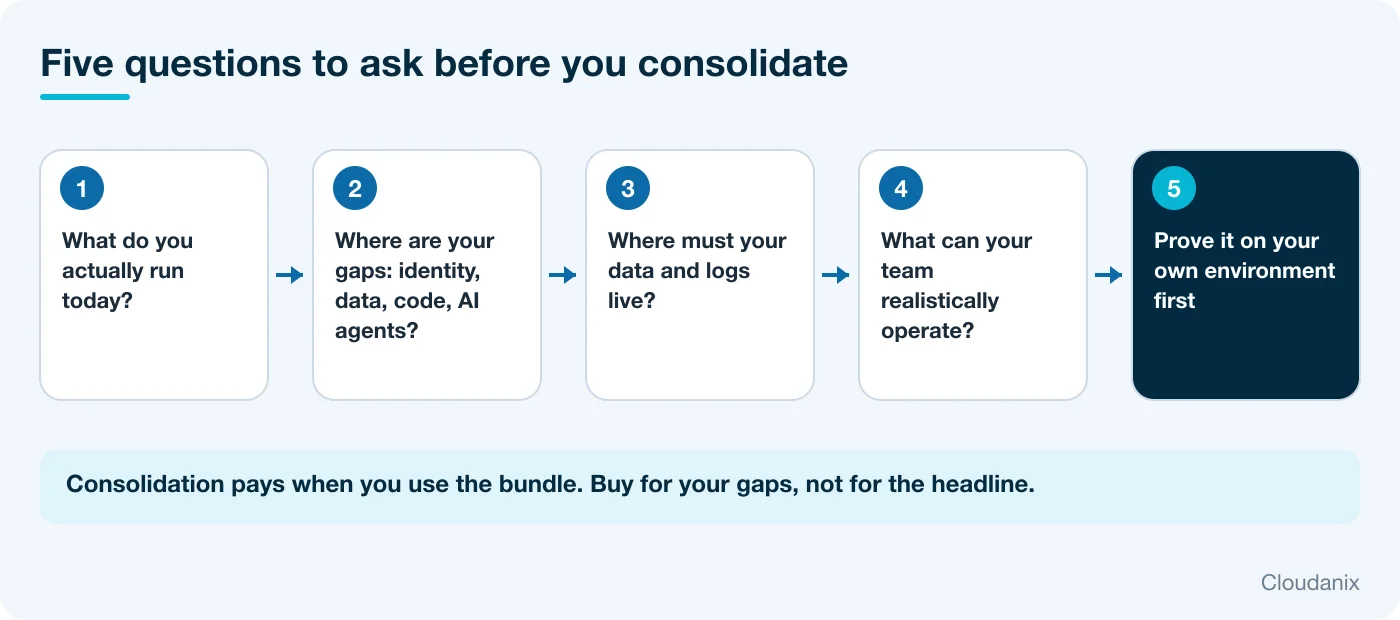
Consolidation pays off when you actually use most of the bundle. If you do not run the vendor’s endpoint product, or you already have a network access solution you are happy with, a larger bundle may mean paying for capabilities you will not deploy. Our comparison page puts it this way for CrowdStrike: its unified agent and console approach is strong for companies that are already Falcon shops, and less compelling for companies that are not.
The gaps do not go away because the logo gets bigger
A platform that is strong at endpoint and network access still has to be asked about the places where cloud incidents actually start. In recent weeks those have been identity and credentials, databases, build pipelines and AI coding agents, for example a poisoned Python package that stole cloud tokens, a key a vendor never retired and stolen prompts from AI providers. Ask any vendor, large or small, how it covers each of these.
Your negotiating position may change
When vendors merge, the combined company often wants to move customers onto a single, larger contract. That can bring discounts, and it can bring price increases, bundled products you did not ask for, and pressure to renew early. Know your renewal dates and your alternatives before the conversation starts.
Product roadmaps will shift
Companies that merge decide which overlapping products to keep. Customers of a product that overlaps with a stronger one sometimes find its development slows. If a tool you rely on is a candidate, you need a plan.
Regional and sovereignty questions get bigger
Larger platforms usually centralize. If you must keep data in a specific country or inside your own cloud account, as many Indian, European and Middle Eastern organizations do, ask where the combined platform will store and process your data, and get the answer in writing.
The Buyer’s Guide
This guide is deliberately vendor-neutral. You can use it whether you stay with your current vendors, consolidate onto a larger platform, or choose a smaller specialist.
Step 1: Write down what you actually run and what it costs
Make a one-page table with every security tool you pay for, what it covers, who uses it, when it renews and what it costs. Include the shelfware: tools bought and barely used. You cannot judge a consolidation offer without knowing your current baseline. Most teams are surprised by how many overlapping tools they have, and how many renewals fall within the next 12 months.
Step 2: Map your gaps, not your logos
For each area below, mark whether you have solid coverage, partial coverage or none:
- Cloud posture (misconfigurations across your cloud accounts)
- Identity and access (who can do what, and how long that access lasts)
- Workloads and containers (runtime, vulnerabilities)
- Code and software supply chain (dependencies, secrets, build pipelines)
- Data and databases (who queries personal data, what they see)
- AI coding agents and AI services (what they can read, send and access)
- Network and endpoint (where large vendors are typically strongest)
- Detection and response (who watches, who acts, how fast)
Consolidate where you have overlap and shelfware. Buy where you have genuine gaps. Do not let a bundle that is strongest where you are already covered stand in for the gaps.
Step 3: Ask vendors the questions that expose lock-in
Whoever you talk to, put these in writing:
- Data export. Can I export all my findings, configurations, logs and history in an open format, at any time, without extra fees?
- Termination. What happens to my contract if you are acquired, or if a product I rely on is discontinued, merged or end-of-lifed? Can I leave without penalty?
- Price protection. What is the cap on renewal increases, and what is included in the price I am quoted?
- Roadmap commitments. Which promised integrations are shipping today, and which are plans? Ask for dates, and for what happens if they slip.
- Data location. Where will my data be stored and processed, can I choose, and does a merger change that?
- Support. Who answers my questions, how fast, and through what channel?
Step 4: Test on your own environment
A demo shows what a product can do in its best case. A proof of value on your environment shows what it does for you. Define success before you start, using measures you can count:
- Time to first useful finding after connecting your cloud accounts
- Noise: how many findings need action, versus how many are just present
- Accuracy: a sample of findings checked by an engineer, with the percentage that were real
- Coverage: how many of your accounts, clusters, repositories and databases were covered
- Fix path: does each finding come with steps your engineers can follow
- Fit with your tools: Slack or Teams, Jira, your identity provider and your CI/CD
Use the same scorecard for each vendor, including the incumbent. You can use a simple weighted table:
| Criterion | Weight | Vendor A | Vendor B | Vendor C |
|---|---|---|---|---|
| Covers my top three gaps | 30% | |||
| Time to first finding | 15% | |||
| Signal-to-noise on my data | 15% | |||
| Fix guidance quality | 10% | |||
| Data location and control | 10% | |||
| Support model | 10% | |||
| Total cost over 3 years | 10% |
Step 5: Do not give up controls you have just because a platform promises them later
If a vendor says a future integration will replace three of your tools, keep those tools until it ships and you have tested it. Plan any migration in stages, with one function moving at a time and a rollback path.
Step 6: Plan your renewal calendar and your leverage
List renewals for the next 24 months. For each, decide: renew, replace, or consolidate. Start conversations six months ahead. Competition between vendors, including from smaller specialists, is your best source of leverage, and mergers tend to create more of it, not less, because some customers will want options.
Step 7: Do not let the news set your agenda
The best response to a large acquisition is usually to finish the work you were already planning: close your identity gaps, reduce standing access, secure your pipelines and databases, and test your incident response. Deals close slowly. Breaches do not.
Where Cloudanix Fits, and Where It Does Not
What Cloudanix is. Cloudanix is a CNAPP+ platform. It covers cloud posture, identity, code, workloads and data in one graph, plus the additions listed below. It is agentless for most functions and typically connects in about 30 minutes, with a lightweight agent only where runtime telemetry needs it.
What it is not. Cloudanix does not sell endpoint protection or network security products. We do not replace a company’s endpoint tool, and we do not compete with Zscaler’s network access products. If you are choosing between those, this post’s general guide applies, and we are not the right vendor for that decision.
Where we are different, per our comparison page. The page, which marks what each vendor publicly ships today, compares Cloudanix with CrowdStrike Falcon Cloud Security. Highlights:
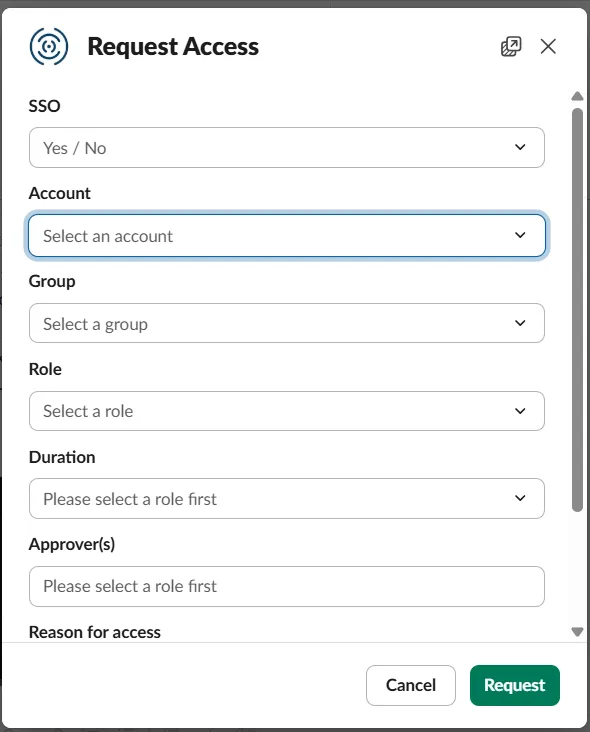
- Access that expires. A just-in-time access broker for humans, service accounts, CI/CD pipelines and AI agents, with Cloud JIT, Database JIT and Agentic JIT. The page lists a JIT broker as something Falcon does not ship today, while Falcon offers permission analysis (CIEM).
- Database access and DAM. DAM adds query-level guardrails, masking and audit inside the customer’s own cloud, on top of Database JIT.
- AI coding agents. Coding Agent JIT and Coding Agent Guardrail broker credentials to agents and block secrets and personal data before they reach a model.
- Regional and in-account deployment. Separate regional deployments in the US, EU, India and the Middle East, plus CloudPrem, which runs inside your own cloud account. Compliance mappings include DPDPA, RBI and IRDAI.
- Code to cloud on one graph. Code Security covers SAST, SCA, secrets, IaC and container images, correlated with what runs in the cloud, when the layers are connected.
- Published pricing. Pricing is on our pricing page.
Where CrowdStrike is stronger, per the same page. If you already run Falcon for endpoint, the unified agent and console can be genuinely valuable. CrowdStrike has a mature managed security service ecosystem (Falcon Complete, OverWatch) and a strong analyst position. Companies that are US-centric, already on Falcon and not yet shipping AI coding agents are the best fit for it. Read the full Cloudanix vs CrowdStrike comparison, and the overview of all comparisons, and judge for yourself.
How to use us in this conversation. If your gaps are identity, databases, pipelines, AI agents and data location, ask us for a proof of value on your own cloud accounts. You can measure it with the scorecard above. If your gap is endpoint or network access, use a different shortlist.
What we cannot promise. We cannot tell you how a combined CrowdStrike and Zscaler will integrate or price its products, since those decisions have not been made. We are an independent vendor, which means our roadmap is our own, and also that we are smaller than the vendors in this story. We believe buyers should test that trade-off, not take it on trust.
Quick Reference Checklist
- Wrote a one-page table of every security tool, cost, owner and renewal date
- Marked each security area as strong, partial or missing, focusing on gaps and not logos
- Listed renewals for the next 24 months and decided renew, replace or consolidate
- Asked every vendor in writing about export, termination on change of control, price caps, roadmap dates and data location
- Defined success measures before any proof of value
- Ran the same proof of value on your own environment for each shortlisted vendor
- Kept existing controls until promised integrations are shipped and tested
- Continued work on identity, standing access, pipelines, databases and incident response regardless of the news
Key Takeaways
- CrowdStrike agreed on November 23, 2026 to buy Zscaler for about $43.9 billion in stock. The deal is expected to close in the second half of CrowdStrike’s fiscal 2028, and nothing changes in your contracts until then.
- The companies plan one platform, one data layer and one contract. That is an intention, and integration takes time.
- Consolidation pays off when you use most of the bundle. Buy for your gaps, not for the logo.
- Put export, termination, price and data-location terms in writing, and test every vendor on your own environment with the same scorecard.
- Keep doing the basics: remove standing access, secure pipelines and databases, and rehearse incident response.
Want a measured proof of value for identity, database, pipeline and AI-agent coverage on your own cloud accounts, using a vendor-neutral scorecard? Book a session and we will run it with you.
People Also Read
- Cloudanix vs CrowdStrike Falcon Cloud Security
- Cloudanix Comparisons: How We Stack Up Against Leading Platforms
- Best Wiz Alternatives in 2026: A Technical Comparison
- Top 10 CNAPP Tools in 2026: A Complete Guide
- Agentless vs Agent-Based CNAPP: A 2026 Buyer’s Guide
- From Native and Open Source Tools to a Correlated CNAPP for a Lean Security Team
- CNAPP vs CSPM: Which Do You Need?
- What is CNAPP?
- CrowdStrike Alternatives: A Shopper’s Read
- Cloudanix Pricing