Customer Snapshot
| Attribute | Details |
|---|---|
| Industry | FinTech / SaaS |
| Company Size | 200–500 employees |
| Cloud Environment | GCP (70%), Azure (30%) |
| Workloads | VMs + GKE (Kubernetes-heavy) |
| Databases | MySQL (primary), plus a document store |
| Code & CI/CD | GitHub, Jenkins |
| IAM Profile | 10–15 people with cloud console access |
| Compliance | ISO 27001, SOC 1, SOC 2, GDPR |
| Active Evaluations | Wiz, Orca, Cloudanix |
| Primary Interest | CSPM, with appetite for the full platform |
The Situation: A Three-Way Evaluation That Started With CSPM
This is a pattern we see constantly in mid-market FinTech. A company runs two enterprise SaaS products on GCP, handles financial transactions through an OLTP data tier, and keeps a secondary Azure footprint for roughly 30 percent of its infrastructure. The engineering organisation has grown faster than the security function, which is lean by design — a VP driving digital transformation and automation, paired with a security-focused counterpart. Two decision-makers for a cloud estate that spans two providers, multiple GKE clusters, a fleet of VMs, and databases carrying regulated data.
They came to the market for one thing: Cloud Security Posture Management. That was the trigger. But the moment the conversation opened up, the real scope became obvious. They were not buying a point tool for this quarter’s audit. They were making a platform decision that would shape their security stack for the next two to three years, and they were evaluating it against the two loudest names in the category: Wiz and Orca.
They were sophisticated buyers. Before the first call, someone on the team had already used an AI assistant to generate a side-by-side comparison of Wiz, Orca, and Cloudanix. They knew the feature grid. What they were actually trying to resolve was a harder question that no feature grid answers cleanly: given a GCP-heavy, GKE-first, multi-cloud estate with four compliance frameworks and a two-person security team, which platform covers the most surface — today and two years out — without forcing them into tool sprawl?
This article is about how that question gets answered, and why the honest answer for this profile points to a CNAPP+ rather than a pure-play CNAPP.
The Core Tension
Wiz and Orca are strong products. That is not in dispute, and pretending otherwise would be dishonest to a technical buyer. The tension for this specific team is not “which tool has the best CSPM.” It is structural:
- They are 70% GCP and 30% Azure, so single-cloud depth matters less than genuine cross-cloud correlation.
- GKE is the primary compute surface, not an afterthought, so Kubernetes needs to be a first-class citizen, not a CIS-benchmark checkbox.
- They run under four compliance frameworks simultaneously, so evidence generation across both clouds cannot be a manual spreadsheet exercise.
- They are a two-person security function, so every additional console, support queue, and billing relationship is a tax they pay forever.
- They came for CSPM but expressed interest in the whole platform, which means today’s purchase is really a bet on tomorrow’s roadmap.
Against that backdrop, the comparison stops being about who detects the most misconfigurations and becomes about who removes the most future work. The team’s own framing was telling: a colleague who advises them had suggested they look at Cloudanix precisely because the big-brand spotlight — strong marketing, strong analyst presence — does not always map to the best fit for a mid-market team watching both its budget and its headcount.
Where the Evaluation Got Interesting
The “Spotlight” Problem Is Real — and It Cuts Both Ways
The team raised it directly: Wiz and Orca get a lot of attention because they have the budget to earn it. That is true. Heavy content engines, G2 dominance, analyst reports, conference presence. For an enterprise with a dedicated security team and an enterprise budget, that visibility often correlates with a safe choice.
But spotlight is not the same as fit. The question a mid-market FinTech should ask is not “who is the market leader” but “who is built for a company my size, with my cloud mix, my team size, and my price tolerance.” The honest counter to the spotlight is capability plus economics: match the capabilities that matter for this estate, deliver them on a single correlated platform, and price them for the mid-market. That is the argument, and it only holds if the capabilities genuinely line up. So the evaluation came down to four questions.
Question 1: Can It Actually Unify GCP and Azure?
Running 70% GCP and 30% Azure means living inside two different security models every day: GCP’s organisation → folder → project → resource hierarchy, and Azure’s management group → subscription → resource group model. Each cloud ships its own native tooling — GCP Security Command Center and Microsoft Defender for Cloud — and each is deliberately blind to the other.
Both Wiz and Orca provide multi-cloud posture and will show GCP and Azure in one product. That is table stakes, and both clear it. The deeper question for this team was correlation, not aggregation: when an identity in Azure AD has permissions that reach GCP resources through federated access, does the platform render that as a single attack path, or as two unrelated findings in two tabs? Aggregation puts both clouds on one screen. Correlation tells you that a misconfiguration in one cloud is reachable by an identity in the other — which, for a FinTech worried about blast radius, is the thing that actually matters.
Question 2: Is GKE a First-Class Surface or a Checkbox?
This is where pure-play CSPM tools frequently thin out for a Kubernetes-first team. Most CSPMs run the CIS Kubernetes Benchmark and declare Kubernetes “covered.” For a team where GKE is 70%+ of compute, that is not coverage; it is a gesture.
A GKE-first estate needs the orchestration layer treated as a set of first-class graph entities — clusters, namespaces, workloads, RBAC bindings, network policies, pod security contexts — assessed with the same depth applied to cloud resources. The specific gaps that bite:
- Pod security misconfigurations: privileged pods, host PID/network sharing, containers running as root, missing security contexts.
- RBAC sprawl: ClusterRoleBindings granting far more than the workload needs, default service accounts left active.
- Network policy gaps: namespaces with no NetworkPolicy, allowing lateral movement.
- GKE-specific hardening: Workload Identity not configured, Binary Authorization not enforced, private clusters not enabled, legacy ABAC still active.
- Image risk: workloads pulling from public registries, unsigned images, base images with known and actively exploited CVEs.
Question 3: Does It Carry Four Frameworks Without Manual Assembly?
ISO 27001, SOC 1, SOC 2, and GDPR each have distinct control structures, audit cycles, and evidence requirements. For a FinTech, these are conditions of doing business, not optional hygiene. The painful part is never understanding the frameworks; it is generating evidence across two clouds and their Kubernetes workloads without burning a week of a scarce engineer’s time before every audit.
Question 4: What Happens After CSPM?
This is the decisive question, and it is the one feature grids obscure. The team said plainly that they were interested in the entire platform. That reframes the whole evaluation. If CSPM is the first module of a longer journey, then the right lens is: what does the vendor ship for the surfaces this team will reach next — identity, access, and the data tier — and does buying CSPM today commit them to shopping for three more vendors over the next two years?
Where Wiz and Orca Stop for This Profile
Both products solve today’s CSPM problem well. The structural gaps show up against this team’s two-to-three-year horizon.
Wiz — Strong CSPM, Bounded Platform
Wiz excels at agentless posture, attack-path visualisation, and toxic-combination detection, with strong GCP coverage and a polished enterprise motion. For a pure CSPM decision, it is a credible choice. Where it stops for this team:
- SaaS-only deployment. No option to run inside the customer’s own GCP or Azure account. For a FinTech handling transaction data, data residency and egress control are not minor preferences.
- No Just-In-Time access. As the team moves to eliminate standing privilege across GCP, Azure, GKE, and databases, Wiz offers no broker for time-bound access.
- No Database Activity Monitoring. With MySQL carrying OLTP data, the team will need query-level monitoring, role-based masking, and destructive-query prevention. The data tier is outside Wiz’s scope.
- Closed graph. Bring-your-own rules, bring-your-own data, and natural-language querying of the asset graph are not on the table.
Orca — Broad Coverage, Same Platform Boundary
Orca pioneered SideScanning for agentless visibility and delivers broad multi-cloud coverage with reasonable Kubernetes support. Where it stops for this team:
- The same JIT and DAM boundary. No built-in time-bound access brokering, no database activity monitoring.
- No coding-agent security. As AI coding tools enter a FinTech engineering team’s workflow — a matter of when, not if — neither Wiz nor Orca offers an on-host guardrail for coding agents.
- Support model. Ticket-based support versus engineering-led, shared-channel support is a meaningful difference for a two-person team that needs answers in minutes, not business days.
The structural point is not that Wiz or Orca are weak. It is that both solve the CSPM problem and leave the identity, access, and data-tier problems for other vendors. For a team explicitly interested in the whole platform, that is the gap that matters.
How Cloudanix Addresses This Situation
Correlated Context, Not Just Aggregated Findings
Cloudanix connects to GCP projects and Azure subscriptions agentlessly, through read-only service accounts and app registrations, with no infrastructure changes. Both clouds land in a single dashboard with findings normalised across providers — the same misconfiguration in GCP IAM and Azure AD carries the same severity, the same remediation guidance, and the same compliance mapping. More importantly, cross-cloud relationships are rendered as single attack paths: an Azure AD identity that can reach GCP resources through federation shows up as one connected risk, not two orphaned findings. For a 70/30 estate, that collapses two security workflows into one.
Contextual Severity: The Direct Answer to Alert Fatigue
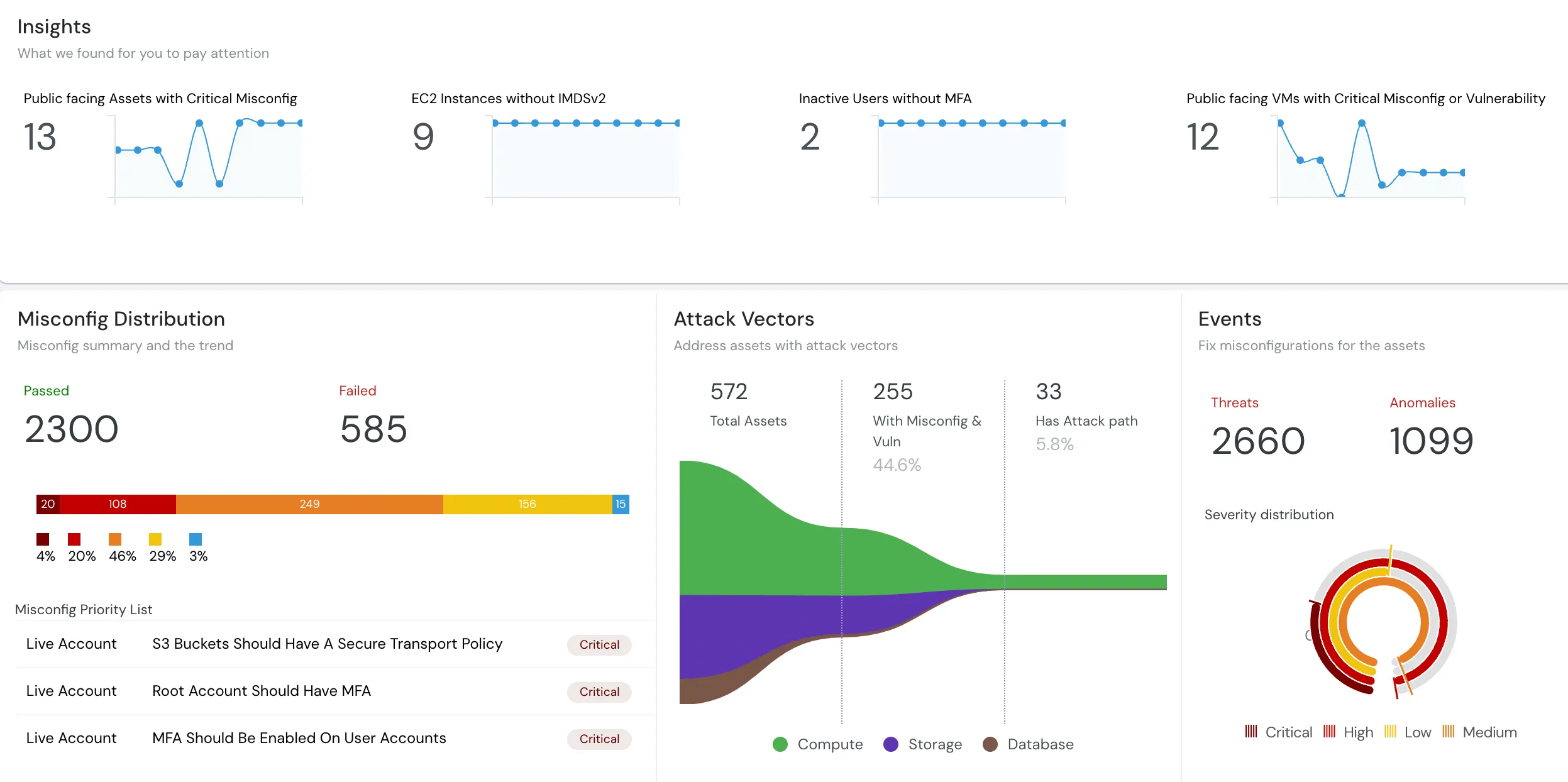
The core differentiator against flat-severity CSPM is that Cloudanix recomputes severity per asset from a security graph that weighs exposure, environment, data sensitivity, and identity — and shows the reasoning. A misconfigured internal-only dev resource and a public-facing production resource holding regulated data do not get the same “Critical” badge. For a two-person team, this is the difference between a queue of thousands of equal-weight alerts and a short, ordered list of what actually matters first. It reduces noise without hiding findings — the reasoning is always visible, so nothing is silently suppressed.
GKE as a First-Class Citizen
Cloudanix treats GKE clusters, namespaces, workloads, RBAC bindings, network policies, and pod security configurations as first-class entities in the same asset graph as cloud resources:
- Kubernetes Security Posture Management (KSPM): continuous assessment against the CIS Kubernetes Benchmark, GKE-specific hardening, and custom rules — not a one-time scan.
- Workload-level visibility: every pod, deployment, and statefulset assessed for security-context issues, privilege-escalation paths, and image vulnerabilities.
- RBAC analysis: over-permissive ClusterRoleBindings and lingering default service accounts surfaced with specific remediation.
- Network policy assessment: namespaces without NetworkPolicies flagged with blast-radius context.
- GKE hardening checks: Workload Identity, Binary Authorization, private cluster mode, legacy ABAC detection, Shielded GKE Nodes.
- Image vulnerability scanning: CVEs correlated with EPSS and KEV, so the team knows not just that a CVE exists but whether it is actively exploited and whether their workload is exposed.
Four Frameworks, Continuous Evidence
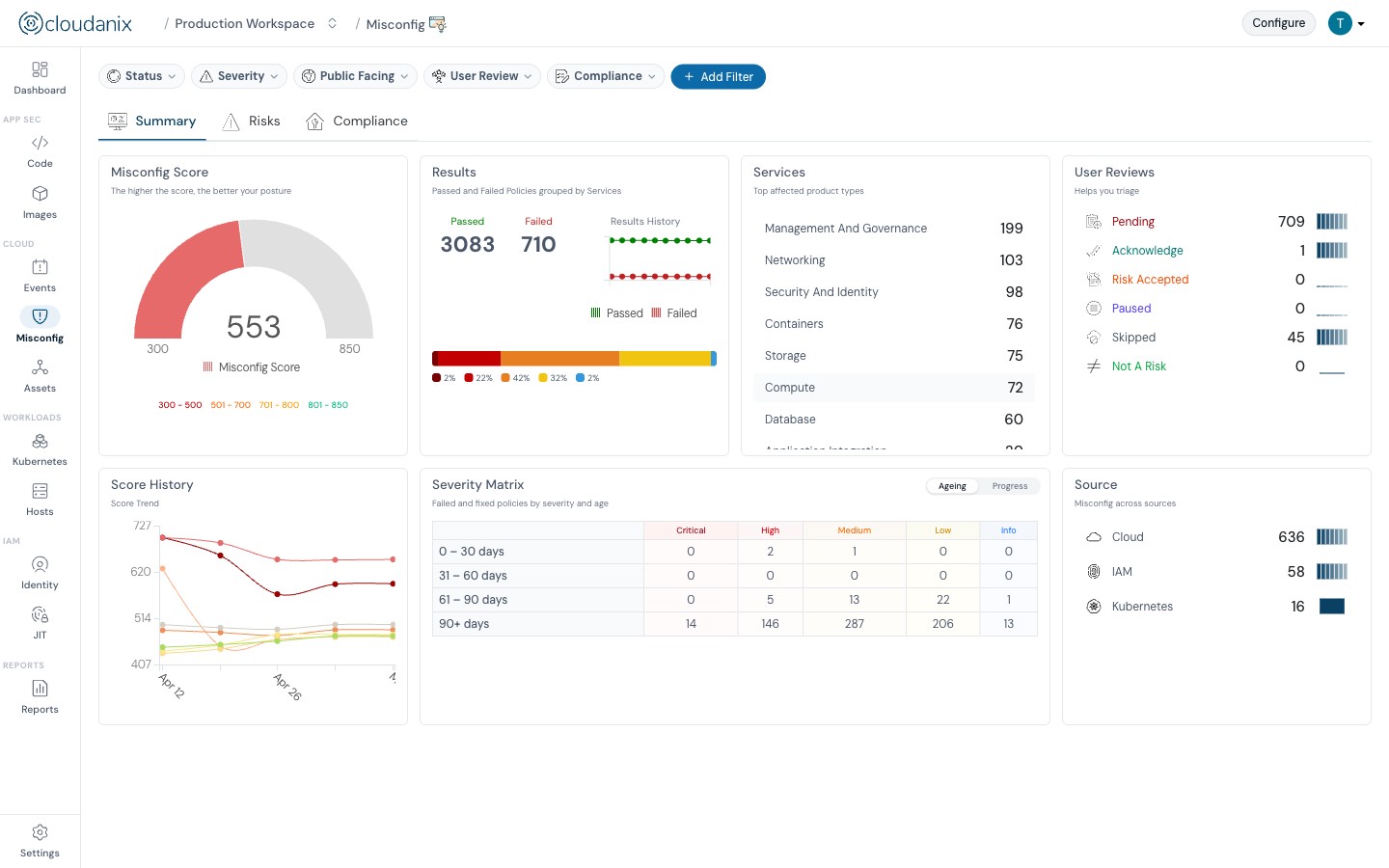
Cloudanix maps findings to ISO 27001, SOC 1, SOC 2, and GDPR out of the box — all four this team runs — plus many more, across both GCP and Azure and across Kubernetes workloads. One compliance dashboard shows posture against all four frameworks at once; control-level evidence maps specific findings to specific ISO 27001 Annex A controls, SOC 2 Trust Service Criteria, and GDPR Articles; and audit-ready evidence exports in Excel and PDF. The week-long spreadsheet assembly before every audit disappears.
Mid-Market Economics and Engineering-Led Support
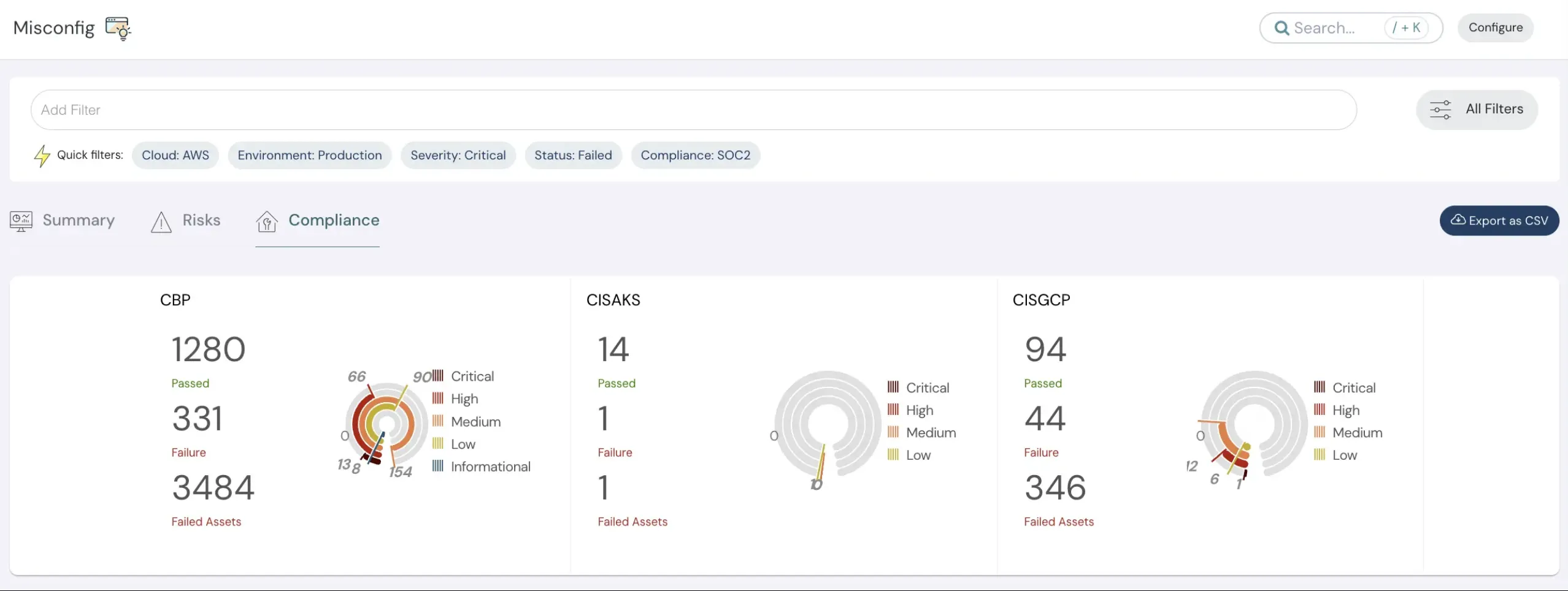
The capability match is only half the argument. The other half is economics: Cloudanix is priced for the mid-market, not the enterprise, and support is engineering-led through a shared channel rather than a ticket queue. For a two-person security team, fast answers from the people who build the product is not a soft benefit — it is operational capacity they do not have to hire for.
The Platform Grows With the Team
This is the answer to Question 4, and the reason a CNAPP+ fits this profile better than a pure-play CNAPP. The expansion path requires no new vendors:
- Today: CSPM + Compliance + Code Security across GCP and Azure.
- Next: CIEM for the 10–15 console users — over-permissive roles, unused permissions, identity risk.
- Then: Just-In-Time Access for GCP, Azure, GKE, and databases — standing privilege eliminated, access brokered via Slack with full audit.
- Eventually: Database Activity Monitoring for the MySQL data tier — query-level monitoring, role-based masking for GDPR-regulated data, destructive-query prevention.
Buying Cloudanix for CSPM today is not a dead end that forces a JIT vendor, a DAM vendor, and a coding-agent-security vendor over the next two years. It is one asset graph and one rule engine that already covers those surfaces.
Platform Impact
| Dimension | Pure-Play CNAPP (Wiz / Orca) | Cloudanix CNAPP+ |
|---|---|---|
| GCP + Azure | Aggregated in one view | Correlated as single attack paths |
| Severity model | Flat, per-rule | Contextual, recomputed per asset |
| GKE depth | CIS benchmark checkbox | First-class graph entities |
| Compliance | Reporting, often manual-adjacent | Four frameworks, continuous, export-ready |
| JIT access | Not covered | Cloud, DB, K8s, VM on one engine |
| Data tier (DAM) | Not covered | Query-level audit + masking |
| Deployment | SaaS-only | SaaS or in-your-cloud options |
| Pricing | Enterprise-tier | Mid-market |
| Support | Ticket-based | Engineering-led shared channel |
The Bigger Picture: Fit Beats Spotlight for Mid-Market FinTech
The instinct to buy the most visible brand is understandable, especially under audit pressure. But a GCP-heavy, GKE-first, multi-cloud FinTech with four frameworks and a two-person security team is not the enterprise profile that the loudest CNAPPs are built and priced for. The right question is not “who leads the category” but “who removes the most future work for a team of my size and shape.”
For this profile, the answer is a platform that covers CSPM, KSPM, and compliance today, correlates posture with identity and the data tier, prices for the mid-market, and ships a credible path to JIT, CIEM, and DAM — so the first security purchase is also the last platform decision for a long while. That is the argument against spotlight, and for this team, it holds.
Key Outcomes
- ✅ Correlated Multi-Cloud: GCP and Azure as connected attack paths, not two dashboards.
- ✅ Contextual Severity: Alert noise cut without hiding findings — reasoning always shown.
- ✅ GKE-First KSPM: Clusters, workloads, RBAC, and network policy as first-class entities.
- ✅ Four-Framework Compliance: ISO 27001, SOC 1, SOC 2, GDPR mapped continuously, export-ready.
- ✅ Mid-Market Economics: Enterprise capability without enterprise pricing.
- ✅ Single Platform Path: CSPM → CIEM → JIT → DAM with no new vendors.
- ✅ Covers Wiz/Orca Gaps: JIT, DAM, in-your-cloud deployment, and coding-agent security.
Evaluating Wiz and Orca for a Mid-Market FinTech Estate?
If you are GCP-heavy with an Azure footprint, GKE is your primary compute surface, and you are weighing a 2–3 year platform decision across four compliance frameworks with a lean security team — bring Cloudanix into the evaluation. One correlated platform, agentless onboarding in 30 minutes, mid-market pricing, and a path from CSPM to full CNAPP+ without tool sprawl.
Book a Free Assessment to see your GCP and Azure environment through Cloudanix — unified findings, contextual severity, and compliance mapping — in under 30 minutes.
Related Resources
- Multi-Cloud CSPM for a GCP-Heavy FinTech with GKE Workloads
- What is CSPM (Cloud Security Posture Management)?
- Why Flat Per-Rule Severity Is Broken — and What Contextual Severity Fixes
- CNAPP vs CSPM: Which Do You Need?
- Best Wiz Alternatives in 2026: A Technical Comparison
- From Tool Sprawl to a Single Dashboard: E-Commerce Cloud Security
- Cloudanix vs Wiz
- Cloudanix vs Orca