Customer Snapshot
| Attribute | Details |
|---|---|
| Industry | Conversational AI / SaaS Platform |
| Cloud Environment | AWS (primary), Azure (multi-region), GCP |
| VM Estate | 1,000+ VMs; ~500 targeted for vulnerability coverage |
| Prior Approach | Self-run open-source security agent on critical machines |
| Team Size | Small central InfoSec team |
| Focus Area | VM Vulnerability Management / Workload Protection |
The Situation: A Capable Open-Source Agent That Had Become a Job
This team ran an open-source security monitoring agent on a subset of their most critical virtual machines. It is a genuinely capable platform — flexible, widely adopted, and effective at collecting endpoint telemetry and detecting vulnerabilities. But running it well, at scale, is itself a full-time responsibility.
With more than a thousand VMs in the estate and roughly five hundred targeted for coverage, the team was weighing whether to expand a system that was already generating more operational load than they wanted. The skepticism was specifically about the vulnerability management experience: the sheer volume of notifications, the false-positive rate, and the ongoing burden of managing and upgrading the agent fleet.
The team’s position was pragmatic. They were not ideologically opposed to the tool. If a solution could actually solve the underlying problems — management, upgrades, false positives, and notification volume — they were open to a managed approach that took the operational weight off their plate.
The Core Challenge
A small security team was responsible for vulnerability coverage across a large VM estate, using a self-run open-source agent whose operational overhead — fleet management, version upgrades, false positives, and notification volume — was growing faster than the team’s capacity to absorb it. Expanding coverage meant expanding the noise.
Where the Pain Was Concentrated
1. Notification Volume That Buried the Signal
A high volume of alerts is not a feature; past a threshold, it is a liability. When every machine emits a steady stream of findings and a meaningful fraction are false positives, the team stops reading them closely. The alert that actually matters — the exploitable vulnerability on an internet-facing host — is the one buried in the stream nobody has time to triage.
2. False Positives That Eroded Trust
False positives do not just waste triage time; they erode confidence in the entire signal. Once a team learns that a large share of “critical” findings are noise, every finding is treated with suspicion, and the tool’s authority as a source of truth degrades. Rebuilding that trust is harder than reducing the noise in the first place.
3. Management and Upgrade Burden
Running a self-managed agent fleet across a thousand-plus VMs spanning three clouds means owning the deployment lifecycle: rolling out the agent, keeping versions consistent, applying upgrades, and handling the machines where the agent drifts or fails. For a small team, this is time spent maintaining the security tool rather than acting on what it finds.
4. Coverage Gaps From an Uninstrumented Majority
Because the agent ran only on the most critical machines, the majority of the estate had no continuous vulnerability coverage. Expanding coverage would have multiplied the management and notification burden, so the practical outcome was a large uninstrumented surface — machines with no eyes on their vulnerability posture.
The Cloudanix Approach: Managed Coverage Without the Overhead
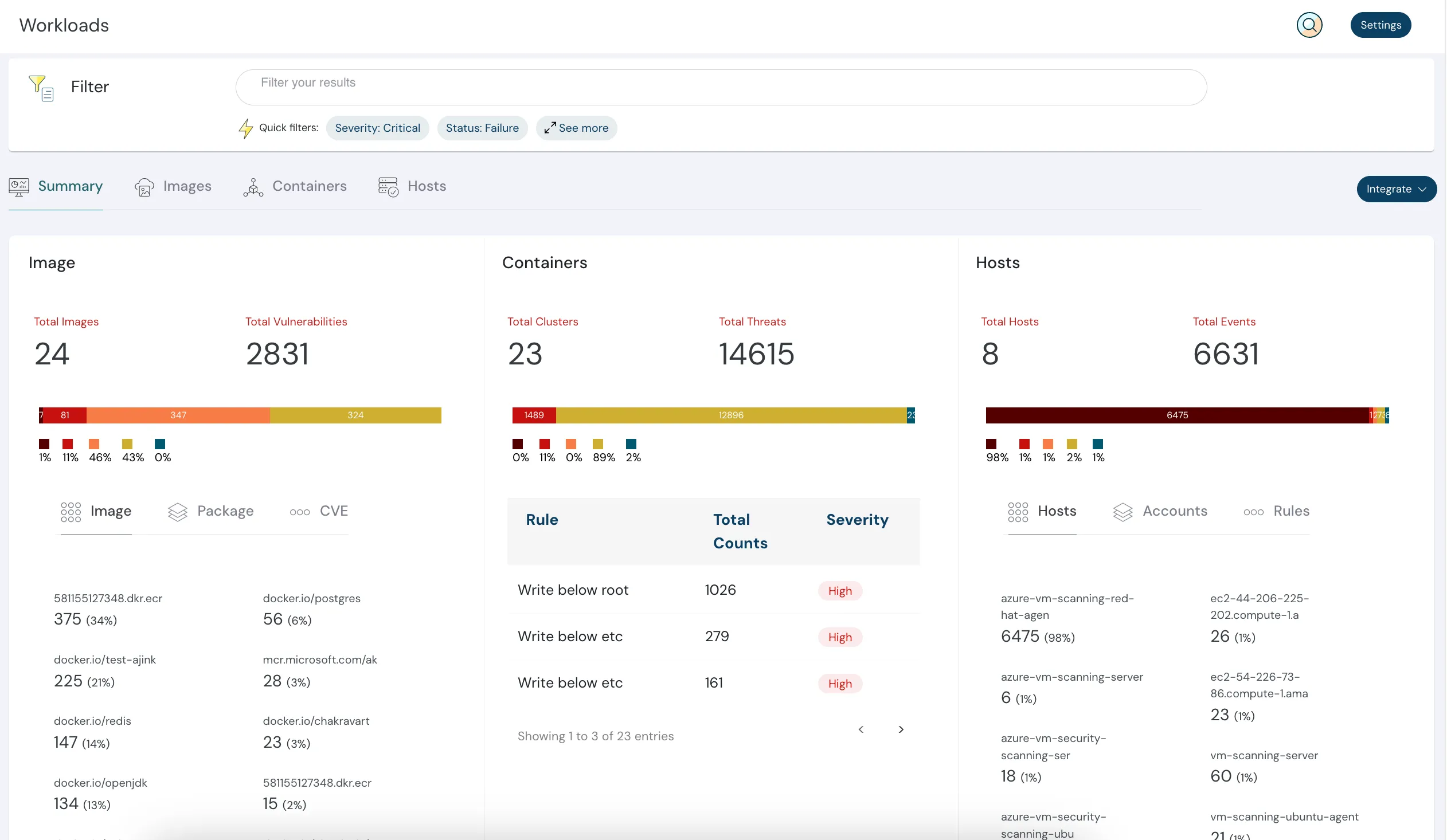
Cloudanix’s Workload Protection provides vulnerability management for the VM estate as a managed capability — designed to deliver the detection value without the fleet-management, upgrade, and notification burden of a self-run open-source deployment.
Vulnerability Detection Across the Estate
Cloudanix surfaces vulnerabilities across the VM estate — the OS-level and package-level exposures that matter — and does so across AWS, Azure, and GCP under one model rather than one system per cloud. The goal is coverage of the estate, not just the handful of machines a small team can afford to hand-manage.
Contextual Prioritization to Cut the Noise
The antidote to notification fatigue is not fewer findings — it is better-ranked findings. Cloudanix applies contextual severity, recomputing the importance of each finding based on exposure, environment, and reachability, so an exploitable vulnerability on an internet-facing production VM rises above a low-consequence finding on an isolated internal host. Zero-Day Watch further sharpens this by correlating fresh-exploit intelligence (KEV and EPSS signals) against the estate, so the team’s attention goes to what is actually being exploited.
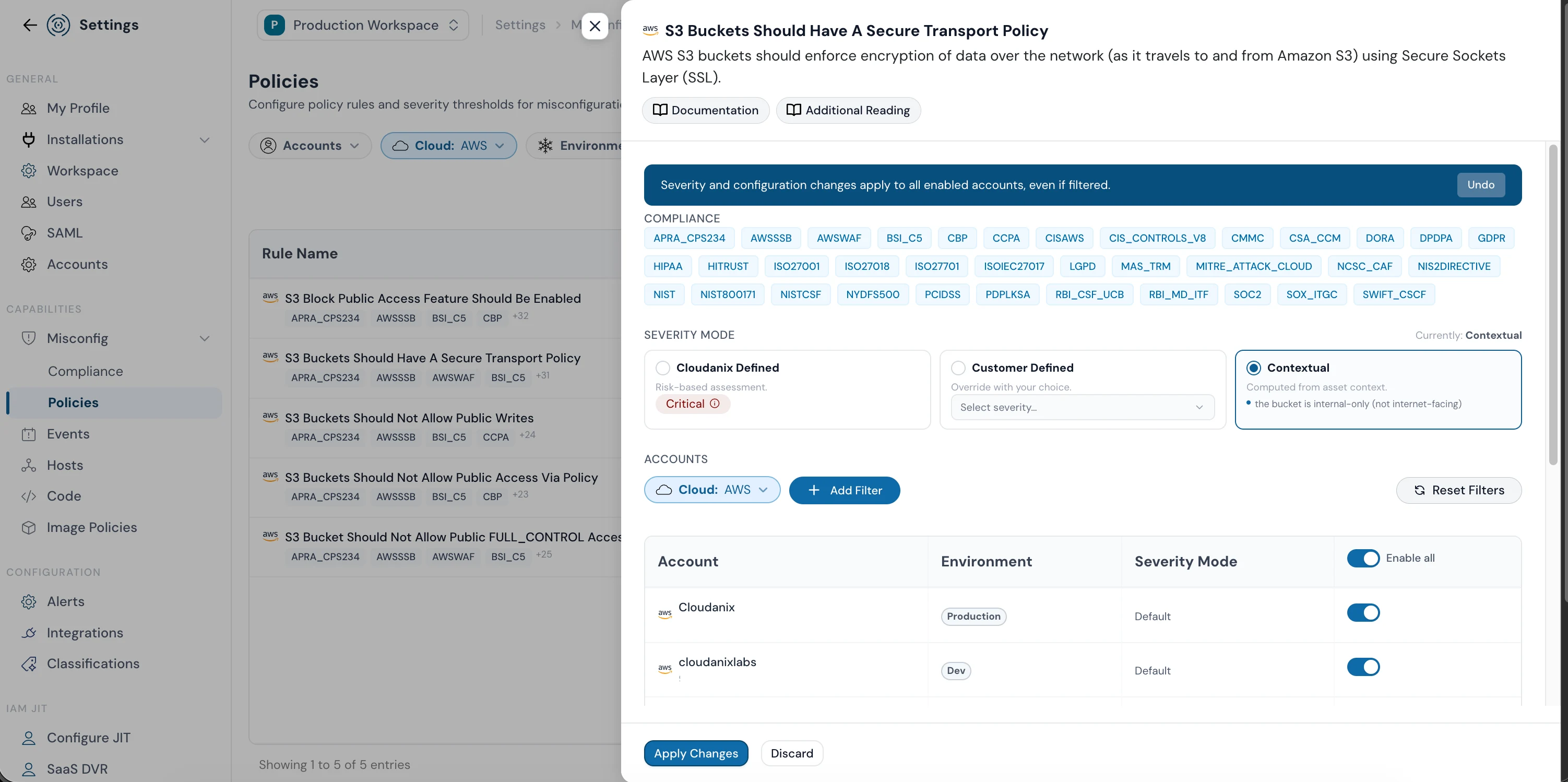
This is the direct answer to the volume-and-false-positives problem: the stream becomes a prioritized list, not an undifferentiated feed.
Managed Lifecycle Instead of Self-Run Fleet Ops
By moving to a managed workload-protection capability, the deployment, upgrade, and maintenance burden of a self-run agent fleet is absorbed by the platform rather than the team. Consistent with an honest posture on architecture, runtime VM telemetry uses a lightweight agent where it genuinely earns its place — but the operational lifecycle around it is not the customer’s day job.
Correlated With the Rest of the Graph
VM vulnerability findings do not sit in isolation. On Cloudanix’s asset graph, a vulnerable VM is connected to the identities that can reach it, the network exposure in front of it, and the workloads it runs — so the team sees not just “this VM has a CVE” but “this exploitable CVE sits on an internet-facing VM reachable by an over-privileged role.” That is the difference between a finding and an attack path.
A Note on Comparison
The open-source security monitoring platform this team ran is a strong, widely used tool, and many teams operate it successfully. The challenge here was not the tool’s capability — it was the operational cost of running it well across a large, multi-cloud VM estate with a small team. For teams that value the flexibility of open source and have the headcount to operate it, that trade-off can make sense. This team wanted the detection outcome without owning the operational lifecycle, which is where a managed approach fits. What is Wazuh? covers the open-source platform in more depth.
The Outcome
The team moved toward managed VM vulnerability management across its multi-cloud estate — trading the fleet-management, upgrade, and notification burden of a self-run agent for coverage that scales beyond the handful of hand-managed critical machines, with findings prioritized by real-world context rather than delivered as an undifferentiated stream.
Key Results
✅ Coverage Beyond Critical Machines: Vulnerability visibility across the estate, not just a subset ✅ Less Notification Fatigue: Contextual severity turns the stream into a prioritized list ✅ Exploit-Aware Prioritization: KEV/EPSS correlation surfaces what is actually being exploited ✅ Lower Operational Overhead: Managed lifecycle instead of self-run fleet ops ✅ Multi-Cloud Under One Model: AWS, Azure, and GCP in one view ✅ Findings as Attack Paths: VM vulnerabilities correlated with identity and exposure
Running a Self-Managed Security Agent Across a Large VM Estate?
If your vulnerability management is a self-run agent fleet generating more noise and maintenance than your team can keep up with, Cloudanix offers managed coverage with contextual prioritization.
Schedule a Demo to see VM vulnerability management across your multi-cloud estate.
Related Resources
- What is CWPP?
- What is Vulnerability Management?
- What is Wazuh?
- What is CISA KEV Catalog?
- What is EPSS?
- How to Prioritize Vulnerabilities Based on Business Risk
- Container Security and Real-Time Visibility for Modern Cloud
- Consolidating VM, Container, Code, and Cloud Security for a Conversational-AI Platform