
Every security scanning program eventually runs into the same reality: not every finding should be acted on, and not every finding should keep reappearing. A vulnerability may be a false positive. A flagged pattern may be an accepted risk the business has consciously decided to live with. A dependency issue may not be exploitable in your specific context. Business exception handling is the discipline of suppressing these findings deliberately — with a record of who decided, and why — rather than either drowning in noise or silently dismissing signal.
This guide explains what business exceptions are, why they need justification, and how a healthy exception workflow keeps suppressed findings accountable.
What Is a Business Exception?
A business exception is a decision to treat a specific finding as not requiring remediation — either because it is not a real problem, or because the organization has weighed the risk and chosen to accept it. Common forms include:
- False positive: the finding is not actually a vulnerability in your context (for example, a flagged code pattern that is safe given how it is used).
- Accepted risk: the finding is real, but the business has decided the cost or disruption of fixing it outweighs the risk, at least for now.
- Not exploitable in context: a dependency has a known CVE, but the vulnerable code path is not reachable in your application.
- Compensating control exists: the risk is mitigated by another control, so the finding does not need direct remediation.
Without a way to record these decisions, teams are stuck between two bad options: fix everything (impossible and wasteful) or ignore findings ad hoc (untracked and ungoverned). Exception handling is the structured middle path.
Allow-Lists and Disallow-Lists
Two related mechanisms shape which findings are surfaced and which are suppressed:
- Allow-list: a defined set of findings, patterns, or identifiers that are explicitly permitted — treated as acceptable and not flagged going forward. For example, allow-listing a specific CVE that has been assessed as not-exploitable in your environment so it stops reappearing in every scan.
- Disallow-list: the inverse — a set of things that must always be flagged or blocked, regardless of other logic. For example, ensuring a particular class of secret or a specific dangerous pattern is never allowed to pass, even if other checks are relaxed.
Together, these give a team fine-grained control over the signal: suppress what has been assessed and accepted, and hard-enforce what must never slip through.
Why Exceptions Need a Justification
The single most important property of a healthy exception workflow is that every exception carries a captured reason. This is what separates a governed decision from a silent dismissal.
Consider the difference. Without justification: “this finding is excluded.” With justification: “this finding is excluded because it was assessed as not-exploitable in our context on [date] by [role], with this reasoning.” The first is a gap an auditor will flag and a future engineer will not understand. The second is a defensible decision with a trail.
Mandatory justification matters for several reasons:
- Accountability. An exception is a security decision. Recording who made it and why makes that decision reviewable rather than anonymous.
- Auditability. Auditors ask why known findings were not remediated. A captured justification is the answer; its absence is a finding in itself.
- Institutional memory. Six months later, when someone asks “why is this vulnerability suppressed?”, the reason is on record — not lost with whoever clicked the button.
- Preventing casual suppression. Requiring a reason introduces friction that discourages dismissing findings just to clear a dashboard. The small cost of typing a justification is a feature, not a nuisance.
What a Healthy Exception Workflow Looks Like
A well-designed exception capability includes:
- Granular targeting. The ability to exclude a specific finding, a specific file, or a specific pattern — not just a blunt on/off switch.
- False-positive marking. A distinct way to mark something as a false positive, separate from accepting a real risk, so the two are not conflated in reporting.
- Captured reasons. A justification recorded with every exception, ideally required rather than optional.
- Allow/disallow lists. The ability to permanently permit assessed-and-accepted items and hard-enforce must-block items.
- Reviewability. A way to see all active exceptions and revisit them, because an accepted risk today may not be acceptable next quarter.
Exceptions Should Expire
An exception is a snapshot of a decision made under a specific set of facts, and those facts change. A CVE assessed as not-exploitable today becomes exploitable when someone adds a new code path that reaches it. A risk accepted “until next quarter” is often still suppressed two years later because nobody revisited it. The most common failure mode in exception handling is not the initial decision — it is that the decision is never reviewed again.
The fix is to treat exceptions as time-bound by default. Give every exception an expiry, after which the finding resurfaces and someone has to consciously renew the decision or remediate. This turns “accepted risk” from a permanent trapdoor into a reviewable position. A quarterly or per-release review of active exceptions serves the same purpose: it forces the question “is this still true?” instead of letting suppressions accumulate silently. Tie the review cadence to how fast your environment changes — fast-moving services need shorter windows than stable ones.
Exceptions and Prioritization Are Two Sides of the Same Problem
It is worth being clear about what an exception is for. The goal is not to make the dashboard green; it is to focus finite engineering time on the findings that actually matter. That makes exception handling the mirror image of vulnerability prioritization. Prioritization pushes the genuinely dangerous findings to the top; exceptions push the assessed-and-accepted ones out of the way. Both are trying to raise signal-to-noise.
This is also why “not exploitable in context” is such a common and legitimate exception. A dependency CVE that sits in a code path your application never calls is real in the abstract but inert in your deployment. The industry has a formal way to express exactly this — the Vulnerability Exploitability eXchange (VEX) concept, which lets you assert that a known vulnerability is or is not affected in your product. Recording a reachability-based “not affected” determination as a justified exception is precisely the kind of decision that keeps a queue honest. Grounding these decisions in real exploitability signals — reachability, and external inputs like EPSS and the CISA KEV catalog — makes them defensible rather than convenient.
Common Anti-Patterns
Exception handling goes wrong in recognizable ways:
- Blanket suppression. Excluding an entire severity class or a whole scanner because it is noisy throws away real findings alongside the false positives. Target narrowly.
- Conflating false positives with accepted risk. “This isn’t a real vulnerability” and “this is a real vulnerability we’ve chosen to live with” are very different statements. Reporting that merges them hides genuine accepted risk from leadership.
- Suppression without an owner. An exception with no named owner is an exception nobody will ever revisit. Attach accountability to each one.
- Overriding hard-block controls. Some things — leaked secrets, for instance — should never be exceptable. If your workflow lets an exception silence a secret detection, that is a design flaw, not a feature.
- Undocumented “temporary” exceptions. The temporary exception with no expiry is the permanent exception in disguise.
How Cloudanix Handles Exceptions
Cloudanix Code Security supports exception handling designed around accountability. Teams can exclude specific findings, exclude files, and mark findings as false positives — and capture the reason for the exclusion so a suppressed finding is a documented decision rather than a silent one. This pairs naturally with quality gates: a team can suppress an assessed-and-accepted finding while still enforcing hard-block conditions (such as secrets) that no exception should override.
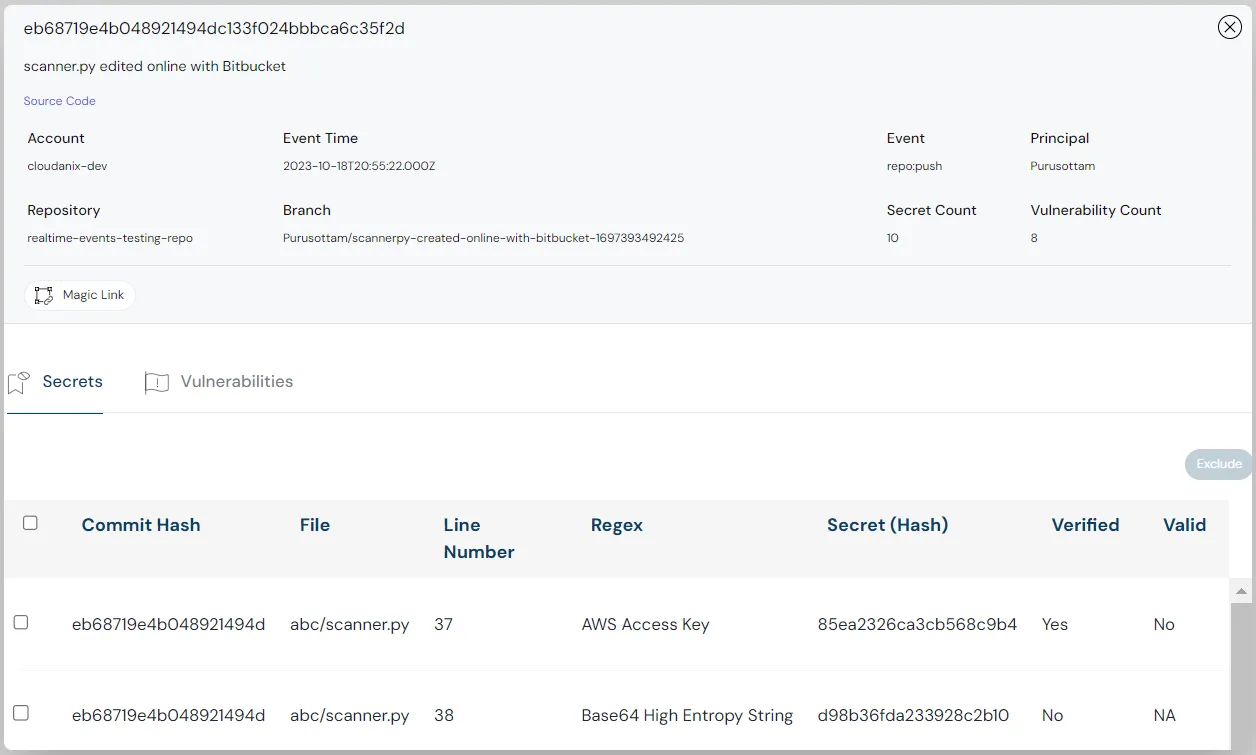
Richer allow-list and mandatory-justification workflows are an area of ongoing enhancement; the underlying principle Cloudanix builds toward is consistent — an exception should always carry a reason on record. If a specific exception capability is central to your program, confirm current support with the Cloudanix team for your setup.
The Takeaway
Business exception handling is how a security program stays honest at scale. You cannot fix every finding, and you should not ignore findings ad hoc. The answer is a workflow that lets you suppress deliberately — with allow-lists for what you have assessed and accepted, disallow-lists for what must never pass, and a captured justification on every exception so that suppressing a finding is a governed, reviewable decision rather than a silent one.