
A pull request (PR) quality gate is an automated checkpoint that decides whether a pull request is allowed to merge, based on whether it meets a defined set of criteria. If the change passes the criteria, the gate is green and the merge can proceed. If it fails — for example, because it introduces vulnerabilities above a set severity, or leaks a secret — the gate blocks the merge until the issue is addressed.
Quality gates are what turn code scanning from a report into a control. A scanner that only produces findings tells you what is wrong; a quality gate acts on those findings by stopping risky code before it reaches the default branch.
How a Quality Gate Works
A quality gate sits in the pull request workflow, typically integrated with your source-control platform. When a developer opens or updates a PR, the gate evaluates the change against its configured rules and reports a pass or fail status directly on the PR. Common inputs a gate evaluates include:
- SAST findings — static-analysis issues in the changed code.
- SCA findings — vulnerable dependencies introduced by the change.
- Secrets — credentials or keys detected in the diff.
- IaC misconfigurations — insecure infrastructure definitions in the change.
The gate combines these against its thresholds and produces a single outcome: merge allowed, or blocked.
Configuring Thresholds
The core configuration decision is where to set the bar. A few common approaches:
- Severity threshold: block the PR if it introduces findings at or above a chosen severity (for example, block on any High or Critical finding).
- Count threshold: block if the number of findings of a given severity exceeds a limit.
- Category-specific rules: apply different logic to different finding types — for instance, tolerate a low-severity code-quality issue but never tolerate a leaked secret.
Two configuration principles matter in practice:
Set defaults centrally, override where needed. A tenant-level default gives consistency across all repositories, while repository-level overrides let sensitive repositories enforce stricter rules. This avoids configuring every repo by hand while still allowing tighter control where it counts.
Tune before you enforce. A gate turned to strict enforcement before false positives are calibrated will block PRs unpredictably and erode developer trust. An untrusted gate is worse than no gate. Start in a reporting posture, calibrate, then enforce.
Where a Quality Gate Fits in CI/CD
A PR quality gate is one specific instance of a broader idea: an automated go/no-go decision embedded in the delivery pipeline. It lives at the pull request boundary because that is the last cheap place to stop a change before it becomes part of the shared history. That timing is deliberate — it is shift-left security applied at the exact moment a human is already reviewing the change, so security feedback arrives alongside code review rather than days later in a separate tool.
Mechanically, the gate is usually wired as a required status check on the branch protection rules of your default branch. The scanner runs on the PR (on open and on each push), reports its result back as a commit status or check run, and the platform refuses the merge button until that check is green. Because it is enforced by branch protection rather than by convention, it cannot be skipped by a developer who is in a hurry — which is the whole point of making it a control rather than a suggestion. For the wider pipeline picture, see what is a CI/CD pipeline.
New Findings vs Total Findings
One of the most important — and most overlooked — design choices in a quality gate is whether it evaluates the whole codebase or only the change. Gating on total findings across an existing repository is usually a mistake: a legacy repo may carry hundreds of pre-existing issues, and blocking every PR because of debt nobody introduced today punishes the wrong people and trains developers to route around the gate.
A diff-aware or baseline-aware gate instead asks: does this pull request make things worse? It compares findings introduced by the change against a baseline of what already existed, and blocks only on net-new risk. This keeps the gate fair and focused: you stop the bleeding on new code while tackling legacy debt on a separate, deliberate track rather than at merge time. It also keeps the signal high — a developer who sees the gate fail knows it is because of something in their diff, not an artifact of history.
The same principle informs how findings are surfaced. Annotating the specific changed line that introduced a finding, rather than dumping a repository-wide report, is what makes a blocked PR actionable in the moment.
Why Secrets Should Be a Hard-Fail Condition
Most findings can reasonably be weighed on a severity scale. Secrets are the exception, and they deserve special treatment in gate logic.
The reason is that a committed secret does not require exploitation to become a problem. The instant an access key or database credential lands on a shared branch, it must be treated as exposed — it is in the history, in clones, potentially in CI logs and mirrors. Rotation becomes mandatory the moment it merges.
This is why a well-configured gate treats a detected secret as an absolute fail condition — the PR fails if a secret is present, regardless of whether every other check passes. A gate that evaluates only an aggregate severity score can, by design, let a secret slip through when the other signals are clean. For credentials, that is exactly the wrong behavior. Prevention (blocking before merge) is the only cheap option; everything after merge is cleanup and rotation.
The corollary: a secret-blocking gate is only as good as the detection behind it. If the scanner knows only a few hundred common patterns, custom internal tokens and non-standard credentials sail through and the gate never fires. Broad secret-pattern coverage is what makes a secret-blocking gate trustworthy rather than cosmetic.
Quality Gates and Governance
Because a quality gate is a security control, changes to it matter. If an engineering manager relaxes or disables a gate to push through an urgent release, that is a change in the organization’s security posture — and one the security team should be able to see. A mature quality-gate implementation pairs the gate with an audit trail of configuration changes and an exception workflow that captures a justification when findings are suppressed, so delegating gate control to teams stays accountable.
Common Pitfalls
Quality gates fail in predictable ways. Knowing them upfront saves a lot of rework:
- Enforcing before tuning. Turning on strict blocking while the scanner still produces false positives is the fastest way to lose developer trust. Once a team stops believing the gate, they lobby to weaken it and you are worse off than before.
- Gating on total debt. As above, blocking on pre-existing findings makes the gate feel arbitrary. Gate on net-new risk.
- No exception path. There will be legitimate cases where a finding must be accepted (a false positive, a compensating control, a business deadline). Without a governed way to record that decision, developers either get stuck or bypass the gate entirely. A tracked exception workflow keeps those decisions visible and time-bound.
- Slow feedback. If the gate takes fifteen minutes to report, developers context-switch away and the feedback loop breaks. Scans that run on the diff are faster and keep the loop tight.
- One threshold for every repo. A customer-facing payments service and an internal prototype do not warrant the same bar. Central defaults with per-repo overrides let you match strictness to risk.
How Cloudanix Implements Quality Gates
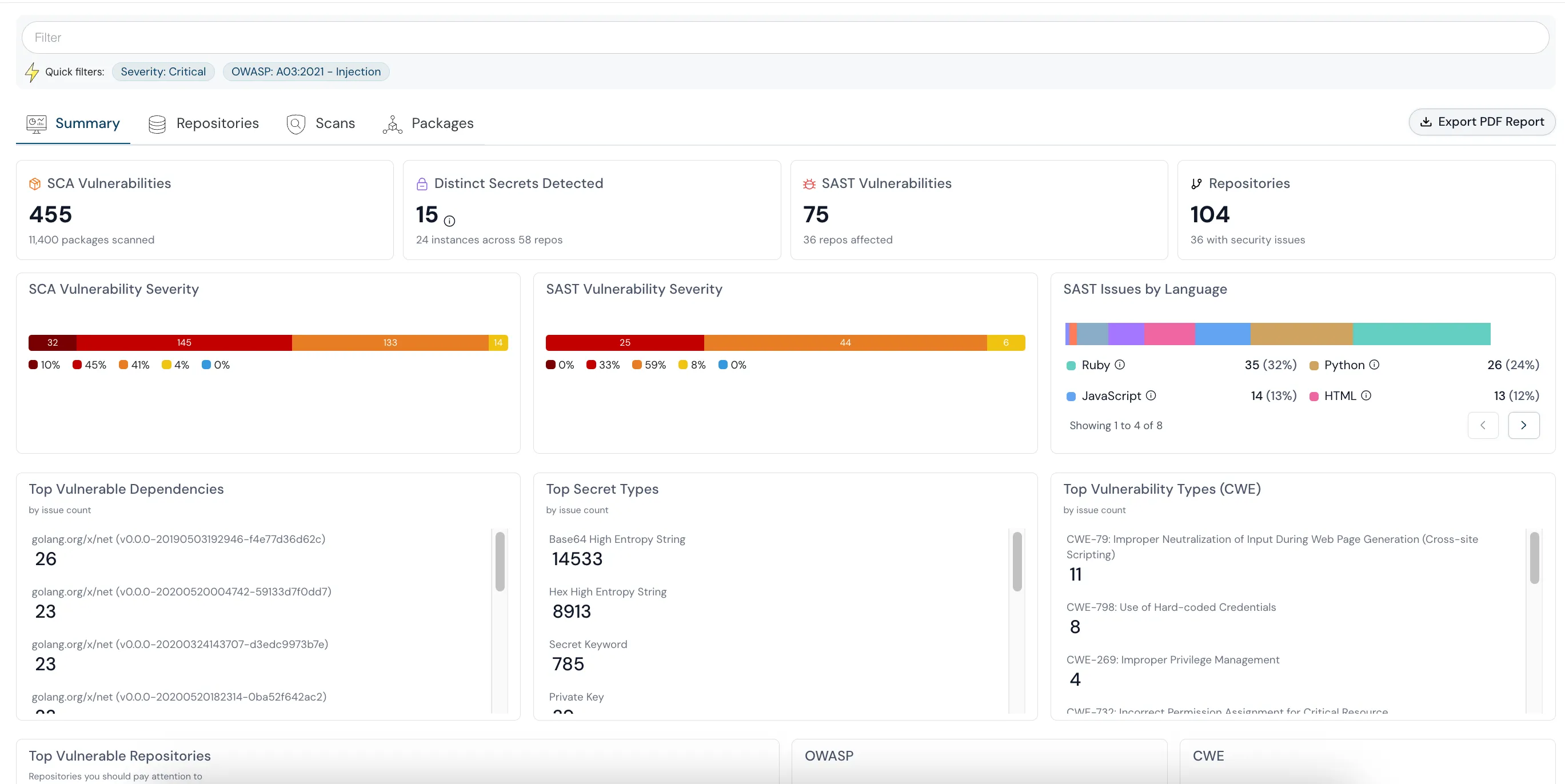
Cloudanix Code Security supports configurable quality gates at both tenant and repository level, evaluating SAST, SCA, secrets, and IaC findings against severity thresholds — with repository-level settings able to override tenant defaults. Detected secrets can be treated as a hard-fail condition, backed by 2,000+ secret patterns plus bring-your-own-pattern support so the gate fires on custom credentials as reliably as standard ones. Findings surface as pull request annotations at the relevant code line, so a blocked PR comes with the context a developer needs to fix it.
The Takeaway
A PR quality gate is the mechanism that turns code scanning into an enforceable control — blocking risky pull requests before they merge. Configure thresholds centrally with repo-level overrides, tune before you enforce so developers trust the gate, and treat secrets as an absolute fail condition independent of the aggregate score. Pair the gate with an audit trail and exception workflow, and it becomes not just a control but a governed one.