
Customer Snapshot
| Attribute | Details |
|---|---|
| Industry | Technology / SaaS |
| Scenario | A smaller company’s AWS accounts being absorbed into a larger parent’s AWS Organization |
| Account Volume | ~10 accounts to migrate, into a parent org with ~120 existing accounts |
| Existing Governance | Cloudanix JIT already running in the original organization |
| Migration Pattern | Test one account first, then migrate the rest in waves |
| Onboarding Mechanism | CloudFormation stacks / StackSets per organization |
| Cloudanix Scope | Cloud Console JIT, Database JIT — maintained across the transition |
The Situation: The Accounts Are Moving to a New Home
Mergers and acquisitions don’t just change org charts — they change the AWS Organization your accounts live in. When a smaller company is absorbed into a larger one, its AWS accounts are typically migrated out of their original organization and into the parent’s. On paper this is an administrative move. In practice, every tool, control, and integration that was wired to the original organization has to be reconsidered, because organization-level constructs don’t follow the account across the boundary automatically.
Access governance is one of those controls, and it’s an easy one to overlook until it breaks. This company had Cloudanix JIT running cleanly across its original AWS Organization. Then the accounts started moving into the parent company’s organization — about ten accounts in total, joining a parent org that already contained roughly 120 accounts. The original onboarding stack still existed in the old setup. The new organization, meanwhile, had only its own master account onboarded. The migrated accounts were, for a window, in limbo: physically in the new org, but not yet governed there.
The goal was to move through the migration without a period where access to production accounts was ungoverned — no gap where standing privilege could creep back in because JIT “wasn’t set up yet over here.”
The Core Challenge
Organization-level onboarding is tied to the organization. When an account leaves one AWS Organization and joins another, its access governance doesn’t travel with it — the old onboarding becomes stale, and the new organization doesn’t know the account exists until it’s deliberately onboarded. Done carelessly, this creates a dangerous interval: accounts live in the new org with no JIT governing them, defaulting back to standing access precisely during the chaos of a migration. The challenge was to sequence offboarding, migration, and re-onboarding so governance was never silently absent.
Where the Gaps Were
Org-Level Constructs Don’t Cross the Boundary
The core technical reality is that onboarding at the organization level is bound to that organization. Specifically:
- The original onboarding stack stays behind. The CloudFormation footprint that onboarded accounts in the old organization doesn’t re-home itself. Left in place on a migrated account, it’s stale — pointing at an organizational context that no longer applies to the account.
- Child accounts aren’t visible until org onboarding completes. In the new organization, member accounts aren’t automatically discoverable by the governance layer until the organization-level onboarding is run there. An account can be sitting in the new org, fully migrated, and still be invisible to JIT because the new org’s onboarding hasn’t reached it.
- Re-onboarding is mandatory, not optional. After migration, onboarding must be re-run for the account in its new organizational home. There is no “it’ll just pick up where it left off.” The account has to be onboarded into the new org’s governance explicitly.
The Silent Gap Nobody Schedules
The dangerous part of a migration isn’t any single step — it’s the interval between steps if they aren’t sequenced deliberately. Consider the naive order: migrate the account first, deal with governance later. For the duration of “later,” the account is in the new organization with:
- No JIT engine governing access to it.
- Whatever standing IAM assignments existed, now effectively unmanaged.
- No time-bound grants, no auto-revocation, no fresh audit trail.
That interval can stretch from hours to weeks depending on how the migration waves are planned. It is exactly the window an attacker or an accident would exploit, and it exists purely because governance was treated as a cleanup task rather than part of the migration itself.
Scale Makes Sequencing Non-Negotiable
With roughly ten accounts moving into a 120-account parent org, “just do it carefully” doesn’t scale as a plan. Each account needs the same disciplined sequence, and the parent org’s size means the governance layer has to be scoped so the migrated accounts’ identities don’t drown in the parent’s enormous identity surface (a concern addressed in depth in filtering JIT sync scope). A repeatable sequence is the only thing that keeps ten migrations from becoming ten improvisations.
The Cloudanix Solution: A Repeatable Offboard–Migrate–Re-Onboard Sequence
The resolution was to make governance continuity an explicit part of the migration runbook, not an afterthought. The sequence, proven on a test account first and then applied in waves, was: disconnect from the old organization, migrate the account, re-onboard into the new organization.
Step 1: Prove It on One Account
Before touching production at scale, the team migrated a single test account end to end. This validated the whole chain in a low-stakes setting: that offboarding cleanly removed the stale onboarding, that the account migrated without surprises, and that re-onboarding in the new org restored full JIT governance with the right identities visible. The test account confirmed the runbook before the real accounts followed it — the single most effective risk reduction available in a migration.
Step 2: Offboard / Disconnect from the Old Organization
For each account, the first action is to disconnect it from governance in the original organization. This removes the stale onboarding footprint so the account isn’t carrying a dead organizational context into its new home. This mirrors the discipline required in any clean account migration and JIT continuity flow: you don’t migrate on top of an old integration, you remove it first.
Step 3: Migrate the Account
The account moves from the old AWS Organization into the parent’s. This is the AWS-level organizational move. Crucially, in the planned sequence this happens after offboarding and immediately before re-onboarding — so the ungoverned interval is as short as the runbook can make it, not an open-ended “we’ll get to it.”
Step 4: Re-Onboard Into the New Organization
Onboarding is re-run for the account in its new organizational home. The preferred mechanism at scale is organization-level onboarding scoped to exactly the accounts that should be governed — not the parent org’s entire 120-account population. Two scoping approaches apply:
- OU-based (preferred): a dedicated Organizational Unit holds the migrated accounts, and a CloudFormation StackSet governs only that OU. Future migrated accounts dropped into the OU onboard automatically — the runbook gets easier with each wave.
- Account-number-based (fallback): where an OU isn’t available, specific account IDs are targeted explicitly.
Either way, the outcome is the same: the migrated accounts become governed in the new org, and the parent’s unrelated accounts are left untouched.
Step 5: Verify Governance Is Live Before Declaring Done
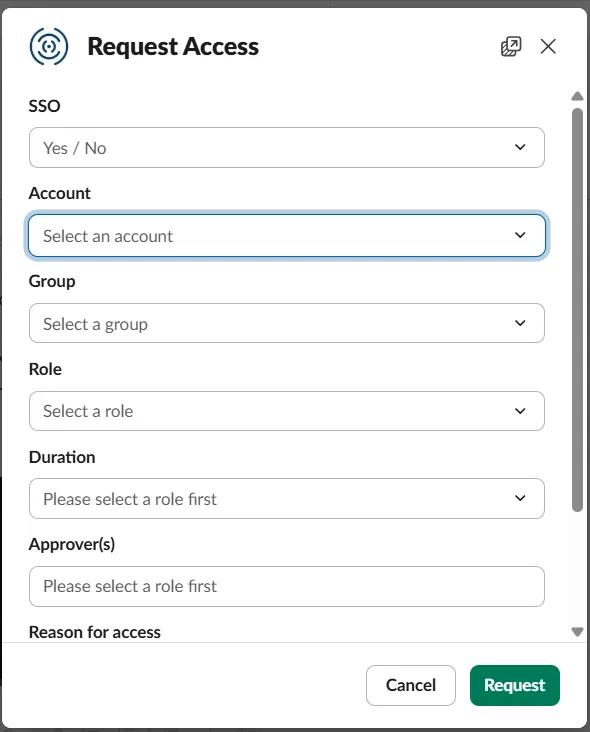
Re-onboarding isn’t complete until it’s confirmed working. For each migrated account the team verified that the account and its groups were visible in JIT, that permission sets synced correctly, that an access request routed to the right approver, and that a grant provisioned and revoked as expected. Only then was the account considered governed in its new home.
Keeping the Database Layer Continuous Too
For accounts running Database JIT, the same continuity discipline applies to the data tier. The ECS-based proxy and supporting resources are part of what gets re-established in the new organizational context, so database access remains identity-stamped and time-bound through the transition rather than falling back to shared credentials during the move. The principle is identical: don’t let the migration become an excuse for a window of ungoverned database access.
Handling the Stale Onboarding Footprint Precisely
One operational detail deserves attention because it’s where migrations get messy in practice: the old onboarding footprint has to be removed from the right place, in the right order, and verified gone. In a mature environment the governance layer is realised through CloudFormation stacks (for individual accounts) and StackSets (for organization-level onboarding). When an account migrates, the stack that onboarded it in the old organization becomes an orphan — it references an organizational context the account no longer belongs to.
Leaving that orphan in place causes two problems. First, it’s confusing: anyone auditing the account later finds a Cloudanix onboarding footprint that points at the wrong organization, and has to work out whether it’s live or dead. Second, it’s untidy from a least-privilege standpoint — a role and its associated resources exist for a relationship that no longer applies. The disciplined move is to remove the stale stack as part of the offboard step, before migration, and to confirm its removal rather than assume the console reflected it. In an org-level StackSet model, this also means being surgical: when only a subset of accounts is moving, the StackSet should be adjusted to drop exactly those accounts — not torn down wholesale, which would disrupt the accounts staying behind.
Getting this precise is what separates a migration that leaves a clean estate from one that leaves a trail of orphaned stacks nobody dares delete years later because no one remembers what they do.
Why a Test Account Is Worth the Extra Day
It’s tempting, under migration deadline pressure, to skip the test-account rehearsal and go straight to the real accounts — especially when the team has done migrations before and feels confident. Resisting that temptation is the highest-leverage decision in the whole exercise. A test account surfaces the environment-specific surprises — a region mismatch, a naming collision, an approver that was never configured, an identity that churns during the IdP re-sync — in a setting where getting it wrong costs nothing. Discovering any one of those on a production account mid-wave costs far more than the day the rehearsal takes. The test account is cheap insurance against the one surprise that turns a routine migration into an incident.
Platform Impact
| Dimension | Naive “Migrate First, Govern Later” | Sequenced Offboard–Migrate–Re-Onboard |
|---|---|---|
| Ungoverned interval | Hours to weeks per account | Minimized by sequence; verified closed |
| Stale onboarding footprint | Left behind, pointing at old org | Removed on offboard |
| Account visibility in new org | Unknown until someone notices | Confirmed via re-onboard + verification |
| Standing privilege during move | Re-emerges by default | Prevented — JIT restored per account |
| Scaling across many accounts | Improvised each time | Repeatable runbook, OU-scoped automation |
| Database access during move | Risk of shared-credential fallback | Continuous, identity-stamped |
Why Governance Continuity Belongs in the Migration Runbook
The instinct during an M&A migration is to treat the AWS-level account move as the real work and everything else as follow-up. That instinct is what creates the ungoverned interval. Access governance is bound to the organization, so the moment an account changes organizations, its governance has to be deliberately torn down and rebuilt — and the only safe place to do that is inside the migration sequence itself, account by account, verified before moving on.
Proven on a test account, scoped with OU-based onboarding, and verified at each step, the offboard–migrate–re-onboard sequence turns a merger from a governance liability into a routine, repeatable operation. The accounts arrive in their new home already governed, with no standing-privilege gap and no stale footprint left behind.
Absorbing Accounts Into a New AWS Organization?
If a merger, acquisition, or reorganization is moving your accounts into a different AWS Organization, Cloudanix helps you keep JIT governance continuous through the transition — a repeatable offboard, migrate, re-onboard sequence with OU-scoped onboarding and per-account verification, so there’s never a window where production access is ungoverned.
Book a Free Assessment to plan a governance-continuous migration for your accounts.
Related Resources
- AWS Account Migration and JIT Continuity: Moving Between Organizations
- OU-Based vs Account-Based Onboarding: Restricting Cloudanix Scope in Large AWS Organizations
- Keeping Tenant Identities Isolated: Filtering JIT Sync Scope in a Shared AWS Organization
- JIT Cloud for Multi-Account AWS Organizations: SSO and Permission Sets
- Right-Sizing Cloudanix Permissions: Minimizing Access for JIT Functionality













