
Customer Snapshot
| Attribute | Details |
|---|---|
| Industry | Technology / SaaS |
| Scenario | Managing a cloud account on behalf of an end customer, with ownership transfer planned |
| Cloud Environment | AWS, dedicated account for the customer workload |
| Ownership Timeline | ~3 months of SaaS-managed operation, then transfer to the end customer |
| Databases | RDS in private subnets |
| Who Needs Access | SaaS company’s own engineers and operators during the managed window |
| Existing Concern | “Is it worth standing up access governance for an account we’ll hand back?” |
| Cloudanix Scope | Cloud Console JIT, Database JIT, security reporting |
The Situation: You Own It Today, Someone Else Owns It in 90 Days
Not every cloud account you operate is one you’ll keep. Modern SaaS and platform companies regularly run infrastructure on behalf of a customer for a defined window — a migration period, a white-glove onboarding, a proof-of-value, or a staged rollout — before transferring ownership of that account to the customer. During that window, the SaaS company’s own engineers and operators need real access to the account: to deploy, to debug, to query the database, to produce security evidence the customer will later ask for.
This company found itself in exactly that position. A new end customer’s workload lived in a dedicated AWS account that the SaaS company owned and managed. The plan was explicit: operate it for roughly three months, then transfer ownership to the customer. Cloud access to the account was already being governed by Cloudanix JIT for their other accounts. The open question was narrower and more pragmatic: is it worth onboarding this temporary account into access governance at all, given that we’re going to hand it back?
It’s a fair question, and the instinct behind it — don’t over-invest in something short-lived — is reasonable. But the instinct leads to the wrong answer, and the reason it does is the whole point of this use case.
The Core Challenge
A cloud account under temporary management is still a cloud account with real data, real workloads, and real access needs. Skipping access governance “because it’s temporary” means running the riskiest kind of access — informal, standing, undocumented — on precisely the environment that will later be scrutinized by its new owner. The challenge was to govern access cleanly for a short window, produce the security evidence the customer would expect, and then tear the whole thing down with no residue when ownership transferred.
Where the Gaps Were
The “It’s Only Temporary” Trap
The temptation with a short-lived managed account is to handle access the quick way: a few shared IAM users, a couple of broadly-scoped roles, maybe a credential pasted into a runbook. It feels proportionate to the timeline. In practice it is the worst of both worlds:
- Standing access on a sensitive environment. The account holds a customer’s workload and data. Informal access means engineers carry standing privileges to it for the entire managed window — the exact pattern that turns a single compromised laptop into a customer-data incident.
- No audit trail to hand over. When ownership transfers, the new owner inherits an account with no record of who accessed what during the months you ran it. That is an uncomfortable conversation and, in regulated contexts, a genuine compliance gap.
- Messy teardown. Informal access is hard to fully revoke because nobody has a complete list of what was granted. Shared users linger. Roles survive. The account changes hands with forgotten doors still open.
The Two Fears That Drove the Hesitation
When the team talked it through, the hesitation came down to two concrete worries, both about effort rather than value:
-
“Setup is a lot of work for a 90-day account.” The assumption was that onboarding access governance for a single temporary account would be a project — days of configuration, network changes, custom policy work — that wouldn’t pay back over a three-month life.
-
“Running two systems adds friction.” If this one account used a different, lighter access method while every other account used proper JIT, engineers would have to remember which account worked which way. Two mental models, two request paths, two sets of instructions for new team members. Friction compounds, and friction is where mistakes live.
Both fears are legitimate. The resolution wasn’t to dismiss them — it was to show that the real numbers didn’t support them.
The Database Dimension
The account’s workload included an RDS database in a private subnet. Database access is where the “temporary account” shortcut gets most dangerous, because the fallback — a shared database credential handed around the team — is both the easiest thing to do and the hardest thing to clean up. A shared DB credential used across a managed window has no identity attribution (you can’t tell who ran which query), no expiry aligned to the work, and no clean revocation story at handoff. It is the single artifact most likely to still be valid, in someone’s saved connection, long after the account changed hands.
The Cloudanix Solution: Govern It Like Any Other Account, Tear It Down in Two Hours
The resolution was to treat the temporary account exactly like a permanent one for access governance — same JIT engine, same request flow, same audit trail — because the cost of doing so turned out to be far lower than the team assumed, and the cost of not doing so turned out to be far higher.
Installation Measured in Hours, Not Days
The team’s first fear was that onboarding would be a project. It wasn’t. Bringing the account under Cloudanix access governance — cloud console JIT plus Database JIT for the RDS instance — took on the order of an hour or two of setup, not days. The database side reused the same deployment pattern already proven across the company’s other VPCs: a lightweight proxy running on ECS inside the account’s own VPC, no network peering, no changes to the application. Once the pattern exists in an organisation, replicating it onto one more account is a known, scripted operation.
That single fact dismantled the “too much work” objection. A one-to-two-hour setup, amortised over a three-month managed window, is not a meaningful cost. It is cheaper than the first incident-response conversation you’d have if an informal credential leaked.
One System, Not Two
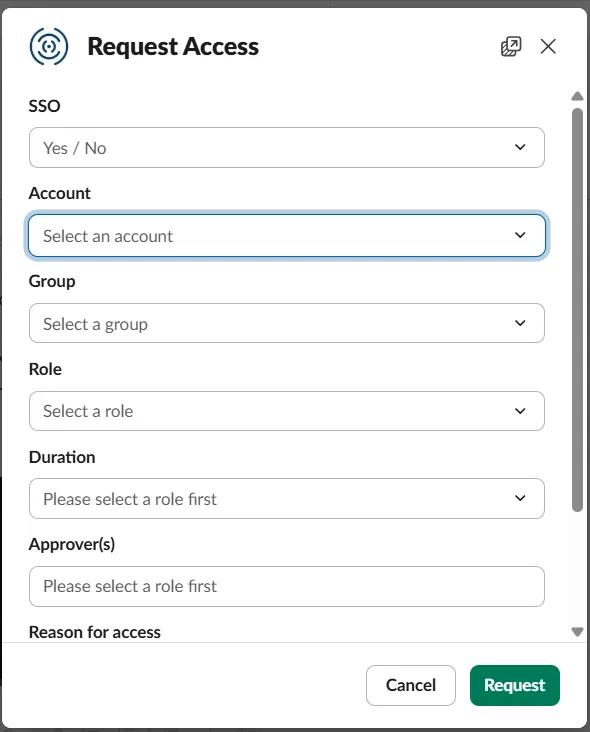
The second fear — the friction of running the temporary account differently — resolved itself the moment the account joined the same JIT engine as everything else. Engineers request access to it the same way they request access to any account: from Slack or the console, selecting the account, the role, and the duration. There is no second mental model. New team members learn one access process, not “the normal way, plus the special way for the handoff account.” The temporary account is invisible as a special case precisely because it isn’t treated as one.
This is the counterintuitive part worth stating plainly: adding the account to proper governance reduced friction rather than adding it, because the alternative (a bespoke lightweight method for one account) was the thing that would have created two systems.
How Access Worked During the Managed Window
-
Engineer requests access to the managed account — console or database — specifying the role and duration. Read-only to the database for a debugging task; scoped write for a deployment; whatever the work requires.
-
Approval routes by policy. The same policies that govern the company’s other accounts apply here. Routine, low-risk access can auto-approve; sensitive operations route to an approver.
-
Access is granted for the window and no longer. The engineer gets exactly the access they requested, for exactly as long as they requested it, and it auto-revokes afterward. No standing privilege accumulates on the customer’s future account.
-
Database queries are identity-stamped. Every query against the RDS instance is attributed to the real engineer — not a shared credential. This is the record that becomes valuable at handoff.
-
Every grant, approval, and revocation is logged to a single timeline, exportable as evidence.
Security Reporting the New Owner Will Actually Want
Because the account was governed from day one, the SaaS company could produce exactly the security evidence the end customer would expect to receive with the keys: a clean record of who accessed the account and its database during the managed period, what roles were used, and confirmation that no standing access persisted. The team also surfaced security reporting on the account’s workloads — including the container images running in it — so the handoff package was a posture report plus an access-audit trail, not a shrug.
This reframes the entire economics of the decision. Access governance on a temporary account isn’t overhead you absorb for your own convenience; it’s a deliverable that makes the handoff more professional and the relationship stronger.
Teardown Measured in Hours, Too
When ownership transfers, the governance comes off as cleanly as it went on. Because every grant was time-bound and nothing stood permanently, there is no sprawl of lingering users and roles to hunt down. The Database JIT components — the ECS-based proxy and its supporting resources — are removed with the same scripted process that installed them, on the order of an hour or two. The CloudFormation footprint Cloudanix created is removed. The account changes hands with no Cloudanix residue and, critically, no forgotten standing access. For the mechanics of removing onboarding cleanly, the same discipline applies as in any offboarding-before-migration flow.
Platform Impact
| Dimension | Informal “It’s Temporary” Access | Cloudanix JIT on the Managed Account |
|---|---|---|
| Setup effort | “Nothing” — but risk is immediate | ~1–2 hours, scripted |
| Standing access during window | Yes, for the full 3 months | Zero — time-bound only |
| Database access | Shared credential, no attribution | Identity-stamped per engineer |
| Audit trail at handoff | None | Complete, exportable timeline |
| Second system for engineers | Yes (a special case to remember) | No — same flow as every account |
| Teardown at ownership transfer | Manual, error-prone, residue likely | ~1–2 hours, scripted, no residue |
| Security evidence for new owner | Not available | Access audit + posture report |
Why “Temporary” Is the Wrong Reason to Skip Governance
The decision to govern a short-lived account comes down to a single reframe. The question is not “is it worth setting up access governance for an account we’ll hand back?” The question is “do we want to run the account we’ll hand back as the least governed thing in our estate?” Phrased that way, the answer is obvious. The account you’ll transfer to a customer is the one whose access history will be inspected most closely, by the party with the most reason to care.
Once setup and teardown are each a one-to-two-hour scripted operation, the entire effort objection evaporates — and what’s left is a managed window with zero standing privilege, full identity-stamped database attribution, and a handoff package that includes real security evidence. The temporary account ends up better governed than the shortcut would ever have made it, at a cost small enough to disappear into the noise of a three-month engagement.
Managing an Account You’ll Eventually Hand Back?
If your team operates cloud accounts on behalf of customers — during migrations, onboarding, or staged rollouts — and you’ve been treating that access as “temporary enough to skip,” Cloudanix JIT gives you time-bound, identity-stamped, fully audited access that installs in a couple of hours and tears down just as fast when ownership transfers. One engine, one request flow, no special cases, and a clean audit trail to hand over with the keys.
Book a Free Assessment to see JIT and Database JIT running on a managed account in a single session.
Related Resources
- JIT Database Access: Replacing HashiCorp Vault Temporary Tokens
- JIT DB Onboarding in VPC-Constrained Environments: Avoiding CIDR Conflicts
- AWS Account Migration and JIT Continuity: Moving Between Organizations
- Mastering Third-Party Access with a Just-in-Time Approach
- SOC2 Readiness with JIT: How Ephemeral Access Simplifies Procurement and Compliance













