
Customer Snapshot
| Attribute | Details |
|---|---|
| Industry | Technology / AI SaaS |
| Cloud Environment | AWS (4 accounts), EKS, RDS |
| Team Size | ~150 users |
| Compliance Status | ISO 27001 certified, clean Pen Test, SOC 2 in progress |
| SOC 2 Driver | Enterprise procurement requires SOC 2 attestation |
| Access Governance Before | Jira + StackStorm + manual — fragmented audit trail |
| Access Governance After | Cloudanix JIT — automatic, unified audit per access event |
| Cloudanix Scope | Cloud Console JIT, Database JIT, Kubernetes JIT |
The Situation: SOC 2 Is a Procurement Gate, Not Just a Security Exercise
This AI SaaS company had ISO 27001 certification and a clean penetration test report. Their security posture wasn’t weak — it was documented, reviewed, and externally validated. But when enterprise sales conversations advanced past the technical evaluation, procurement teams asked one question repeatedly:
“Do you have SOC 2?”
The answer was “not yet.” And for enterprise procurement, that answer was a blocker. Not a disqualifier in the pilot phase — the team was explicit that SOC 2 wasn’t mandatory for initial evaluation. But for contract signing and vendor approval, procurement would need SOC 2 Type II attestation.
The company committed to SOC 2 submission and began preparing. Access governance was identified as one of the areas requiring the most work — not because access was ungoverned, but because the evidence of governance was scattered and manually assembled.
The existing access workflow (Jira tickets, StackStorm automation, manual approvals, calendar-based revocation) functioned day-to-day. But it couldn’t produce the evidence artifacts SOC 2 auditors expect:
- A formal access request and approval process with documented outcomes.
- Time-bound access with verified revocation.
- An audit trail connecting identity to action within each access window.
- Periodic access reviews demonstrating that privileges are appropriate and current.
JIT access didn’t just improve security posture — it made SOC 2 compliance evidence a natural byproduct of daily operations rather than a quarterly project.
The Core Challenge
The company’s access management worked operationally but couldn’t produce the governance evidence SOC 2 requires. Implementing JIT access simultaneously improved security (eliminating standing privilege) and made compliance evidence automatic (every access event generates a complete audit record).
Where SOC 2 Access Controls Map to JIT
CC6.1: Logical and Physical Access Controls
SOC 2 requirement: The entity implements logical access security measures to protect against unauthorized access to information assets.
What JIT provides:
- Zero standing access by default. No user has persistent elevated privilege to any cloud account, database, or Kubernetes cluster.
- Every access event requires explicit authentication (via SSO/IdP) and authorization (via approval workflow or auto-approval policy).
- Policies define who can request what, preventing unauthorized access attempts at the request level — users can’t even request roles outside their group’s permitted set.
Evidence artifact: Policy configuration showing group → account → role mappings with boundary enforcement. Access denial logs showing requests outside policy boundaries rejected.
CC6.2: Registration and Authorization of Users
SOC 2 requirement: Users are registered and authorized before being issued system credentials or granted access.
What JIT provides:
- Users are registered in the Identity Provider (Google Workspace) and synced to AWS IAM Identity Center.
- Group membership (managed in IdP) determines what a user is authorized to request.
- JIT policies enforce that group membership is a prerequisite for any access request.
- No ad-hoc credential issuance — every access event follows the registered user → group membership → policy check → request → approval chain.
Evidence artifact: User roster showing IdP registration, group assignments, and corresponding JIT policy entitlements. Audit records showing every access event traced to a registered, group-verified user.
CC6.3: Access Removal
SOC 2 requirement: The entity removes access to protected information assets when system access is no longer required.
What JIT provides:
- Automatic revocation at session expiry. Every access grant has a hard time limit. When the window closes, the permission set assignment is removed from IAM Identity Center, the database credential is invalidated, or the Kubernetes kubeconfig expires.
- Verified removal. The audit trail includes a REVOKE event confirming that the IAM change was executed (not just scheduled).
- No accumulation. Access doesn’t persist between sessions. Each new request starts from zero privilege — there’s no accumulated standing access to review and remove.
Evidence artifact: 100% revocation rate across all JIT access events in any time period. Audit timeline showing the REVOKE event for every GRANT, with timestamp, verification, and no exceptions.
CC6.6: Monitoring and Assessment
SOC 2 requirement: The entity implements controls to prevent, detect, and act on security threats.
What JIT provides:
- Real-time visibility into who has active access at any moment.
- Historical audit of every access event with actions taken during each session.
- Anomaly detection: Requests outside normal patterns (unusual hours, unusual roles, unusual accounts) are visible and reviewable.
- Integration with SIEM: JIT audit events exportable to Splunk, Elastic, or SumoLogic for correlation with other security telemetry.
Evidence artifact: Dashboard showing real-time access state. Historical access reports filterable by user, account, role, and time period. SIEM integration showing JIT events alongside other security data.
What Changes for Audit Evidence Production
Before JIT: Evidence Is a Project
Producing access governance evidence for SOC 2 auditors required:
- Sample selection: Auditor requests 25 access events from Q1.
- Jira correlation: Find the corresponding Jira tickets (request and approval).
- StackStorm correlation: Match StackStorm execution logs to the ticket (provisioning evidence).
- CloudTrail correlation: Find the IAM events corresponding to each access grant.
- Revocation evidence: Attempt to find CloudTrail events showing access removal. For calendar-based revocation, demonstrate that the calendar event existed and that CloudTrail shows a subsequent removal (which may not align perfectly in time).
- Assembly: Create a spreadsheet or document linking all four data sources per access event.
Estimated time: 2–3 days per audit cycle for access governance evidence alone.
Risk: Evidence gaps where correlation fails (timestamps don’t align, StackStorm didn’t log the action, revocation didn’t occur on schedule).
After JIT: Evidence Is an Export
Producing the same evidence:
- Auditor requests 25 access events from Q1.
- Query Cloudanix: Filter by date range (Q1), randomly sample 25 events.
- Export: Each event contains: requester identity, approval (who, when, method), grant (what, where, when), actions during session, revocation (when, verified).
Estimated time: 15 minutes per audit cycle.
Risk: None. Every access event generates a complete record automatically. There are no gaps to explain because the audit trail is a structural property of the JIT system, not a retrospective assembly from independent sources.
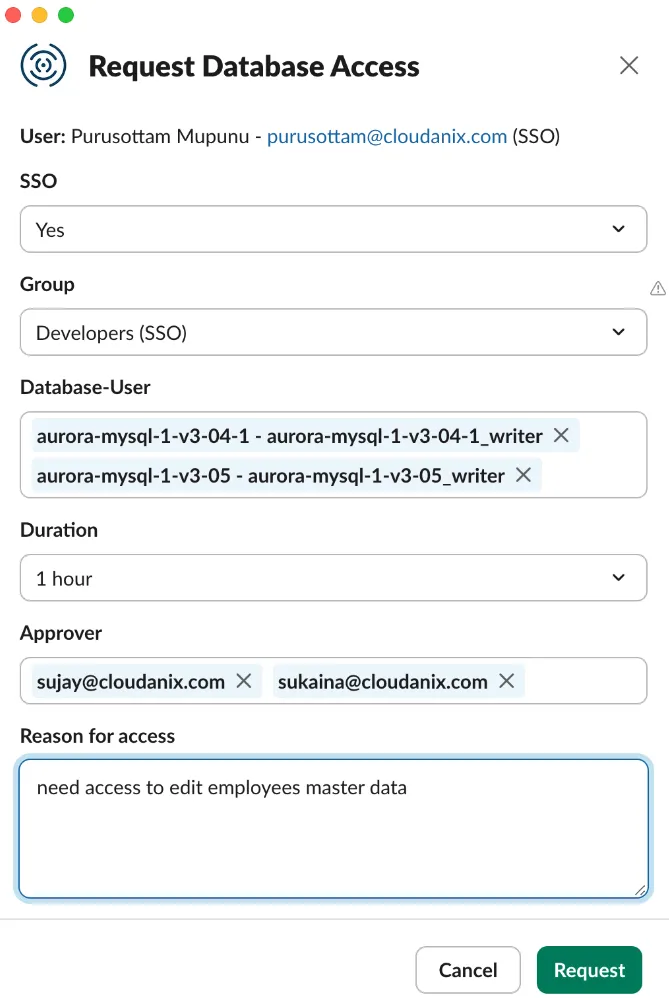
SOC 2 Type II: Demonstrating Controls Over Time
SOC 2 Type I attests that controls exist at a point in time. Type II attests that controls operated effectively over a period (typically 3–12 months). The distinction matters for access governance:
Type I evidence: “Here’s our JIT policy configuration. Here’s a sample access event showing the lifecycle works.”
Type II evidence: “Here are all access events over the last 6 months. Here’s proof that every one followed the policy, was approved appropriately, and was revoked on time. Here are the zero exceptions.”
JIT access makes Type II evidence trivial because:
- 100% of access events go through the JIT lifecycle. There’s no “shadow” access channel that bypasses governance.
- 100% of grants are time-bound with verified revocation. There’s no reliance on manual processes that might fail.
- 100% of events are recorded with the same completeness. No sampling bias, no missing records, no correlation gaps.
The audit period isn’t a window of anxiety (“did our manual processes work consistently?”). It’s a query against data that exists because the system cannot operate without generating it.
Beyond Access Controls: JIT’s Broader SOC 2 Impact
Change Management (CC8.1)
JIT audit trails documenting who accessed what systems during change windows provides evidence that changes were made by authorized individuals during approved timeframes. Kubernetes JIT sessions showing specific kubectl commands during a deployment window demonstrate controlled change execution.
Incident Response (CC7.4)
When an incident occurs, the JIT audit immediately answers: “Who had access to the affected system in the relevant timeframe? What actions did they take?” This is forensic evidence that traditional access models can’t produce without extensive CloudTrail analysis and correlation.
Vendor Management (CC9.2)
For third-party access (contractors, consultants), JIT provides time-bound, scoped, audited access — demonstrating that vendor access is governed with the same rigor as employee access. Vendor JIT sessions, along with Database JIT sessions, have the same audit completeness as internal sessions. For a primer on the framework itself, see what SOC 2 compliance is.
Platform Impact
| SOC 2 Aspect | Before JIT | After JIT |
|---|---|---|
| Evidence production time | 2–3 days per audit cycle | 15 minutes per audit cycle |
| Evidence completeness | Partial (correlation gaps) | 100% (structural property) |
| Revocation compliance | Best-effort (calendar) | 100% verified (automatic) |
| Access review preparation | Weeks of spreadsheet assembly | Real-time dashboard |
| Auditor confidence | “Show me how you correlate these 4 systems” | “Here’s one timeline per event” |
| Continuous compliance readiness | No (evidence assembled retrospectively) | Yes (evidence generated continuously) |
| Standing privilege exceptions | Many (access persists between reviews) | Zero (no standing access exists) |
The Procurement Conversation Changes
Before SOC 2 readiness:
- “Do you have SOC 2?” → “Not yet, we’re working on it.”
- Enterprise procurement processes stall or require extended security questionnaire responses.
After SOC 2 with JIT-backed access governance:
- “Do you have SOC 2?” → “Yes, Type II. Here’s our attestation letter.”
- Access governance section of security questionnaires answered with specific, provable controls rather than described manual processes.
For a company whose enterprise sales depend on passing procurement security reviews, the ROI of JIT access isn’t just “better security” — it’s “shorter sales cycles with enterprise customers.”
Preparing for SOC 2 with Manual Access Governance?
If your SOC 2 preparation involves making scattered access evidence auditable — correlating Jira tickets with CloudTrail events and demonstrating revocation through manual processes — Cloudanix JIT makes access governance evidence automatic. Every access event generates a complete, audit-ready record. SOC 2 evidence becomes an export, not a project.
Book a Free Assessment to see how JIT access evidence maps to your SOC 2 access control requirements.
Related Resources
- What is Cloud Compliance?
- Closing the Audit Trail Gap: From Missing Logs to Complete JIT Access Auditing
- Why Excel Is the Biggest Security Risk in Your User Access Review
- Implementing JIT Access in AWS, Azure & GCP: Complete Guide
- Consolidating CNAPP, Code Security, and DAM for Regulated Payments FinTech