

Large technology companies are quietly moving parts of their services into India. GitHub announced that customers of GitHub Enterprise Cloud can now choose to keep their code and in-scope repository data in India. According to Analytics India Magazine, OpenAI recently began offering inference residency in India for supported workloads, so businesses can process them in-country. Amazon Web Services has expanded its India inference profile across its Mumbai and Hyderabad regions, and Microsoft opened its fourth India data centre in Hyderabad earlier this year. The timing is not a coincidence. The same report says the Data Protection Board of India has set May 2027 as the deadline for full enforcement of the Digital Personal Data Protection (DPDP) Rules.
If you handle the personal data of people in India, the real question is not whether your vendors offer an Indian region. It is whether you can say, with evidence, where personal data sits across your code, cloud, databases, logs and AI tools, who can reach it, and what you would do within hours of a breach. This post explains the news in plain terms, translates DPDP’s security expectations into engineering work, and gives a practical plan you can start now. We cover general steps that need no particular product, and how Cloudanix can help.
Sources: Analytics India Magazine’s report on GitHub’s India data residency and the text of the DPDP Act, 2023 and the DPDP Rules as we read them. We are engineers and security practitioners, not lawyers. Rule numbers, deadlines and penalties should be confirmed with your legal counsel and the official texts before you act on them. We link our earlier posts on the DPDP Removal of Difficulties Order and DPDPA readiness and ransomware for background. Commands are our own guidance and should be tested first.
Who Should Read What
- CISOs, DPOs and heads of compliance: “What the Law Asks of Security,” Steps 1, 2 and 7.
- Engineering and platform leaders: Steps 2 to 6, which are the technical work.
- Cloud and DevOps engineers: Steps 1 and 2 contain commands to find where data lives and to restrict regions.
- Database administrators and data teams: Steps 4 and 5.
- Product and legal teams: “What Happened” and Step 3, on vendors and processors.
What Actually Happened
GitHub added India data residency. Data residency means choosing the country where your data is stored. GitHub Enterprise Cloud customers can now keep their code and in-scope repository data in India, using a dedicated subdomain under GHE.com and Enterprise Managed Users, a mode in which the company’s own identity provider creates and controls the user accounts. GitHub says organizations in financial services, telecommunications and government often have rules about where code is stored, which shape which services they can use.
Other providers made similar moves. The same report says that earlier this month OpenAI introduced API inference residency in India, so businesses and developers can process supported workloads inside the country. AWS expanded its India inference profile across Mumbai and Hyderabad. Microsoft has opened another data centre in Hyderabad.
The deadline behind it. The report says the Data Protection Board of India set May 2027 as the deadline for full enforcement of the DPDP Rules. Other recent coverage notes that the Supreme Court has adjourned a hearing on challenges to the DPDP Act to December 9, and that the rules for registering consent managers are taking shape. Expect more detail to arrive before the deadline.
What the rules do and do not say about location. The report states that the DPDP Rules do not impose a blanket ban on moving data out of India. They do contain targeted localization requirements for Significant Data Fiduciaries under Rule 13(4), based on data volume, sensitivity and risk to national security. A Data Fiduciary is the organization that decides why and how personal data is processed. A Significant Data Fiduciary (SDF) is one that the government designates because of the volume or sensitivity of data it handles, and it carries heavier duties. A Data Processor is a company that handles data on a fiduciary’s behalf, such as a cloud, analytics or AI provider.
Why this matters to security teams, not only lawyers. Vendors offering Indian regions does not make you compliant. It gives you a choice you must now make deliberately: which data goes where, who can reach it, and how you would prove it. Teams that skip the decision will find, close to the deadline, that personal data is scattered through code repositories, test databases, log files, analytics tools and AI prompts.
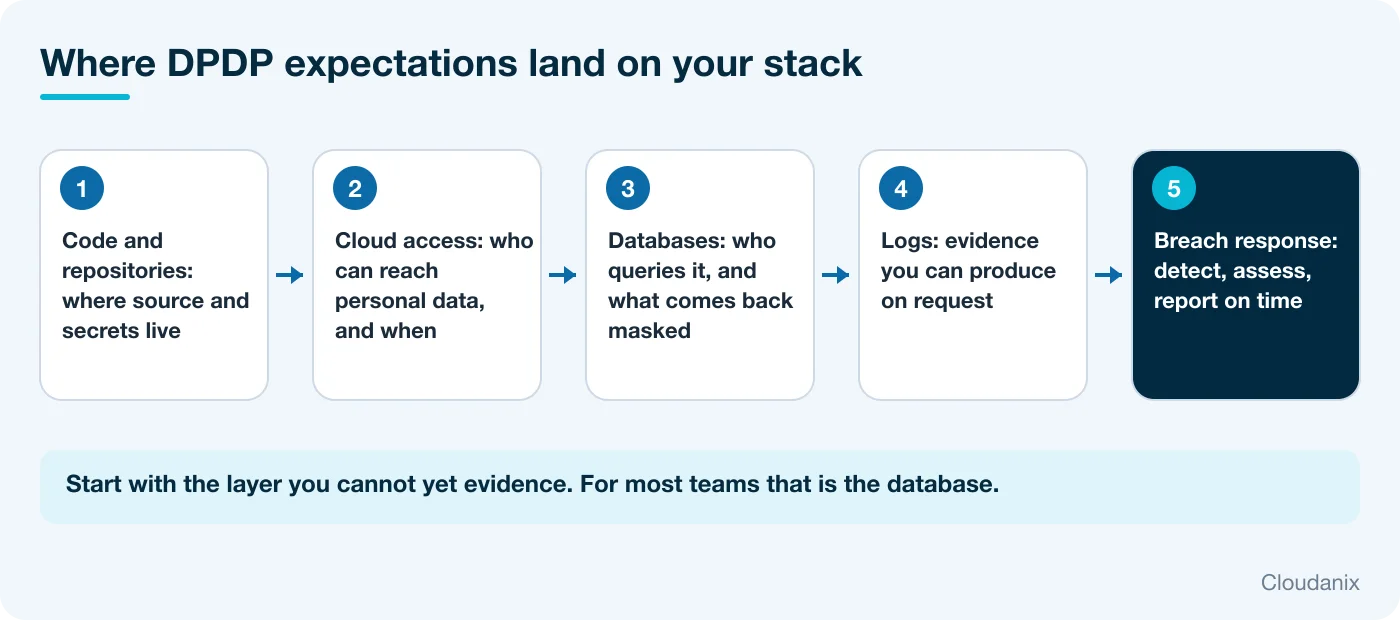
What the Law Asks of Security
Here is a short, plain summary of the parts that most affect engineering work. Confirm details with counsel.
- Reasonable security safeguards. The DPDP Act requires a Data Fiduciary to protect personal data in its possession or under its control, including data processed by a Data Processor, by taking reasonable security safeguards to prevent a personal data breach. The Rules spell out what that means in practice: measures such as encryption or masking, controls over who can access the data, and visibility on access through logs and monitoring, with logs kept for a minimum period (we read this as one year).
- Breach notification. A fiduciary must notify the Data Protection Board and each affected person of a personal data breach, with a more detailed report to the Board within a set time (we read this as 72 hours) after first telling it. The speed of your detection decides whether you can meet this.
- Penalties. The Act’s schedule sets financial penalties that can reach ₹250 crore for failing to take reasonable security safeguards, and separate penalties for failing to notify a breach.
- Extra duties for SDFs. These include data protection impact assessments and periodic independent audits, and, under Rule 13(4), possible limits on transferring certain data outside India.
- Erasure and retention. Data should be deleted when it is no longer needed, which means you must know where it is.
A common thread runs through these: you must be able to answer questions about specific data with evidence. Who accessed the customer table last month? Where does a customer’s data live? Which vendor sees it? How fast would you know about a leak?
The Protection Guide
Step 1: Map where personal data actually lives
Start with an inventory, not a policy. For each system, record whether it holds personal data, what kind, where (country or region), who owns it, and who can reach it. Cover these places, which teams often forget:
- Production databases and read replicas
- Backups and snapshots
- Test, staging and developer databases that were copied from production
- Log files, which often contain emails, phone numbers and identifiers
- Analytics and data warehouse tools
- Code repositories and issue trackers, where fixtures and tickets contain real data
- Support tools and shared drives
- AI services and coding assistants (prompts can carry personal data)
You can start the technical part from your cloud account. This lists where your AWS resources actually are:
# Which regions have databases or storage? (AWS)
for r in $(aws ec2 describe-regions --query "Regions[].RegionName" --output text); do
  n=$(aws rds describe-db-instances --region "$r" --query "length(DBInstances)" --output text 2>/dev/null)
  [ "$n" != "0" ] && [ -n "$n" ] && echo "$r: $n RDS instance(s)"
done

# Region of every S3 bucket
aws s3api list-buckets --query "Buckets[].Name" --output text | tr '\t' '\n' | while read b; do
  loc=$(aws s3api get-bucket-location --bucket "$b" --query LocationConstraint --output text)
  echo "$b  ${loc:-us-east-1}"
done
Do the same for Azure (az resource list --query "[].{name:name,type:type,location:location}") and Google Cloud. Anything outside India that holds personal data of people in India needs a reason.
Step 2: Decide your residency rules, then enforce them
Write a one-page rule: which data classes must stay in India, which may leave, under what safeguards, and who approves exceptions. Then make the cloud enforce it so it does not depend on memory. In AWS, a service control policy can block resource creation outside approved regions:
{
  "Version": "2012-10-17",
  "Statement": [{
    "Sid": "DenyOutsideApprovedRegions",
    "Effect": "Deny",
    "NotAction": ["iam:*","organizations:*","support:*","sts:*","cloudfront:*","route53:*"],
    "Resource": "*",
    "Condition": {
      "StringNotEquals": { "aws:RequestedRegion": ["ap-south-1","ap-south-2"] }
    }
  }]
}
This example allows only the Mumbai and Hyderabad regions for most services (the excluded services are global). Test it in a non-production account first, because it can break tooling that uses other regions. Azure Policy’s “allowed locations” and Google Cloud’s organization policy for resource locations do the same job.
Step 3: Extend the rule to vendors, developer tools and AI
The GitHub news is a reminder that your development tools can hold personal data too.
- For each vendor that touches personal data, record where it processes and stores data, what its contract says, and whether it offers an Indian region.
- Treat AI services as processors. Check whether prompts can carry personal data, where inference runs, and what the provider retains. Our post on prompt theft at AI inference providers shows why “no retention” labels need checking.
- Decide whether code repositories should move to an in-country option, and keep real personal data out of code, tests and tickets regardless of where they are stored.
- Make sure each processor contract obliges it to tell you quickly about a breach, so you can meet your own deadlines.
Step 4: Control who can query personal data, and what they see
This is the layer where most audits find gaps. Native database permissions say “this user can read this table.” They do not say “this user sees the email column masked,” and they do not record which person ran which query.
- Remove shared logins. Give each person their own access, granted for a purpose and a limited time.
- Give support and developers masked views of personal columns by default, and raw access only with approval.
- Limit bulk reads and destructive statements on production data.
- Record every query with the real person’s identity, and store the record where administrators cannot alter it.
A simple SQL example of a masked view for support staff:
CREATE VIEW support_customers AS
SELECT id,
       left(email, 2) || '***@' || split_part(email, '@', 2) AS email,
       'XXXXXX' || right(phone, 4)                          AS phone,
       created_at
FROM customers;

REVOKE ALL ON customers FROM support_role;
GRANT  SELECT ON support_customers TO support_role;
Views are a starting point. They cover only the paths you remember to use them for, which is why a control layer in front of all human sessions is stronger.
Step 5: Keep logs long enough and make them tamper-resistant
The Rules, as we read them, expect access and security logs to be kept for a minimum period. Decide your retention period with counsel, then enforce it:
# Example: keep audit logs 400 days in an S3 bucket, then expire them
aws s3api put-bucket-lifecycle-configuration --bucket your-audit-logs \
  --lifecycle-configuration '{"Rules":[{"ID":"retain-400d","Status":"Enabled","Filter":{"Prefix":""},"Expiration":{"Days":400}}]}'

# Protect against deletion (turn on versioning; use Object Lock for stricter control)
aws s3api put-bucket-versioning --bucket your-audit-logs --versioning-configuration Status=Enabled
Make sure cloud audit logs, database access logs, and administrator session records all flow to this bucket, and that the administrators of production cannot delete them.
Step 6: Be ready to detect and report a breach quickly
The notification clock starts when you become aware of a breach. Shorten that gap:
- Alert on unusual database reads (volume, time, source), new administrators, and logins from unfamiliar places.
- Keep a runbook: who decides that an event is a breach, who drafts the report to the Board and to affected people, and who informs CERT-In, which has its own six-hour reporting direction for many incidents.
- Practice it with a table-top exercise before May 2027. Time how long it takes to answer “whose data was in that table, and who read it?”
Step 7: Build the evidence pack before you are asked
For every control above, keep proof: the data map, region policy, vendor list, access approvals, query logs, retention settings and breach runbook. If you are or may become an SDF, add impact assessments and audit reports. An evidence pack assembled in a calm week is worth far more than one scrambled together during an inquiry.
How Cloudanix Can Help
The steps above work with or without Cloudanix. The platform helps most with the hardest parts for engineering teams: keeping control data in the right place, controlling database access, and producing evidence.
Keep the security platform itself in the right place. Compliance tools can create their own residency problem. Cloudanix runs as regional SaaS in the US, EU, India and the Middle East, with each regional control plane independent and no cross-region traffic. You choose the region at signup. For workloads that must stay entirely within your account, CloudPrem deploys the same platform inside your own cloud account, with your network controls and your encryption keys.
See and control access to personal data in databases. Cloudanix DAM runs inside your own cloud, so the data it governs does not leave your infrastructure. It sits on top of Database JIT, which removes shared database passwords and gives each person approved, time-limited access with every query stamped with their real identity. For each governed session, DAM can mask sensitive columns based on the user’s role (for example, showing only the last four digits), block dangerous statements such as unrestricted deletes and drops, limit how many rows a query returns, and record every query to storage that you own. DAM works with PostgreSQL, MySQL and SQL Server. The query-level audit and PII masking use case shows how a fintech applies it. This answers the auditor’s question: “Who queried the tables holding personal data, what did they see, and can you prove people who should not see raw data did not?”
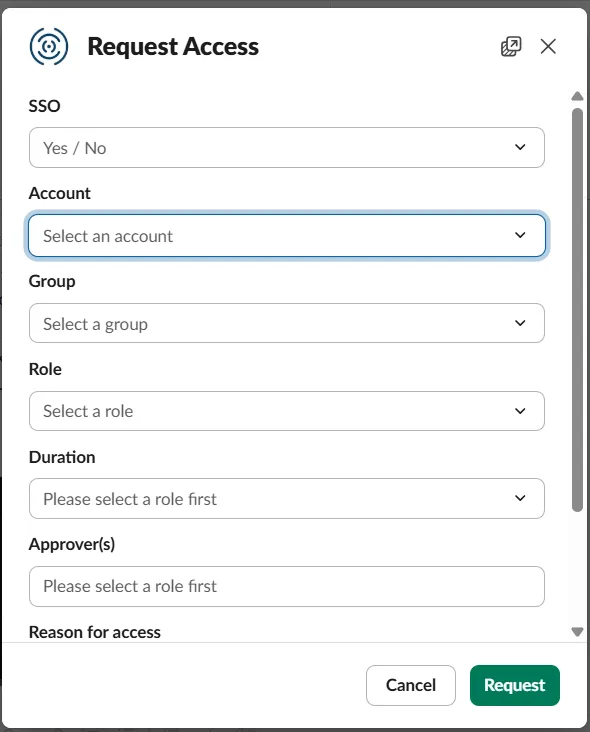
Remove standing access to cloud accounts. Cloud JIT gives people time-boxed AWS, Azure and Google Cloud access through your identity provider, with approvals and a trail to your own storage, covering Step 4 and Step 7. Contractor access does the same for vendors and processors.
Find the exposure and map frameworks. CSPM finds misconfigurations such as public databases and unencrypted storage, and ranks them by exposure, environment, data and identity with contextual severity. The compliance module maps controls to frameworks including DPDPA, RBI guidelines, IRDAI, SEBI and CERT-In incident reporting, with audit-ready exports. See also consolidating cloud security and DAM for an RBI-regulated fintech.
Keep secrets and personal data out of code and AI tools. Code Security scans repositories and full git history for leaked secrets and can block a pull request that contains one. Coding Agent Guardrail blocks secrets and personal data patterns, such as national identifiers and card numbers, from reaching an AI model from a developer’s machine.
What this does not do. Compliance with the DPDP Act is not something a product can give you. It depends on your processes, notices, consent handling, vendor contracts and legal analysis, none of which Cloudanix replaces. The platform covers the technical controls: where its own data lives, who reaches databases and cloud accounts, what they see, what is recorded and how fast you can find out. Confirm with your counsel how the Rules apply to you, especially if you may be designated a Significant Data Fiduciary.
Quick Reference Checklist
- Built an inventory of systems holding personal data, with owner and region
- Included backups, test databases, logs, analytics, repositories and AI tools
- Wrote a data-residency rule and an exceptions process
- Enforced allowed regions with cloud policies
- Recorded where each vendor and processor stores and processes data, and the breach-notice terms
- Checked AI services and coding assistants for personal data in prompts
- Removed shared database logins and enabled approved, time-limited, attributed access
- Masked personal columns for support and developers by default
- Set retention and tamper protection for audit and access logs
- Alerts exist for unusual database reads and new administrators
- Wrote and rehearsed a breach runbook, including CERT-In and Board reporting
- Assembled an evidence pack and confirmed your status with counsel
Key Takeaways
- GitHub now offers India data residency, and OpenAI and AWS have expanded Indian processing, while the Data Protection Board has set May 2027 for full enforcement of the DPDP Rules.
- The Rules do not ban all cross-border transfers, but they set targeted localization for Significant Data Fiduciaries, so you need to know where your data is.
- The security expectations come down to safeguards, access control, logging, breach reporting and evidence. Penalties can reach ₹250 crore.
- The least-prepared layer is usually the database: who queried personal data, what they saw, and proof of it.
- Start with a data map, enforce region rules in the cloud, remove shared access and masked-by-default views, and keep logs you can show.
Want to see where personal data and standing access sit in your cloud and databases today, and how an in-region or in-your-VPC deployment would change that? Book a session and we will map it with you.
People Also Read
- India’s DPDP (Removal of Difficulties) Order, 2026: What It Means for Your Data Layer
- India Is APAC’s Most-Targeted Country for Ransomware: How DPDPA Readiness Doubles as Defense
- Why Your Developers Shouldn’t See Raw Production PII and How to Prevent It
- Database Activity Monitoring Explained: What It Is and How It Differs From Native DB Logging
- Attackers Stole Prompts From Three AI Inference Providers for Months
- Cloud Security for Financial Services: Compliance, JIT Access and a Misconfiguration Playbook
- What is DPDPA Compliance?
- What is Database Audit Logging?
- What is Cloud Compliance?
- CSPM vs DSPM: Differences Explained
- Cloudanix Data Residency
- Cloudanix Database Activity Monitoring