

Microsoft has told customers that a security issue in Azure API Management (APIM) may have let an unauthorized party read secrets stored in some APIM instances. Norway’s National Security Authority (NSM) said on November 20 that the flaw affected several organizations in Norway, including the energy companies Equinor and Skagerak Energi, which had each reported a cyber incident days earlier. NSM added that several sectors in Norway and abroad are affected. SecurityWeek has the report.
If you run APIs on Azure, this is one to read in full even if you are not in energy or in Norway. The lesson goes past one service: when a cloud service holds your secrets, a bug on the provider’s side becomes your credential-rotation project. This post explains what was reported, defines the terms, and gives a practical plan: what to check this week, what to rotate and in what order, and how to design so the next incident costs less. We include general steps that need no extra product, and then how Cloudanix can help.
Primary source: SecurityWeek’s report, which cites Microsoft’s notification to customers (shared on Reddit by a customer), statements from Norway’s NSM, Equinor and Skagerak Energi. Microsoft’s own notification is not public, so we describe only what the report attributes to it. It is unclear how widely the weakness was exploited. Commands are our own guidance. Test them first, and check Microsoft’s documentation for your service tier.
Who Should Read What
- Cloud and platform engineers who run Azure APIM: “What Happened,” Steps 1 to 5. These contain the commands.
- Security and incident response teams: Steps 3, 4 and 6. Rotation alone is not the end of the work.
- CISOs and engineering leaders: “Why This Keeps Happening” and “Key Takeaways.” This is a design question about where secrets live.
- Architects: Step 5 and the Cloudanix section. How you store secrets decides how large a provider-side bug can be.
- Compliance teams: Step 6. Regulators and customers will ask what you did and when.
What Actually Happened
What APIM is. Azure API Management is a Microsoft service for publishing, securing and managing APIs. An API (application programming interface) is a way for programs to talk to each other. APIM sits in front of your back-end services as a gateway: it checks who is calling, applies rules, and passes requests on. To do that job it stores sensitive values for you.
What was exposed. According to the report, an unauthorized party may have been able to reach secrets stored in some APIM instances. The exposed data can include:
- Secrets stored as named values. A named value is a setting you define once in APIM and reuse in policies, for example a password or a token for a back-end service.
- Client secrets for identity providers. These are the passwords APIM uses to connect to a sign-in service, such as the one that authenticates developers on an API portal.
- Subscription keys. These are the keys that API callers present to APIM to prove they are allowed to call an API.
- Tokens for APIM’s direct management APIs. These let someone administer the APIM instance itself.
Which instances were affected. Microsoft said that APIM instances on the older Classic tiers that did not follow its documented security guidance are affected. Instances on the newer v2 tiers are not. Classic tiers are the original product levels, such as Developer, Basic, Standard and Premium. Microsoft’s own documentation is the place to confirm exactly which guidance applies to you, since the report does not list it.
The timeline.
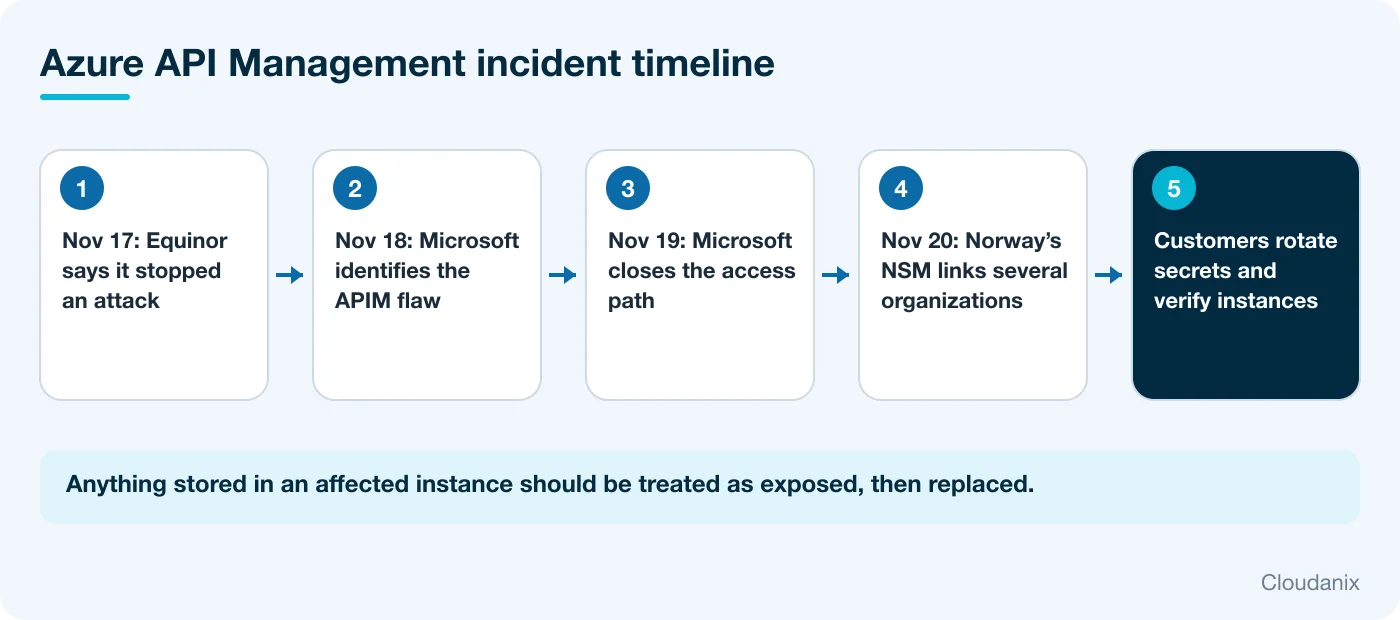
- November 17: Equinor reported that it had detected and stopped an attack on some of its IT systems, with no sign that data was stolen or altered. It said the attack was not a virus and did not appear to target Equinor specifically.
- November 18: Skagerak Energi disclosed activity that may have been an attempted attack on some IT systems, saying operations and production were not affected. The same day, Microsoft says it discovered the issue in APIM.
- November 19: Microsoft says it closed the access path.
- November 20: NSM said the vulnerability had affected several organizations in Norway, including Equinor and Skagerak. It advised APIM users to treat their secrets and named values as compromised and replace them, verify that their instances had been updated, and identify the data that was accessible through the service.
The unanswered question. It is not clear how widely the weakness was exploited. Microsoft’s notice says customers were exposed and that an unauthorized party could have used the issue before it was found. A Norwegian security expert warned that credentials taken from APIM could be used against outside services, and that the damage depends on each credential’s permissions.
Why This Keeps Happening
A gateway is a vault in disguise
A gateway needs credentials to talk to your back ends, to identity providers and to other services. That makes it a concentrated store of other credentials. Whoever breaches it gets many keys at once, which is also the lesson of Zeabur’s breach of 3.2 million environment-variable records.
The provider’s bug becomes your incident
You did not misconfigure anything to be exposed here. The report says the issue was in the service and that Microsoft closed the access path. Your part is the response: finding what was stored, replacing it, and checking whether it was used. Shared responsibility means the provider fixes the platform and you fix what the platform held.
Rotating one secret is not the end
A stolen credential reaches whatever it was allowed to reach. If a named value was a database password, the database is now the question. If it was a client secret for an identity provider, sign-ins are the question. Each stored secret opens a separate investigation.
Long-lived secrets are the expensive ones
A key that never expires stays useful to a thief indefinitely. A credential that is issued per request and expires in minutes is much less valuable by the time anyone finds it.
The Protection Guide
The steps below use built-in Azure tooling and general practice. They do not need any extra product.
Step 1: Find out what you run and on which tier
List every APIM instance across your subscriptions, with its pricing tier:
# All subscriptions you can see
az account list --query "[].id" -o tsv | while read sub; do
  az apim list --subscription "$sub" \
    --query "[].{name:name, rg:resourceGroup, tier:sku.name, location:location}" -o table
done
Look at the tier column. Instances on Developer, Basic, Standard or Premium are Classic tiers. Note which are used for production, which hold regulated data paths, and which are internet-facing. Check Microsoft’s notice and documentation for whether your instance followed the documented security guidance and has the fix.
Step 2: Inventory everything that is stored in each instance
RG=my-resource-group; SVC=my-apim

# Named values: which are marked secret, and which are backed by Key Vault
az apim nv list -g $RG -n $SVC \
  --query "[].{name:name, secret:secret, keyVault:keyVault.secretIdentifier}" -o table

# Subscription keys that exist (the keys themselves are not shown here)
az apim product list -g $RG -n $SVC --query "[].name" -o tsv
az rest --method get \
  --url "https://management.azure.com/subscriptions/$(az account show --query id -o tsv)/resourceGroups/$RG/providers/Microsoft.ApiManagement/service/$SVC/subscriptions?api-version=2022-08-01" \
  --query "value[].{id:name, scope:properties.scope, state:properties.state}" -o table

# Identity providers configured for the developer portal
az rest --method get \
  --url "https://management.azure.com/subscriptions/$(az account show --query id -o tsv)/resourceGroups/$RG/providers/Microsoft.ApiManagement/service/$SVC/identityProviders?api-version=2022-08-01" \
  --query "value[].{name:name, type:properties.type, clientId:properties.clientId}" -o table
For each secret, write down: what it unlocks, who owns that system, and how to replace it. That list is your rotation plan.
Step 3: Rotate in order of what is most dangerous
NSM advises treating secrets and named values as compromised. Order the work by blast radius:
- Credentials to systems that hold data or move money: database passwords, storage keys, back-end service credentials, third-party API keys.
- Identity-provider client secrets: replace them in the sign-in provider first, then update APIM.
- Subscription keys: regenerate for sensitive or high-volume APIs first, and tell the callers.
- Management API access tokens: revoke and reissue. If you do not use the direct management API, turn it off.
- Everything else.
Examples:
# Regenerate a subscription key (primary), then update callers
az rest --method post \
  --url "https://management.azure.com/subscriptions/$SUB/resourceGroups/$RG/providers/Microsoft.ApiManagement/service/$SVC/subscriptions/$SID/regeneratePrimaryKey?api-version=2022-08-01"

# Replace an app registration's client secret (for an identity provider)
az ad app credential reset --id <APP_ID> --display-name "rotated-$(date +%F)" --years 1 --append
# After APIM and any other users have the new secret, delete the old one:
az ad app credential list --id <APP_ID> --query "[].{id:keyId, name:displayName, ends:endDateTime}" -o table
az ad app credential delete --id <APP_ID> --key-id <OLD_KEY_ID>
Rotate from a clean machine, update the dependent systems in the same change, and remove the old secret as soon as the new one works. A rotated secret that is also still valid under the old value has not been rotated.
Step 4: Look for use of the secrets, on both sides
For each secret you replaced, check the system it protects for signs of use during the risk window. The report gives no start date for exposure, so look back as far as your logs allow, and at minimum from the start of November.
In Azure, the Activity Log records when secret values are read from APIM. This query for Log Analytics shows who listed named-value secrets and subscription secrets:
AzureActivity
| where TimeGenerated > ago(90d)
| where OperationNameValue in~ (
    "MICROSOFT.APIMANAGEMENT/SERVICE/NAMEDVALUES/LISTVALUE/ACTION",
    "MICROSOFT.APIMANAGEMENT/SERVICE/SUBSCRIPTIONS/LISTSECRETS/ACTION")
| project TimeGenerated, Caller, CallerIpAddress, OperationNameValue, ResourceId, ActivityStatusValue
| order by TimeGenerated desc
This catches reads through your own management plane. It may not show what the provider-side flaw allowed, so also check the back ends: failed and successful sign-ins to databases and services that APIM used, calls from unfamiliar addresses, and any use of the old subscription keys from new sources.
Step 5: Redesign so the gateway holds fewer secrets
The goal is not to trust the platform less in every case. It is to make sure a platform bug exposes as little as possible.
- Move secrets into Azure Key Vault and reference them from APIM instead of storing the value in APIM. APIM can use a managed identity to read from Key Vault at run time, so the secret value is not kept in the gateway’s own settings. Only the reference is.
- Prefer managed identities to stored credentials. Where APIM talks to an Azure service, let it authenticate with its own identity, with permissions limited to that service. There is then no secret to steal.
- Shorten and scope what must remain. Use per-API or per-product subscription keys, not one key for everything, and set expiry dates. Give back-end credentials read-only or least-privilege rights.
- Reduce network exposure. Put APIM and its back ends in a private network where possible, so a stolen credential cannot be used from anywhere.
- Plan the move to supported tiers. The report says v2-tier instances are not affected. Evaluate migrating, and read Microsoft’s guidance for the trade-offs.
Step 6: Write the record you will need
After an event like this, someone will ask: which instances, which secrets, when did you rotate, did you find misuse? Keep one page per instance with:
- The instances and tiers affected
- The list of secrets, their owners and rotation dates
- The log queries you ran, the time range and the results
- Any customers, partners or regulators notified, and when
Step 7: Prepare for the next “provider bug” day
- Keep an up-to-date map of where every secret lives, so “what was in that service?” takes minutes.
- Practice rotating a secret end to end, including the dependent systems.
- Assign a named owner for each cloud service that holds secrets.
- Subscribe to your provider’s security notifications, and name who reads them.
How Cloudanix Can Help
The general steps work with or without Cloudanix. Where the platform helps is in making secrets fewer and shorter-lived, and in showing what a leaked credential can reach.
See which identities and secrets exist and what they can reach. CIEM and non-human identity inventory service principals, keys and roles across AWS, Azure and Google Cloud, flag the over-permissioned and stale ones, and show what each can reach. When a note says “rotate everything in this gateway,” the first question is what each one could touch. Attack path analysis shows how a leaked credential connects to data and systems, so you rotate the dangerous ones first. Contextual severity ranks findings by exposure, environment, data sensitivity and identity, with the reason attached.
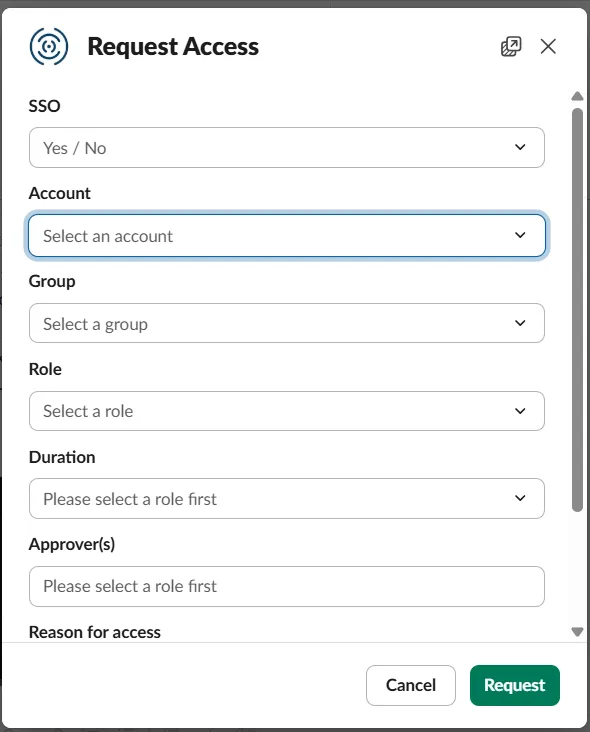
Replace standing credentials with access that expires. The most durable fix for “a secret stored in a service leaked” is to store fewer long-lived secrets. Cloud JIT gives people time-boxed Azure, AWS and Google Cloud access through your existing identity provider, including Microsoft Entra ID, with approval rules and an auditable trail written to storage you own. Database JIT replaces shared database passwords with short-lived, approved, identity-stamped access, and Agentic JIT lets pipelines and services get access that lasts seconds and then revokes itself. A back-end credential that is issued on demand does not sit in a gateway waiting to be read. See governing non-human identities with JIT.
Find secrets before they reach a gateway. Code Security scans repositories and full git history for hardcoded credentials, covers infrastructure-as-code, and can block a pull request that contains a leaked secret. This catches the case where a value is written into a deployment template and then copied into a gateway.
Notice when stolen credentials are used. Cloud UEBA and cloud detection and response baseline each identity and raise an alert when one acts unlike itself, for example a service principal signing in from a new address or touching resources it never used. That is how you spot misuse of a credential that escaped, which is what Step 4 looks for.
What this does not do. Cloudanix cannot see inside Microsoft’s service or fix its vulnerability, and it does not replace Key Vault or Microsoft’s guidance. Before relying on it for this specific service, confirm with us which Azure resource types and checks are covered for API Management in your tenant. The platform’s role is to reduce how many long-lived secrets you hold, show what each could reach, and alert you when one is misused.
Quick Reference Checklist
- Listed every APIM instance and its tier across all subscriptions
- Checked Microsoft’s notice and documentation for each instance
- Inventoried named values, subscription keys, identity-provider secrets and management tokens
- Wrote down what each secret unlocks and who owns it
- Rotated the highest-impact secrets first, from a clean machine
- Removed old values once the new ones worked
- Reviewed Activity Log reads of named-value and subscription secrets
- Checked the systems each secret protects for misuse
- Moved remaining secrets to Key Vault references and managed identities
- Reviewed network exposure and a migration to supported tiers
- Wrote the incident record
Key Takeaways
- Microsoft told customers that a flaw in Azure API Management Classic tiers may have exposed stored secrets. Equinor and Skagerak Energi were among the affected organizations, and NSM says other sectors and countries are affected too.
- Exposed data can include named-value secrets, identity-provider client secrets, subscription keys and management API tokens.
- NSM advises treating them as compromised and replacing them, verifying updates and identifying what the service could reach.
- Rotate by blast radius, look for misuse on the systems the secrets protect, and keep a written record.
- The lasting fix is design: fewer stored secrets, Key Vault references, managed identities and short-lived access.
Want to see which identities and secrets in your Azure estate could reach your most sensitive systems, and how time-boxed access would change that? Book a session and we will map it with you.
People Also Read
- Zeabur Is Shutting Down After a Breach Built on Plaintext Credentials
- Barracuda’s Cloud Breach Started With a Vendor Key That Was Never Retired
- AI Agents Are Scanning GitHub for Your Secrets, and One Reached Azure Key Vault in Five Minutes
- Hackers Are Scanning for Exposed Vite Dev Servers to Steal AWS and Azure Secrets
- Azure JIT Access: Extending Zero Standing Privilege Across Multi-Cloud Environments
- Governing Non-Human Identities with JIT
- What is Secrets Sprawl?
- What is a Service Principal?
- What is Blast Radius in Cloud Security?
- What is Zero Standing Privilege?
- Cloudanix Cloud JIT
- Cloudanix CIEM