
Customer Snapshot
| Attribute | Details |
|---|---|
| Industry | Technology / AI SaaS (acquired by larger enterprise) |
| Cloud Environment | AWS (4+ accounts), EKS, RDS |
| Team Size | ~150 users (growing with acquisition integration) |
| Communication Before | Slack (all JIT requests and approvals via Slack) |
| Communication After | Microsoft Teams (enterprise standard of acquiring company) |
| IdP Migration | Google Workspace → Okta (parallel migration) |
| Timeline | 1–2 months for communication platform cutover |
| Cloudanix Scope | Cloud Console JIT, Database JIT, Kubernetes JIT on MS Teams |
The Situation: The Acquisition Changed Everything Except the Need for Access
When this AI SaaS company was acquired by a larger enterprise, several foundational tools were scheduled for replacement. The acquiring company standardized on:
- Microsoft Teams for communication (replacing Slack).
- Okta as the identity provider (replacing Google Workspace).
- Jira for project management (retained).
The JIT access workflow the team had built and adopted over months was entirely Slack-based. Engineers requested access from Slack. Approvers approved in Slack. Notifications landed in Slack channels. The entire access governance experience lived in Slack.
With Slack being decommissioned in “a month or two,” the team needed JIT access to continue functioning seamlessly on Microsoft Teams — without a gap in coverage, without disrupting the developer experience that drove adoption, and without losing the audit trail continuity that had made their SOC 2 evidence production effortless.
The Core Challenge
A communication platform migration doesn’t change the need for access governance — but it changes where governance happens. Engineers who learned to request access via Slack commands need the same frictionless experience on Teams. Approvers who respond to Slack notifications need the same one-click workflow in Teams. And the transition period (both platforms running simultaneously) needs to work without confusion.
What Could Go Wrong During the Migration
Access Governance Gap During Cutover
If JIT only works on Slack, and Slack is being shut down, there’s a window where:
- Slack channels are quiet (people have moved to Teams).
- Teams integration isn’t yet active.
- Access requests go unanswered because notifications land in a dead channel.
This gap is exactly when teams revert to workarounds: direct messages to the DevOps lead, manual IAM changes “just this once,” pre-granted broad access “until Teams is set up.” Each workaround is a governance gap.
Developer Workflow Disruption
The team had invested months in JIT adoption. The workflow felt natural: type a command in Slack, get approved, access appears. If the Teams experience is meaningfully different — different commands, different interaction pattern, slower response — adoption could regress. Engineers who had stopped using workarounds might restart them if the “official” path is less convenient on the new platform.
Approval Notification Reliability
Approvers had trained their attention on Slack notifications for JIT requests. Moving to Teams means:
- New notification patterns (Teams notifications work differently than Slack).
- Potential missed approvals during the transition period.
- Need to reconfigure where JIT notifications land (which Teams channels, which users).
Audit Trail Continuity
If the migration creates separate audit systems (Slack-era events vs. Teams-era events), compliance evidence production becomes more complex. Auditors asking for “all access events in Q2” should get one consistent dataset, not two partial datasets from different platforms.
The Cloudanix Solution: Platform-Native Teams Integration
Cloudanix supports Microsoft Teams as a first-class notification and interaction channel — with the same request, approval, and notification capabilities available on Slack.
Same Workflow, Different Platform
The developer experience on Teams mirrors what the team already knew from Slack:
Request access:
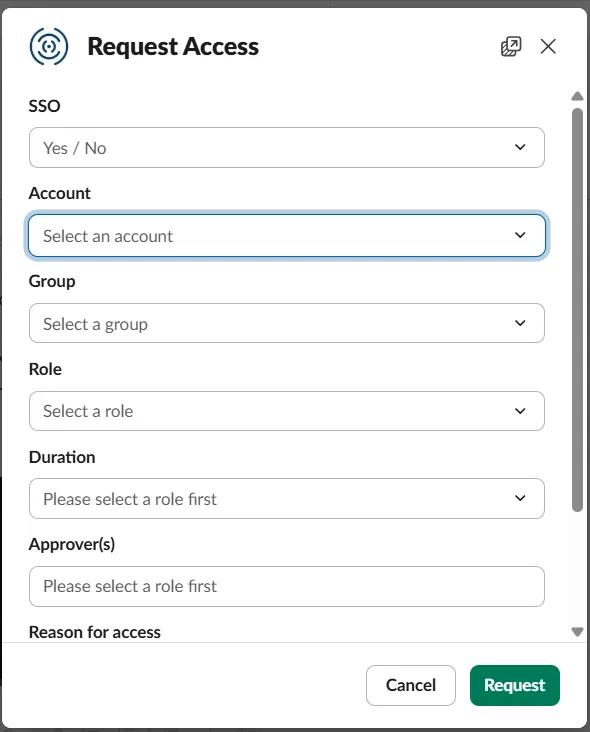
- Developer initiates a JIT request (via the Cloudanix Console or directly from Teams).
- Selects account, role, duration, and provides reason.
- Request is submitted and routed per policy.
Approval notification:
- Approver receives a Teams message with full request context: who’s asking, what they want, which account, for how long, and why.
- Approve or Reject with one click — inline buttons in the Teams message.
- Response time is immediate (same as Slack — the approval triggers provisioning within seconds).
Status notifications:
- Requester notified in Teams when access is approved, granted, and when it’s about to expire.
- Approver notified when access is revoked (if they want visibility).
The interaction pattern is identical. The platform it happens on is different.
Parallel Operation During Migration
During the transition period (both Slack and Teams running), Cloudanix can send notifications to both platforms simultaneously:
- Engineers who’ve already moved to Teams see notifications there.
- Engineers still on Slack (during the transition) continue receiving notifications there.
- Approvers can approve from either platform — the first approval processes the request regardless of which platform it came from.
This eliminates the “gap” scenario: no period where notifications disappear into the void because the wrong platform is configured.
Console as the Platform-Independent Fallback
Throughout any communication platform migration, the Cloudanix Console remains available as the primary interface:
- Always accessible regardless of which chat platform is active.
- Full functionality — request, approve, view history, manage policies.
- No dependency on Slack or Teams being configured correctly.
Teams are coming to daily work, notifications arrive in Teams. But if a notification is missed, or during the exact moment of platform cutover, the Console ensures JIT access never becomes unavailable.
Audit Trail Continuity Across Platform Changes
The audit trail in Cloudanix is independent of the notification channel:
Access Event: jit-cloud-9b2c3d41
[REQUEST] engineer@company.com → Production-1, Developers_Editor, 2h
[APPROVAL] devops-lead@company.com via Microsoft Teams (one-click)
[GRANT] Permission set assigned in IAM Identity Center
[REVOKE] Auto-revoked at 2h expiry
Whether the approval came from Slack (before migration), Teams (after migration), or the Console (platform-independent) — the audit record is the same. Compliance evidence shows one consistent format across the entire timeline, with a notation of which channel the approval came through.
No separate “Slack era” and “Teams era” audit databases. No evidence gaps during the transition. One audit trail, continuous.
Integration with Okta SSO Migration
The communication platform migration happened alongside an IdP change: Google Workspace to Okta. Cloudanix supports both identity providers, making the transition straightforward:
- Before migration: Users authenticate to Cloudanix via Google SSO.
- After migration: Users authenticate to Cloudanix via Okta SSO.
- Configuration change: Update the SSO configuration in Cloudanix to point to Okta instead of Google.
- User experience: “Sign in with Okta” instead of “Sign in with Google.” Same dashboard, same functionality, same audit trail.
The identity change and the communication platform change can happen independently or simultaneously — neither blocks the other, and neither disrupts JIT access continuity.
Platform Impact
| Aspect | During Migration | After Migration |
|---|---|---|
| JIT access availability | Continuous (parallel Slack + Teams + Console) | Continuous (Teams + Console) |
| Developer workflow | Familiar request/approve pattern on new platform | Identical to pre-migration experience |
| Approver experience | One-click approve in Teams (same as Slack) | Native Teams integration |
| Audit trail | Uninterrupted, platform-noted per event | Consistent single format |
| Adoption risk | Minimal (same patterns, different UI chrome) | Zero (fully transitioned) |
| Migration timeline impact | No access governance gap | Clean cutover |
Why Communication Platform Changes Shouldn’t Break Access Governance
Access governance is a security control. Communication platforms are collaboration tools. When a security control depends entirely on a specific collaboration tool, changing that tool becomes a security risk rather than a routine IT migration.
Cloudanix’s architecture separates these concerns:
- Access governance engine (request, approve, provision, revoke, audit) operates independently of any notification channel.
- Notification channels (Slack, Teams, Console) are integrations that deliver UX on top of the engine.
- Adding or removing a channel doesn’t affect the governance model, the policy enforcement, or the audit trail.
This means communication platform migrations are a configuration change, not a re-architecture of access governance. The same channel-independent engine backs Cloud JIT, Database JIT, and Kubernetes JIT alike.
Migrating from Slack to Teams?
If your JIT access workflow lives on Slack and you’re planning a migration to Microsoft Teams — whether due to acquisition, standardization, or preference — Cloudanix supports both platforms natively with the same request, approval, and notification experience. No access governance gap during transition, no audit trail discontinuity, no developer workflow disruption.
Book a Free Assessment to see Cloudanix JIT working with Microsoft Teams for your access workflows.