
Customer Snapshot
| Attribute | Details |
|---|---|
| Industry | Technology / Enterprise SaaS |
| Cloud Environment | Multi-account AWS with production workloads |
| Ticketing System | Jira (change and incident records live here) |
| Approvers | Team leads and managers who sign off on elevated access |
| Problem | Access requests arrived with no linked reason, so approvals became reflexive |
| Desired Behaviour | Each request carries a justification of record; approval has context |
| Cloudanix Scope | Cloud Console JIT with request context and ticket linkage |
The Situation: “I Won’t Approve It If There’s No Ticket”
Approval is only a control if the approver can make a real decision. In many JIT rollouts, the request that lands in front of an approver says something like: engineer X wants role Y in account Z for two hours. That’s the who, what, where, and how-long. The one thing it’s missing is the only thing that lets the approver decide well: why.
Without the why, approval degrades into a reflex. The approver recognises the requester, assumes the request is legitimate, and clicks approve. Over hundreds of requests, this becomes a rubber stamp — a motion that looks like governance but filters nothing. The approver isn’t being lazy; they simply have no basis on which to say no, because no reason was ever attached to say yes to.
A manager on this team said it plainly during a review: I won’t approve a request if there’s no supporting ticket. The team’s change and incident records lived in Jira. The manager’s position was that an access request to production should point at the work that justifies it — a change ticket, an incident, a task of record — so that approving the access means approving a reason, not just a name. The requirement that emerged was to bind each JIT request to a justification of record.
The Core Challenge
An approval workflow with no reason attached to the request isn’t governance — it’s a formality that produces the appearance of oversight while filtering nothing. The challenge was to put a justification of record in front of every approver at decision time, so approval becomes a real judgement, and to carry that justification into the audit trail so that months later anyone can see not just that access was granted, but why.
Where the Gaps Were
Context-Free Requests Make Approval a Reflex
When a request arrives with no linked reason, the approver is structurally set up to rubber-stamp:
- No basis for a “no.” To deny a request responsibly, an approver needs something to evaluate against. “Engineer X wants admin for two hours” offers nothing to evaluate — so the safe, social, and fast move is always to approve.
- Approval fatigue accelerates it. An approver handling many requests a day, none of which carry context, learns to process them as a queue to clear rather than decisions to make. The control decays precisely because it’s exercised often and blindly.
- The approver carries the risk without the information. If a granted access later contributes to an incident, the approver is accountable for a decision they were never given the information to make. That’s an unfair and unsustainable position, and good approvers resent it.
The Audit Trail Can’t Explain Itself
The same missing “why” that weakens approval also hollows out the audit trail. Months later, a reviewer looking at the access history can see that engineer X held role Y in account Z from 2:00 to 4:00 — and has no way to know whether that was a routine deploy, an emergency fix, or something that should never have happened. The record documents the fact of access without the justification for it, which is exactly the gap auditors probe and incident reviewers hate. A justification of record attached at request time is what turns an access log into an access explanation.
Why “Just Train Approvers to Ask” Doesn’t Work
The tempting non-technical fix is to tell approvers: before you approve, ask the requester why. This fails for the same reason manual revocation fails — it depends on a human doing the diligent thing under time pressure, every single time. In practice the back-and-forth adds latency, the requester is often offline when asked, and under a busy queue the “ask first” discipline quietly erodes back into the rubber stamp. The reason has to travel with the request, not be chased after it.
The Cloudanix Solution: Carry the Justification With the Request
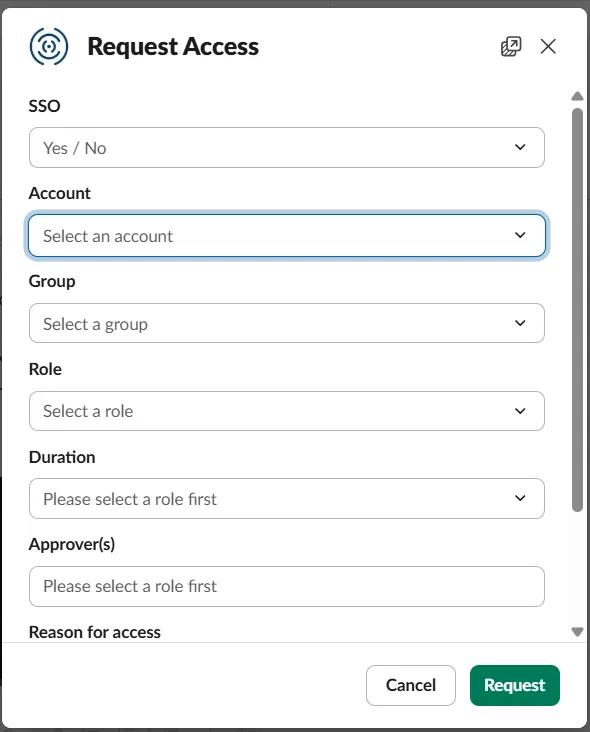
Cloudanix JIT lets a request carry rich context to the approver — including a reference to the ticket of record — so the approval decision is made against a reason, and that reason becomes part of the permanent audit trail.
How Context-Rich Requests Change the Decision
-
The request includes its justification. Alongside the account, role, and duration, the requester supplies the reason — ideally a reference to the Jira ticket (change, incident, or task) that the access is for. The approver sees the full picture at decision time: who, what, where, how long, and why.
-
Approval becomes a real judgement. With the ticket in front of them, the approver can actually evaluate: Is this role appropriate for that change? Does the duration fit the task? Is this incident real? The approval stops being a reflex and becomes a decision — which is the entire point of having an approver.
-
The reason lands in the audit trail. The justification travels into the access record. Later, the audit timeline doesn’t just show that access happened — it shows the ticket it was tied to. The record explains itself.
-
Everything else stays fast. Carrying context doesn’t slow the flow. The requester attaches the reference as part of the same request; the approver gets more signal, not more steps. Routine, low-risk access can still auto-approve under policy where appropriate — the ticket-of-record discipline is targeted at the elevated requests where a reason genuinely matters.
Approval Quality, Not Just Approval Volume
The deeper shift here is from measuring approvals by throughput to measuring them by quality. A workflow that approves a thousand context-free requests has done a thousand units of nothing. A workflow that puts a justification in front of the approver for the requests that matter produces decisions that would survive scrutiny. The ticket-of-record requirement is, at heart, a mechanism for restoring meaning to the approval step — making the approver’s click correspond to an actual evaluation of an actual reason.
The Second-Order Benefit: Requesters Self-Filter
Something useful happens the moment people know their request must carry a reason that an approver will actually read: the quality of requests improves before approval even enters the picture. When a request is context-free and approval is a reflex, there’s no cost to asking for more than you need “just in case.” When the request requires you to name the ticket it’s for, over-asking becomes awkward — the justification for broad, long access to production has to be written down, attached to your name, and shown to someone who can see whether it fits.
This self-filtering is one of the least-discussed benefits of binding access to a reason. The requirement doesn’t just help the approver decide; it changes what gets requested in the first place. People ask for the scope and duration that match the ticket, because the ticket is right there framing the request. The result is a population of requests that are already closer to least privilege before any human reviews them — which, in turn, makes the approver’s job easier and the audit trail tighter. A control that improves behaviour upstream of itself is a rare and valuable thing.
Honest Scoping: What’s Native vs. What’s Process
It’s worth being precise about where the line sits today, because overclaiming here would undermine the trust this very use case is about. Cloudanix JIT carries request context — including a ticket reference — to the approver and into the audit trail, which is what makes approval meaningful and the record self-explaining. Deeper two-way ticketing automation (for example, programmatically creating a Jira ticket as part of the JIT flow, or hard-enforcing that no request proceeds without a validated ticket number) is a direction teams ask about and that can be discussed for a given environment, rather than something to assume out of the box. The honest framing is: the justification-of-record discipline is available today through request context and approver workflow; the depth of ticketing integration is a conversation to have against your specific Jira setup.
This matters because the value — approvers deciding against a reason, and an audit trail that explains itself — is delivered by attaching the justification, regardless of how tightly the two systems are wired. Teams get the governance outcome now, and can scope deeper automation as a follow-on.
Platform Impact
| Dimension | Context-Free Requests | Justification-of-Record Requests |
|---|---|---|
| What the approver sees | Who / what / where / how long | Who / what / where / how long / why |
| Approval behaviour | Reflexive rubber stamp | Real judgement against a reason |
| Approver’s exposure | Accountable without information | Accountable with full context |
| Audit record | Fact of access only | Access plus its justification |
| Incident-review reconstruction | Hunt for the reason after the fact | Reason already on the record |
| Latency | — | No added steps; context travels with request |
Why a Reason Is the Difference Between Oversight and Theatre
An approval step with no reason attached is security theatre: it looks like a gate, consumes real time, and stops nothing. The moment a justification of record travels with the request, the same step becomes genuine oversight — the approver evaluates a real reason, the decision carries weight, and the audit trail inherits an explanation it would otherwise never have had.
That’s why thoughtful approvers push for a ticket on every request. They’re not adding bureaucracy; they’re refusing to be made complicit in a rubber stamp. Binding JIT access to a justification of record gives them the context to decide, gives the organization an audit trail that explains itself, and turns the approval step back into the control it was always supposed to be.
Are Your Approvers Rubber-Stamping Context-Free Requests?
If elevated access requests reach your approvers with no reason attached — leaving them to approve on recognition and trust alone — Cloudanix JIT carries full request context, including a ticket of record, to the approver and into the permanent audit trail. Approval becomes a real decision, and your access history finally explains itself.
Book a Free Assessment to see context-rich JIT requests mapped to your approval and ticketing workflow.
Related Resources
- Jira Integration for JIT: Bridging Access Requests With Existing Ticketing Workflows
- Multi-Level Approval for JIT: Granular Policies for Production vs Development
- Closing the Audit Trail Gap: From Missing Logs to Complete JIT Access Auditing
- Auto-Approval Policies in JIT: Balancing Speed and Security for Developer Access
- Why Excel Is the Biggest Security Risk in Your User Access Review













