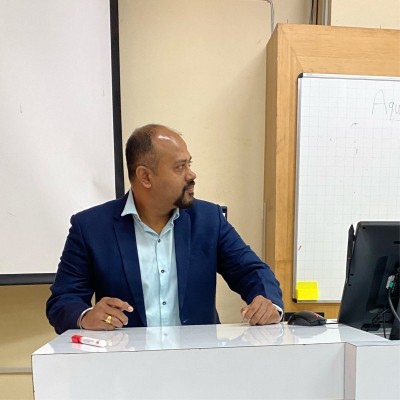
What does it take to close a $3 million deal against Oracle with just two people in the room? According to Faraz Khan, it comes down to simplicity, listening, and making the customer’s life easier — principles that also drive his current work scaling AWS Marketplace adoption across India and APJ.
We spoke with Faraz Khan, an experienced General Manager and AWS Marketplace Leader, on the Scale to Zero podcast. Faraz is responsible for AWS Marketplace adoption for customers, channel acquisitions for reseller business, and ISV partnerships. His career spans Oracle, Epicor, 3i Infotech, and multiple startups across five continents — all built on relationships rather than cold applications.
You can read the complete transcript of the episode here >
What makes a great salesperson in enterprise tech?
Faraz identifies four traits that matter more than technical knowledge:
- Passion for what you are selling. If you are not convinced about your product, the person across the desk will sense it immediately. Passion resonates and builds trust.
- Listening capacity. Customers connect with people who hear their problems. Understanding the customer’s pain is more valuable than a polished pitch.
- Persistence to learn. The urge to keep learning new technologies, markets, and customer contexts separates those who grow from those who plateau.
- Problem-solving instinct. Transferable skills from unexpected backgrounds — audio engineering, hospitality, even waiting tables — often produce better salespeople than pure technical credentials.
His $3M deal against Oracle at Epicor illustrates this perfectly. The competition sent 16 people to a three-day workshop. Faraz showed up with just himself and one pre-sales engineer. The customer later explained: “If you need 16 people to showcase a technology, imagine how many we will need to implement it. You made our life simple.” Simplicity and trust won over feature superiority.
What is AWS Marketplace and why does it matter for ISVs?
Faraz explains it with a simple analogy: you walk into a shop, select a shirt, negotiate with the seller directly. But when it comes to payment, you swipe a credit card instead of paying cash. The relationship between buyer and seller does not change — but the operational complexity disappears.
AWS Marketplace brings three parties together (customers, ISVs, and resellers) without changing how anyone sells or buys. What it does:
- For customers: One bank account, one consolidated invoice, one payment for all ISV purchases. No managing 30–40 separate vendor bank accounts across currencies and tax jurisdictions. Plus, purchases can retire EDP (Enterprise Discount Program) commitments.
- For ISVs: No purchase orders to chase, no vendor registration friction, and the ability to test new markets (like Australia) without establishing a legal entity — just release an offer to a customer’s account ID from India.
- For resellers: They remain part of the ecosystem. Distributors and channel partners can resell through marketplace, becoming consultative partners rather than being limited to single-vendor relationships.
How should ISVs get started with AWS Marketplace co-sell?
Faraz is direct: listing on Marketplace and waiting for leads does not work. The path to success is active co-selling:
- Bring your existing pipeline. Give AWS your top 20 accounts where you already have conversations at 30–40% maturity. Faraz will connect you to the relevant PSMs (Partner Sales Managers) and account managers.
- Use the APN portal. Log opportunities, launch them in the system. This creates visibility — AWS account managers are reviewed on these opportunities and will follow up.
- Map the AWS structure. Six major segments exist: banking/financial, long-tail startups, global SIs, ISVs, telecom/media/entertainment, and retail/corporate. Identify which segment matches your product.
- Build geometric progression. One successful deal with an account manager leads to introductions to their other accounts. Their team manager notices and introduces you further. Success compounds.
For skeptics, Faraz offers a concrete challenge: give him 20 deals at 30–40% maturity. If 25% close through marketplace support within three months, the value is proven. He has never seen anyone turn back after trying.
How do you navigate relationships within AWS as a partner?
AWS is a large organization with many roles — PSMs, account managers, solution architects, ISV partner managers, segment leaders. Faraz advises treating it like mapping a sales account:
- Find your voice within the organization. You do not need to understand every role. Start with what you are good at and who your customers are.
- Your gift is the APN portal. The number of opportunities you have in the system and deals you are nurturing through marketplace is what makes AWS people interested in talking to you.
- Nobody says “not my problem.” AWS culture means every person will either own the answer or direct you to the right person. You have 200 doors to knock — the probability of 10 opening is high.
- Persistence and learning win. It took Faraz 18 months to understand the full AWS structure. Do not expect to learn everything immediately, but keep showing up with value.
What is changing with the India Marketplace launch?
The India Marketplace launch (Phase 1 on October 1, 2025) solves three fundamental problems for Indian customers:
- Local currency billing. Currently, billing comes from AWS Inc. in USD, requiring foreign remittance with unclear tax implications and fluctuating conversion rates. India Marketplace will bill in INR to a local bank account.
- GST invoices. Customers currently cannot claim GST on marketplace purchases. Local invoicing enables proper tax credit claims.
- Consolidated billing. Instead of separate bills from AWS Inc. (USD) and AWS India Private Limited, everything consolidates into one invoice with line items per product.
This removes the friction that has prevented many Indian organizations from fully adopting marketplace for their ISV purchases.
What life lessons apply to both sales and career growth?
Throughout the conversation, Faraz shares principles that transcend sales:
- Relationships over applications. His entire career has been “zero interview” — every role came through relationships, not job applications.
- Transparency builds trust. Being honest about what your product cannot do is more valuable long-term than overselling.
- Bad days are background for good days. Perspective comes from contrast — difficult periods make you appreciate and recognize success.
- Say yes to learning, even when uncomfortable. Faraz never planned to be in sales, IT, or to leave his city. Every unplanned turn led to growth.
- Make a bigger impact. The shift from managing 4–5 accounts to enabling thousands of ISVs and customers through marketplace was driven by wanting broader impact, not just individual deal success.